Blog/Research
A Quick Test of What the British Public Care About in Aid
Spending on overseas development assistance (ODA) – government aid promoting and targeting economic development and welfare of low- and middle-income countries – is still under pressure. First cut by the Conservatives from 0.7% of gross national income to 0.5% in 2021, it was cut again to 0.3% of income by Labour when they came to power in 2024 – despite a manifesto commitment to restoring it to previous levels.
Our whitepaper a year ago (Foundations at Risk) suggested why we saw no widespread outcry: the decision followed a longer direction of travel in public support for foreign aid writ large, driven by ideological shifts coupled with a focus on financial pressures at home (but note that when made specific, the public generally want to maintain health and humanitarian aid).
However, new Labour leader Andy Burnham has put fresh new faces in charge of Britain’s overseas relations and commitments. Kirsty McNeill is the new Minister for Development, and Ed Milliband, the new Foreign Secretary, the latter also taking on the role of UK Governor to the World Bank, saying:
"International development is not an add-on to British foreign policy — it is central to it. By taking on the role of UK Governor to the World Bank, I want to send an unambiguous signal that this Government is serious about its global leadership on development and climate."
What arguments work for aid
Sensing an opportunity, several Labour MPs recently put out an instagram reel making the case for increased spending on overseas aid. Their arguments tend to follow three patterns:
- It is a moral or fair thing to do
- It is good for Britain – it is in Britain’s national interest
- It is good for everyone – it is in givers and receivers’ mutual interests
Looking beyond their (good) intentions, we know there’s some useful research into the efficacy of these different arguments.
- A parliamentary submission from the Development Engagement Lab made clear that moral and mutual interest arguments are more effective than those based on national interest only.
- Some academic research from 2015 (reported here and here), however, showed that the public leans more strategic – towards national interest – than altruistic in their attitudes towards foreign aid, with significant political party differences (Conservatives, UKIP and, interestingly, Labour votes tending towards national interest; Lib Dems, SNP and Greens towards altruism).
- More in Common’s research last year (2025) highlighted an increasing, non-partisan emphasis from voters on the need for Britain to more clearly benefit from aid spending.
- Research by Money Talks in 12 countries in 2025 concluded that debt relief (arguably a form of overseas assistance) should be reframed not simply as a hand-out or charity, but as a strategic investment in resilience, growth and global stability. However, they do find that combining fairness and moral arguments can perform as well as mutual interest arguments (the former actually performing better with faith-based and younger audiences).
Taken together, this research suggests that people have both moral- and interest-based reasons for why they might support foreign aid.
A rapid test of public opinion on ODA
By complete coincidence, on the same day as those MPs went live with their calls to action, we at Focaldata were in field running a survey taking a quick look at similar arguments for aid. In an online poll of 1,693 UK adults representative of the population (fieldwork: 31 July 2026), we asked respondents the following question:
The new Foreign Secretary Ed Miliband has argued that Britain should spend more on overseas aid. Below are some arguments he and others have made. How convincing do you find each one?
- Britain is a rich country. We have a duty to help the poorest people in the world.
- No child in the world should die from a disease we can prevent, or go without food and clean water.
- The amounts are small — about 30p in every £100 the country earns. Far less than people think.
- Diseases spread fast. Stopping outbreaks globally, where they start, is cheaper than fighting them here.
- Wars and crises in poor countries push up our prices at home. Aid helps stop these conflicts from starting.
- Droughts and floods cause emergencies we pay for anyway. Helping countries prepare costs less than clearing up after.
- If Britain steps back, China and Russia step in. Aid buys us influence and allies we'd lose.
- Most people would prefer not to leave their home. Making poorer countries safer means fewer come here.
Three leaned moral (duty, need, fairness), five leaned more towards mutual/national interest (disease control, conflict and price stability, climate resilience, influence, and migration).
The figure below shows the results, comparing the proportion who found each statement convincing (very + somewhat) and unconvincing (very + somewhat), along with a NET convincing score (which simply subtracts the latter from the former). A positive NET convincing score means more people found it convincing than unconvincing, on average.
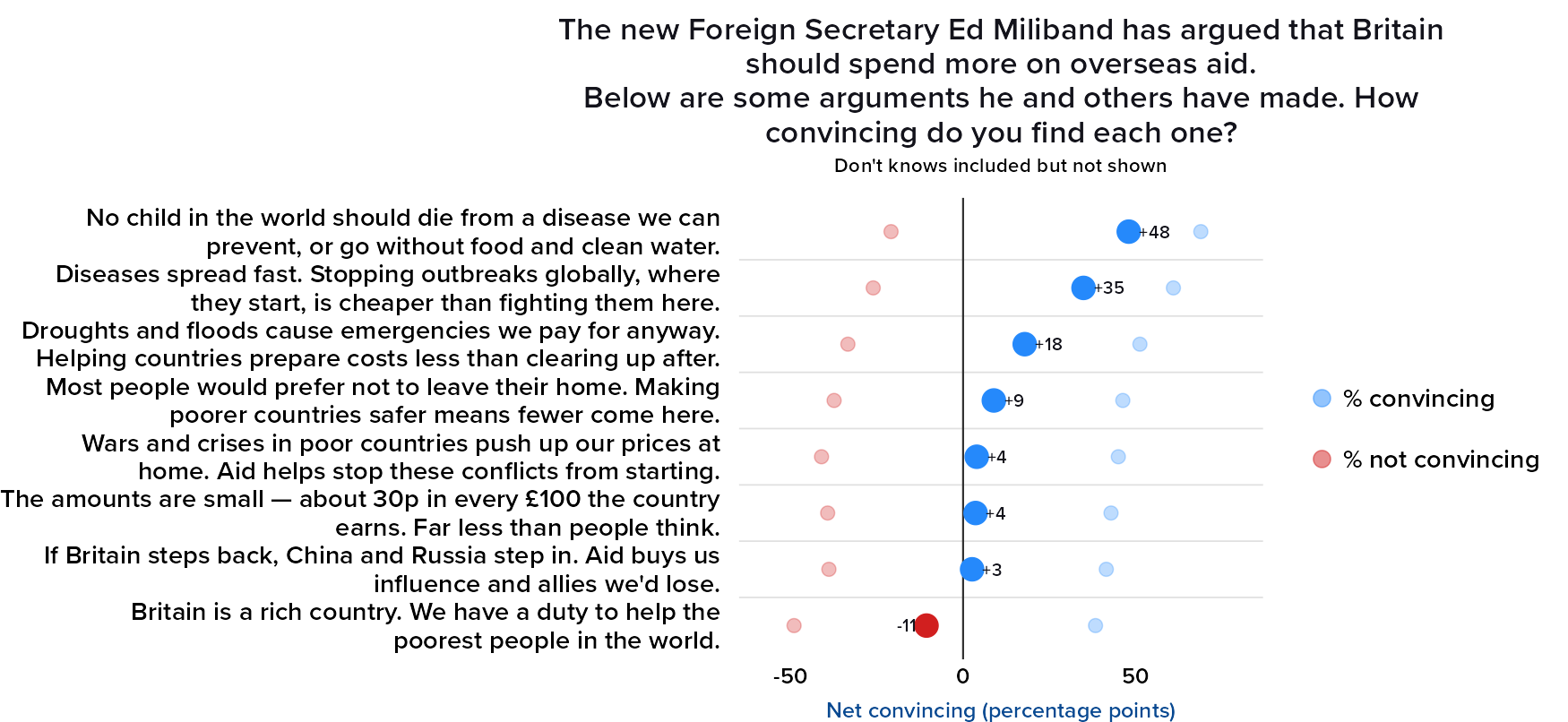
The single most compelling statement in the whole set was a moral appeal about children abroad not dying from preventable causes – i.e., many more people found it convincing than unconvincing.
Conversely, an appeal to duty alone – that Britain is rich and should help the poorest people in the world – was the weakest argument we tested. It is the only argument the public found overall unconvincing.
The strongest mutual interest argument, that stopping disease outbreaks abroad is cheaper than fighting them here, was convincing to a clear majority. A related argument held up too, though less strongly: that helping countries prepare for droughts and floods costs less than paying for the emergencies afterwards.
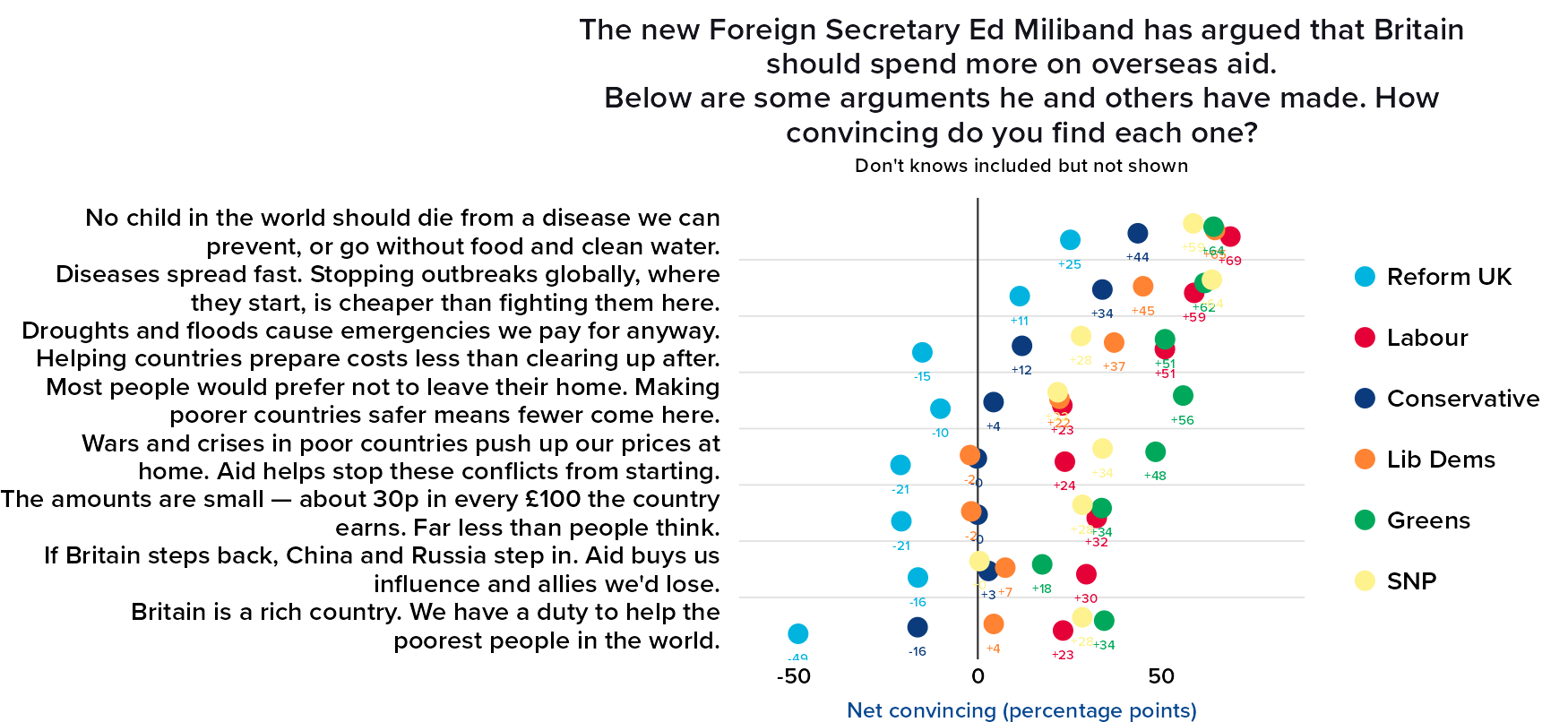
If we cut the results by which political party people say they will vote for (the graph below), we do see a pattern in left-leaning voters more convinced than right-leaning voters overall. But even Reform UK voters – the least convinced by arguments for aid – find, on balance, statements about children in need and infectious disease prevention convincing.
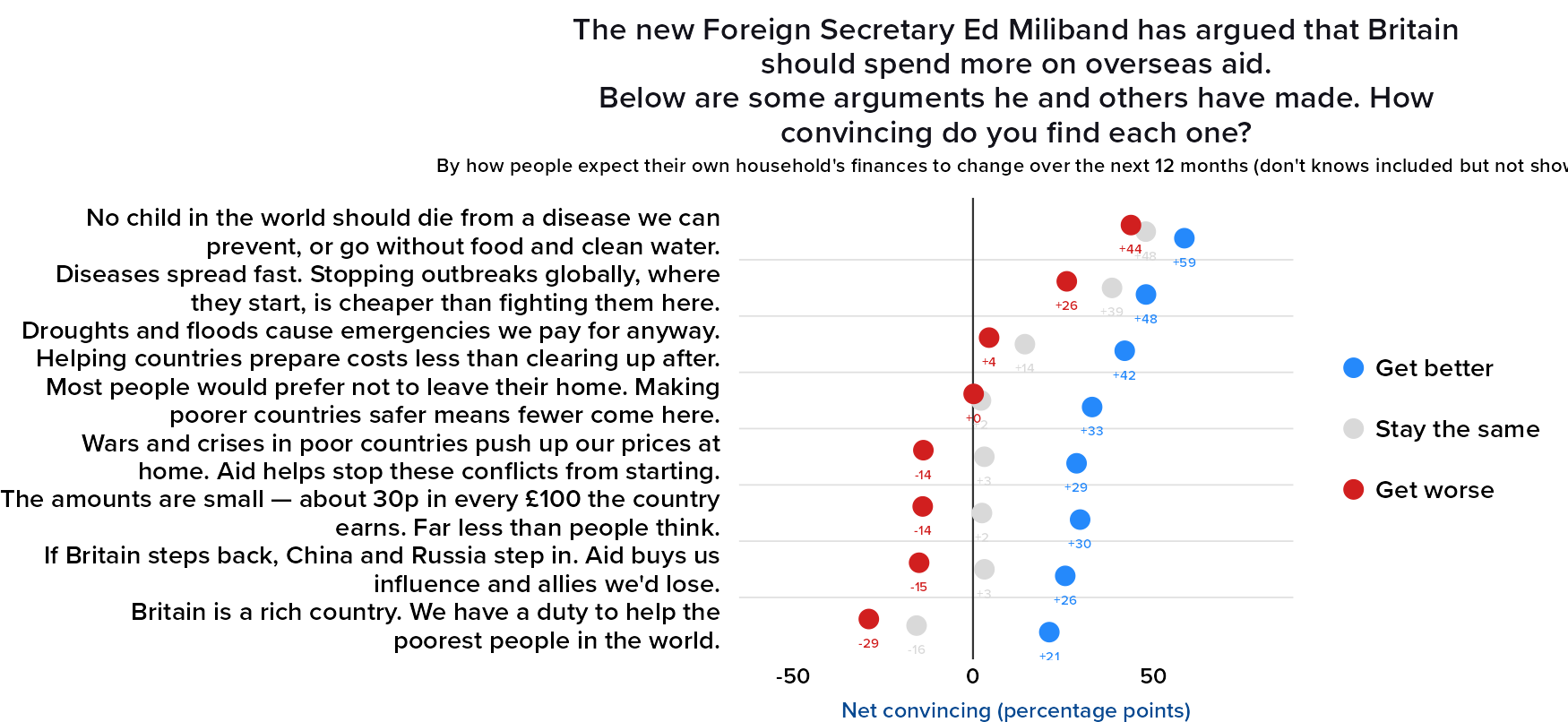
In light of the cost pressures we know people are facing at home, we also cut the data by people’s self-reported, personal financial expectations - how they expect their own household's finances to change over the next 12 months (the graph below). Those who expect an improvement tend to find all arguments convincing; those thinking things will get worse tend not to. This is perhaps unsurprising. Still, we see that both groups still find the same top two arguments convincing overall. And the gap on children in need is much closer than the rest, suggesting this cuts through economic worries.
What we've learned about public support for ODA
Overall, our poll gives a some practical takeaways for anyone thinking about public support for ODA:
- First it confirms there is not an obvious dividing line between moral vs mutual interest – especially when talking about obvious public goods – and that both can appeal to the public.
- Second, on both counts, what worked best is tapping into core physiological “basic needs” framing: child survival and public health are the two we tested here.
- Third, concrete (a child, disease, place) matters more to people than the abstract: some of the weakest arguments were those that stayed very general.
- Fourth, following these principles can find a common ground both across ideological lines and across everyday feelings of optimism.
One argument that we think is currently underappreciated by the public (i.e., they find it one of the least convincing) is a shift in global influence for countries dialling back their development spending around the world – an argument made about the higher order effects of slashed aid budgets in the US. This is a slow-moving and distant issue for most people, but one that may become more important in a shift from a unipolar to multipolar world.
This is only a small test of public opinion, but one which suggests that a clear roadmap towards restoring the UK aid budget to 0.7% of national income must explain to the British public both how it will impact them at home and how it will solve fundamental developmental challenges facing those in need in other countries.
The data for this question and the cross-breaks described can be downloaded here (numbers may differ due to rounding).