Blog/Polling
Britain’s climate fault lines: from the alarmed to the dismissive
It’s London Climate Action Week, and the timing feels particularly apt with temperatures in the UK soaring to a June record of 36.7 degrees. While it can be nice to have some warm and sunny weather on this often rather cloudy and rainy island, the heatwave this week has wreaked havoc on the country’s infrastructure with rail companies advising customers not to travel unless absolutely necessary due to this risk of rails buckling. In spite of this, the British public are still very much divided on the scale of the threat of climate change.
17 years ago, Yale University created six segments in order to better understand the public’s views on global warming in the U.S. The alarmed, concerned, cautious, disengaged, doubtful, and dismissive. Inspired by this categorisation we asked respondents which one of four views on climate change came closest to their own which formed the basis of our own UK segments.
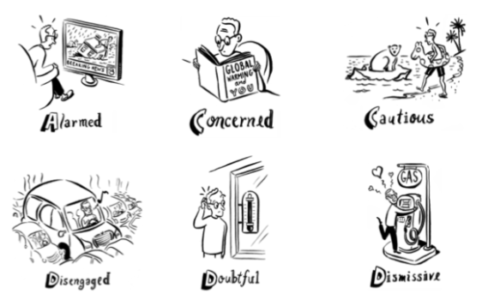
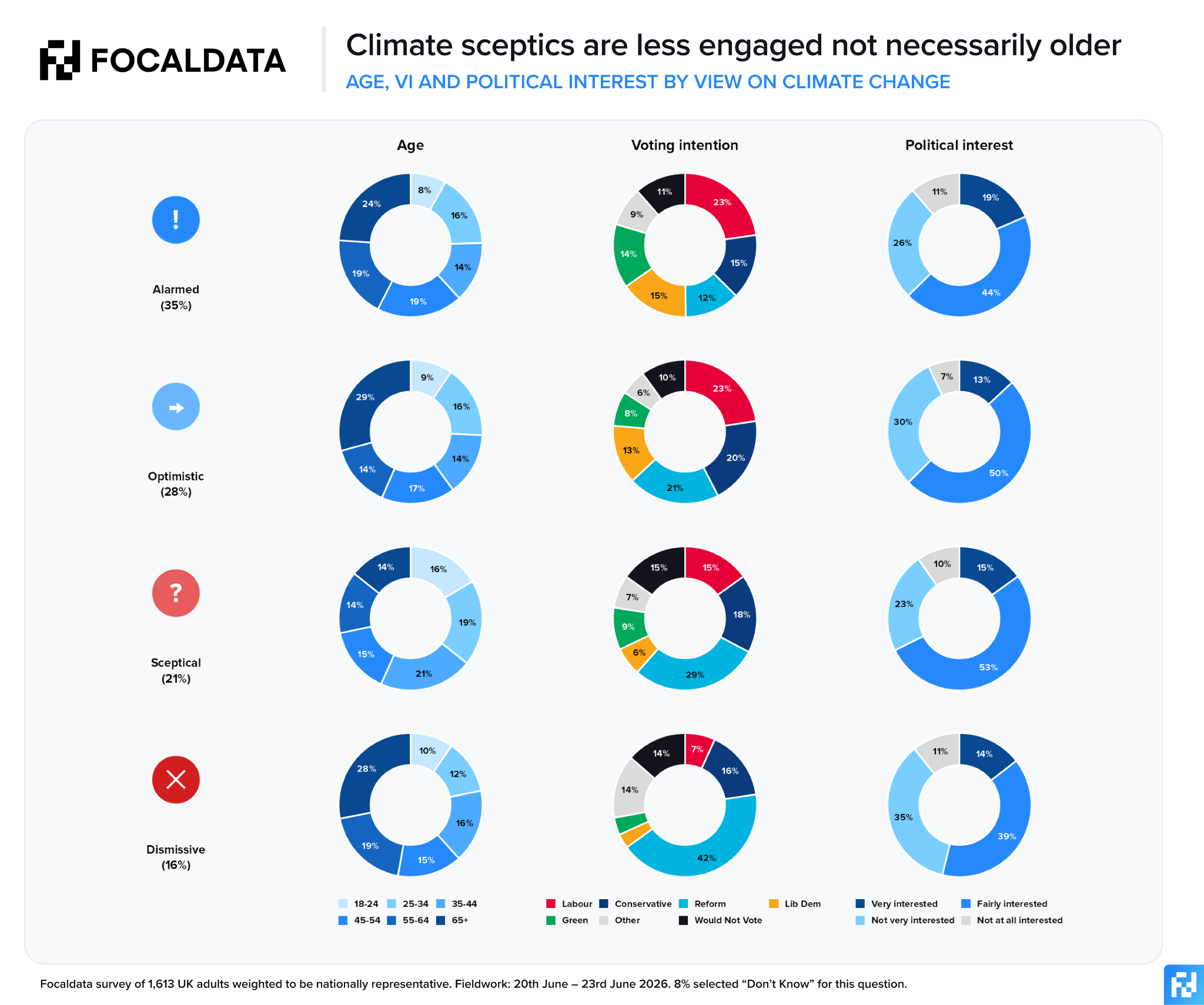
The plurality of voters (35%) make up the alarmed, who said they thought man made climate change posed an existential threat to humanity within the next century. They are the most likely to be politically engaged and the most likely to vote for parties on the left with over 52% saying they intended to vote for the Greens, Lib Dems, or Labour. Yet despite the Greens styling themselves as Britain's “environmental justice” party, Labour (23%), the Conservatives (15%), and the Lib Dems (15%) attract more support among the alarmed than they do (14%).
The second is the optimistic, who said that man-made climate change was real but thought humanity would adapt and overcome it. This group is the second-largest and Conservative voters, as well as those over the age of 65, are overrepresented within it.
The third is the sceptical, who said that while climate change was real its effects and timeline had been exaggerated so it isn’t as big of a threat as some say. Surprisingly this group skewed young as this answer was the most chosen among those aged 18-24. It was also the most chosen option among Asian Brits and among those who would not vote at the next election.
The last was the dismissive, those who said that they didn’t believe in man-made climate change at all. This group skewed older, which surfaces an interesting finding: combined with the sceptical, the age profile becomes roughly even across generations forming a consistent bloc of climate scepticism. The nature of the doubt differs — the younger-skewing sceptics tend to accept man-made climate change but push back on the existential narrative, while older people are more likely to dismiss it altogether. This group is also mostly made up of those who intend to vote for either Reform and those who are not interested in politics. Those who intend not to vote or intend to vote Restore are also overrepresented within this group.
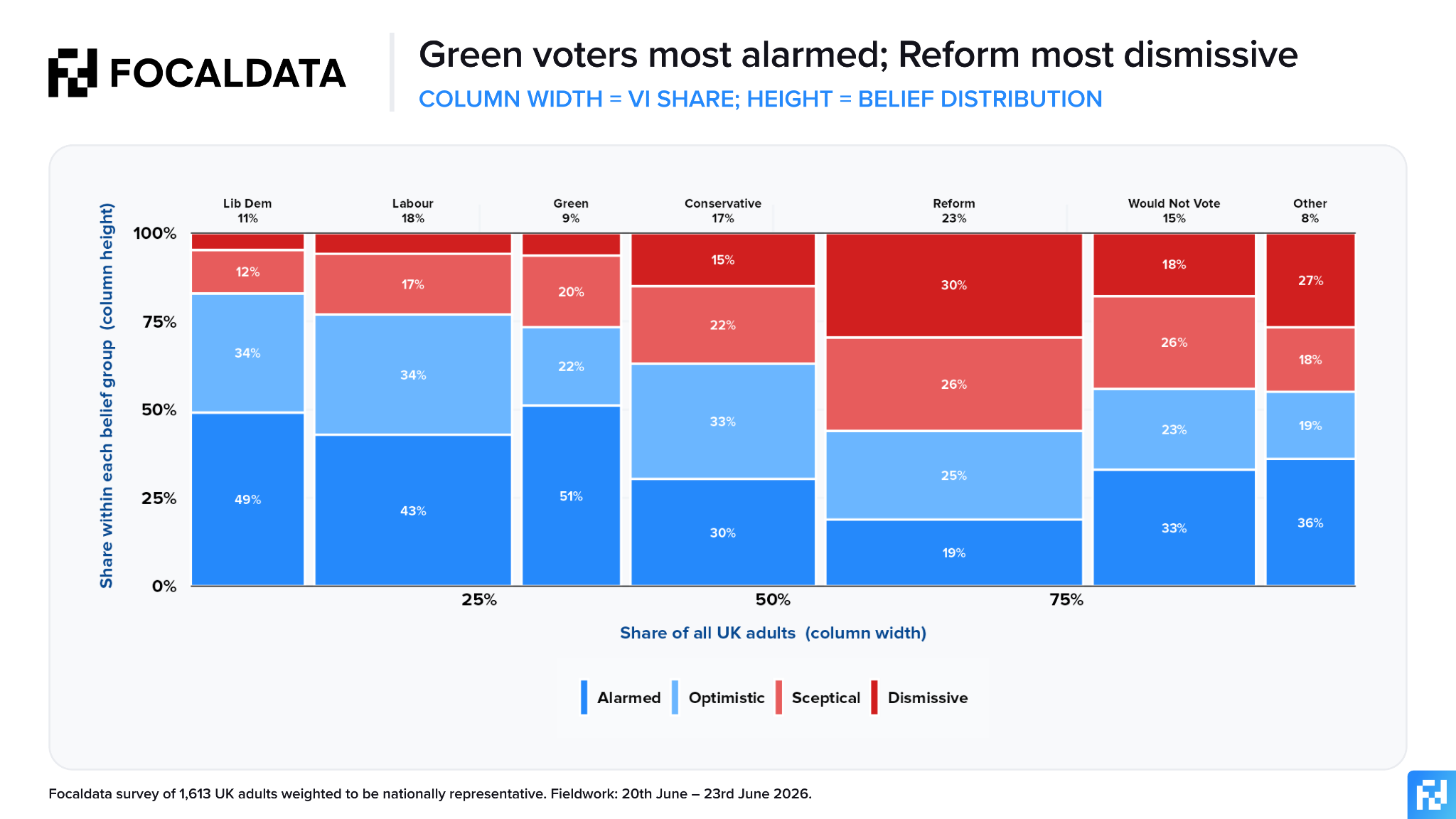
Looking at the groups from a voting intention angle, the sceptical and dismissive bloc are a minority among voters of most major parties. Reform are the only exception, where dismissives form a plurality, making rejection of man-made climate change the most common position in the Reform support bloc. And while Green voters are the most likely of all voters to be in the alarmed group, there are more Green voters who are sceptical and dismissive than there are Labour and Lib Dem voters.
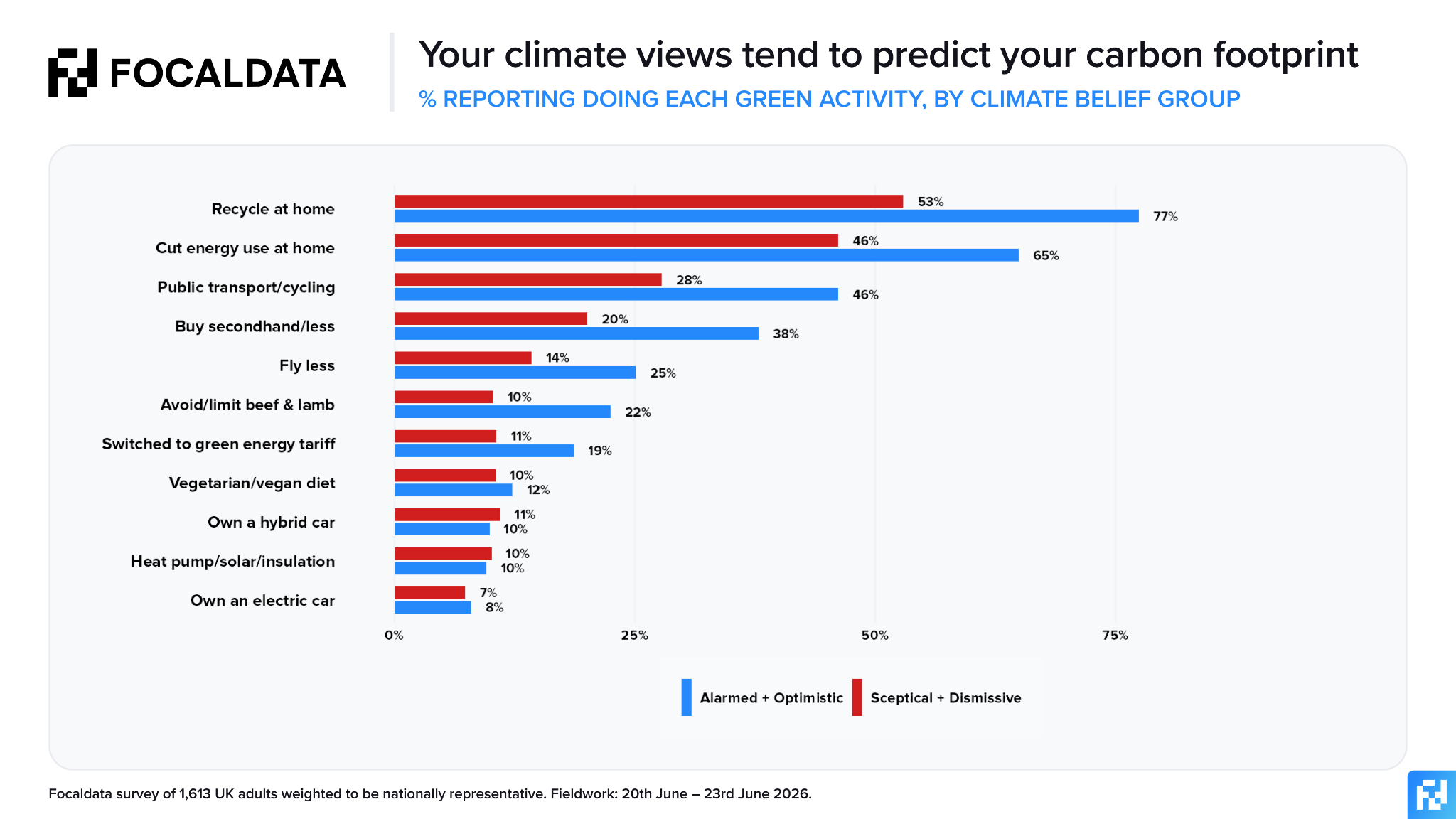
The more sceptical groups were also much less likely than the more climate conscious groups to say that they bought secondhand or recycled — yet they were more, or just about as likely, to say that they were vegetarian or vegan, owned a hybrid or electric car, or had installed a heat pump, solar panels, or insulation. The gap between the two camps is widest in everyday, habitual choices; bigger structural decisions, it seems, are driven more by lifestyle, circumstance, and cost, cutting across climate consciousness and belief.
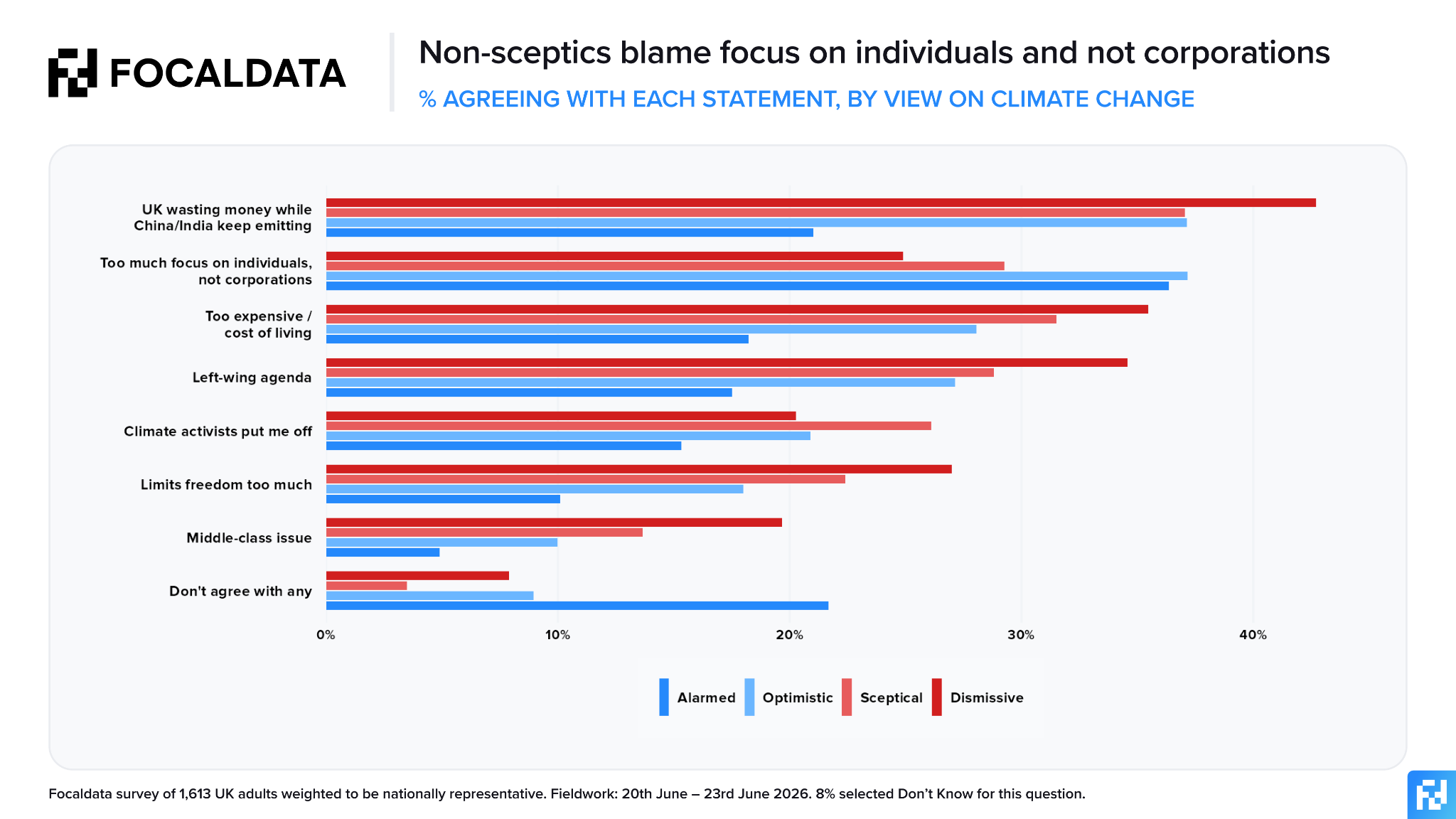
When presented with common criticisms of climate action and net zero policy and asked to select all options they agreed with, again a clear gap emerged between our groups. The sceptical and dismissive were more likely to agree with each criticism listed with the notable exception of the “too much responsibility is being placed on individuals to tackle climate change rather than big corporations” statement.
Of the sceptical and dismissive, the statements with the most cut-through were: that net zero and climate action seem to be less about climate change and more about a left-wing agenda (31%), tackling climate change and reaching net zero is too expensive (33%), and climate action is a waste of time and money when countries like China and India continue to pump out emissions coming top (39%). This last criticism also produced the largest gap between the two climate conscious groups with only 21% of the alarmed selecting it compared to 37% of optimists.The alarmed were also much more likely than other groups to say that they didn’t agree with any of the statements, with 22% selecting this option compared to less than 10% in other groups.
Climate Change: Corporates and Credibility
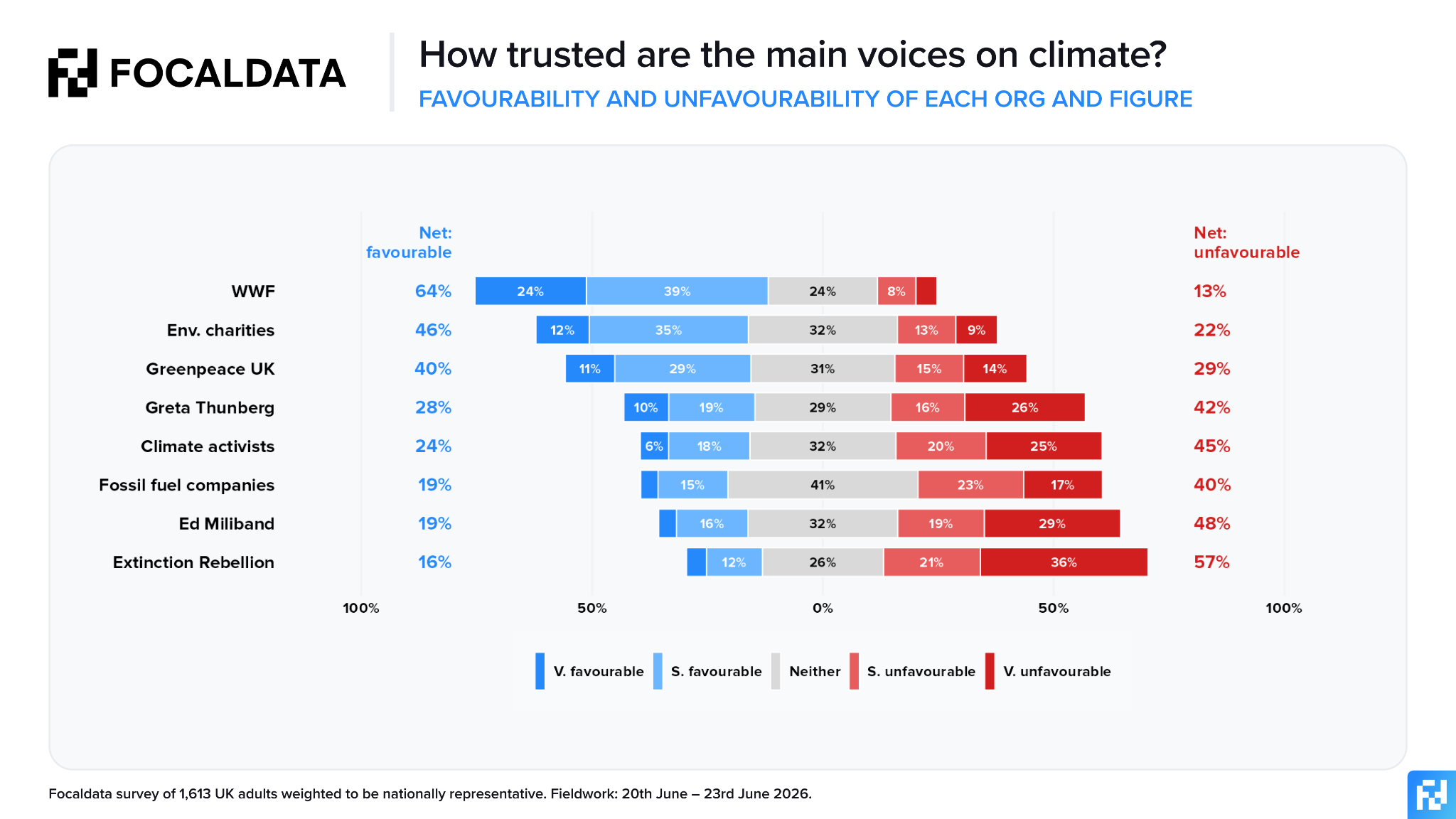
There are some things that the public are less divided on when it comes to climate and the environment. The World Wildlife Foundation (WWF) maintains an overwhelmingly positive reputation: only 13% of Brits said they had viewed the organisation unfavourably and it was the only voice we polled that had a net favourable reputation among every segment. While the sceptical and dismissive have net unfavourable views of environmental charities at large, both have net favourable views of the WWF.
Climate activists and associated groups were viewed much less favourably with Greta Thunberg coming in at -12 and climate activists in general at -21. Younger age groups have a more positive view of both, but they still only just tip into net favourable among 18-34 year olds with Greta on +5 and climate activists only on +1. Ed Miliband and Extinction Rebellion, meanwhile, are viewed even less favourably than fossil fuels companies reaching net -29 and -41 respectively.
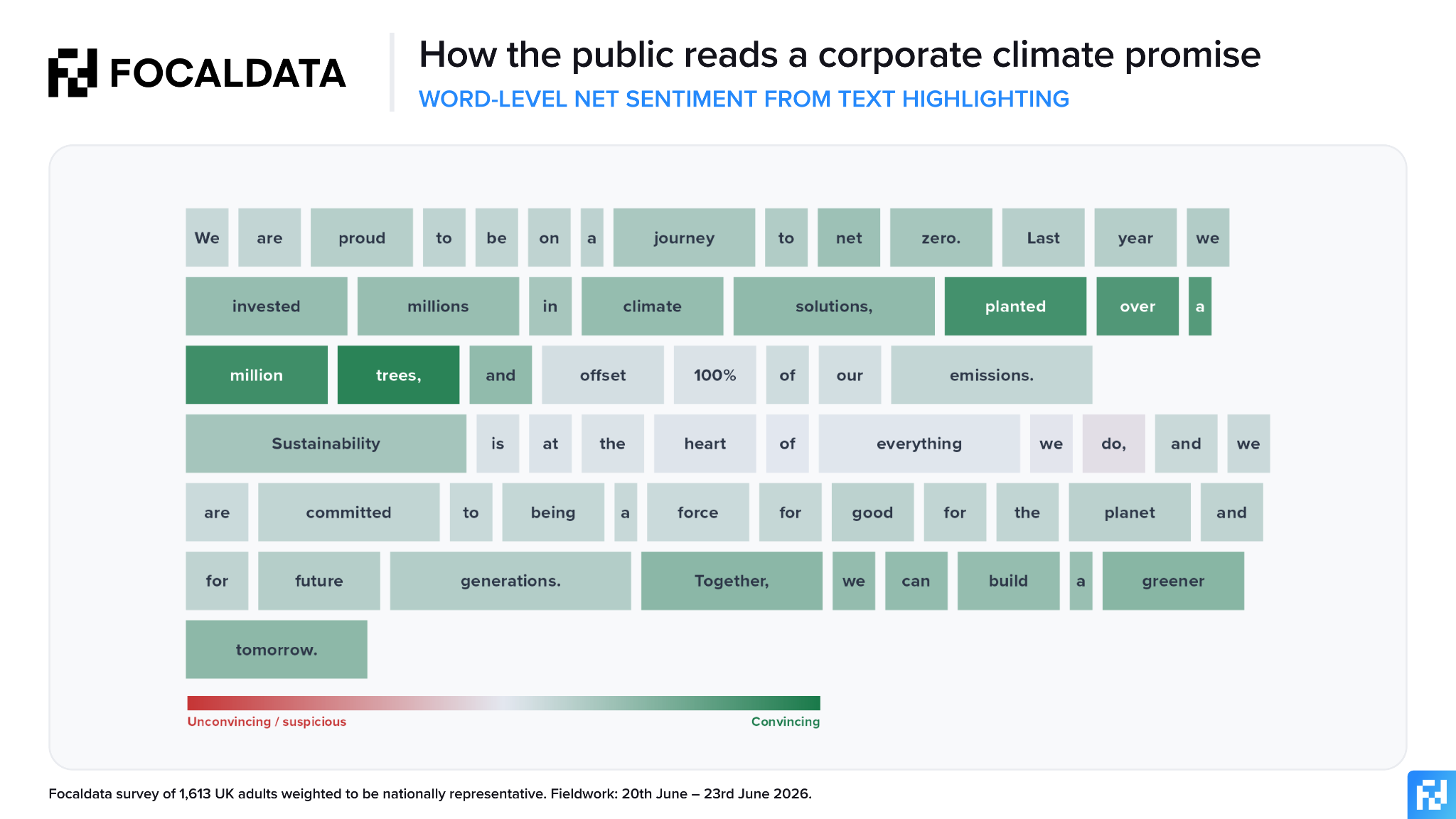
We also gave respondents a generic, AI-generated corporate climate promise and told them to highlight the sections which they felt were most convincing and the sections that were least convincing. Overall, respondents were fairly positive about most of the pledge, particularly the “greener tomorrow” section and the part of the text which went into the specific, concrete steps the hypothetical company had taken to tackle climate change, such as having “invested millions in climate solutions” and “planted over a million trees”. This is perhaps unsurprising given that protecting the natural world is one of the few areas where support for climate action holds across the ideological spectrum, as exemplified by the WWF’s cross-cutting favourability. However, they were less convinced when it came to passages including more technical language, “offset 100% of our emissions,” and were most sceptical of the claim that sustainability was “at the heart of everything” the company does.
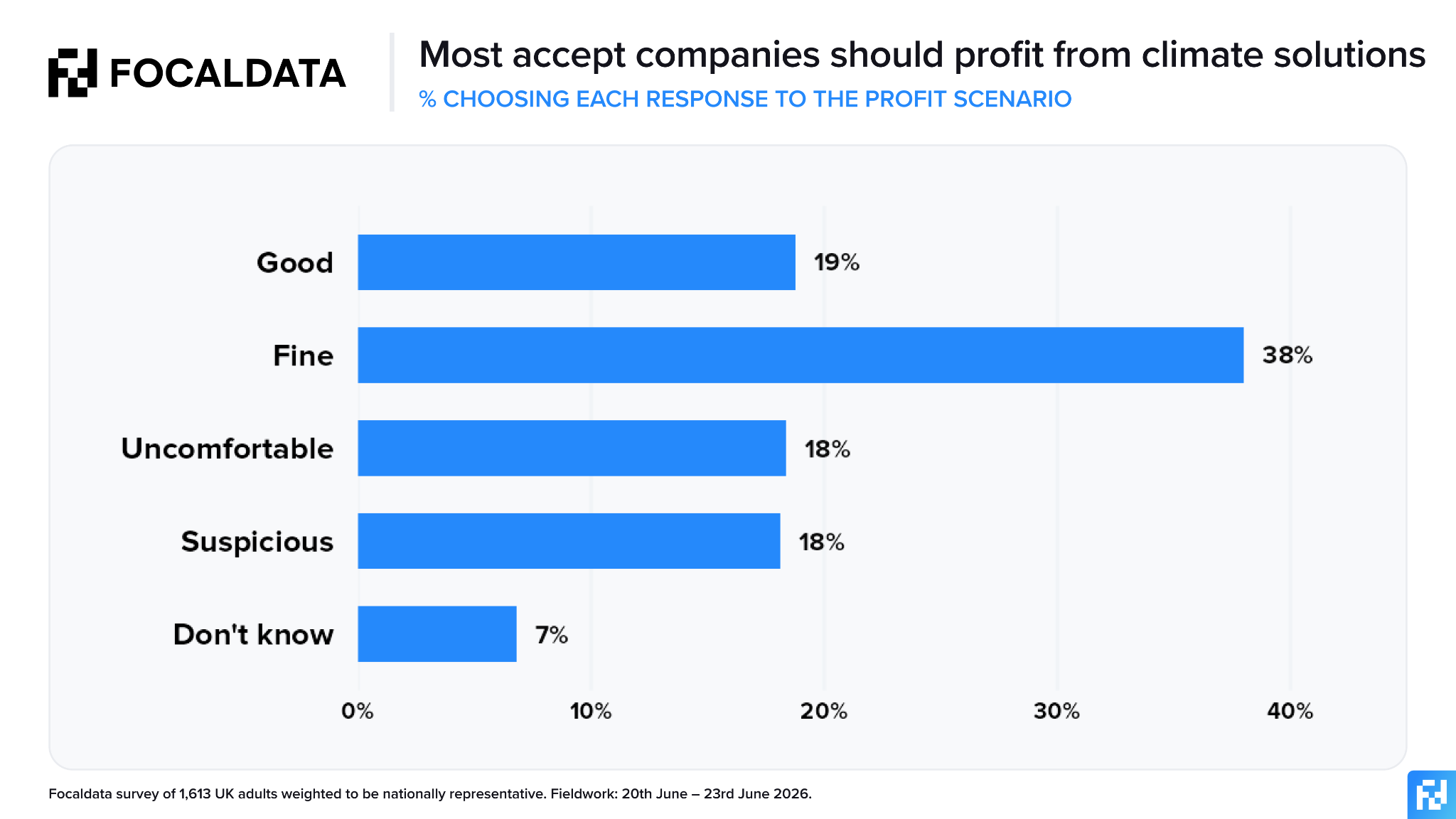
Lastly, we asked respondents their thoughts on companies investing in climate solutions and profit. The question specifically involved a scenario where a company had invested in a climate solution and had ended up making a large profit while also cutting emissions. While 57% said that this was either “good” or “fine” on the basis that companies need to turn a profit to thrive and survive, 36% said they either felt uncomfortable, “companies shouldn’t be profiting from solving a crisis like this,” or suspicious, “if there’s a big profit involved, I doubt the climate benefits are real”.
Those intending to vote Reform and the dismissive were significantly overrepresented among the group that said they were suspicious, which aligns with their general scepticism around climate change. The uncomfortable group wasn’t as distinctive, although sceptics and those intending to vote Lib Dem were slightly overrepresented.
Britain's climate fault lines are not new, but they aren't static either and are constantly changing in reaction to the impact of net zero policies and increasingly extreme weather. If you're interested in learning more about Focaldata's previous work on climate change, please read some of our previous work on the topic such as How to craft the perfect climate change message and our Foundations at Risk white paper.
Data tables for this survey can be downloaded here.