Blog/
Burnham’s Budget: What Will Voters Accept?
Andy Burnham is still in the honeymoon phase. Labour has a clear and growing lead in the polls, thanks to the new Prime Minister restitching three quarters of its 2024 coalition back together. Defectors to the Greens and Liberal Democrats have returned in droves. But the next steps in Labour’s recovery are less straightforward: to make further gains, Burnham must appeal to voters Labour has lost to both the left and right. Tomorrow’s Budget is a banana skin in this respect. Expectations are through the floor, as just 15% believe it will leave their household better off, and the need to satisfy both the public’s call for radical action and the bond market’s demand for stability leave little margin for error.
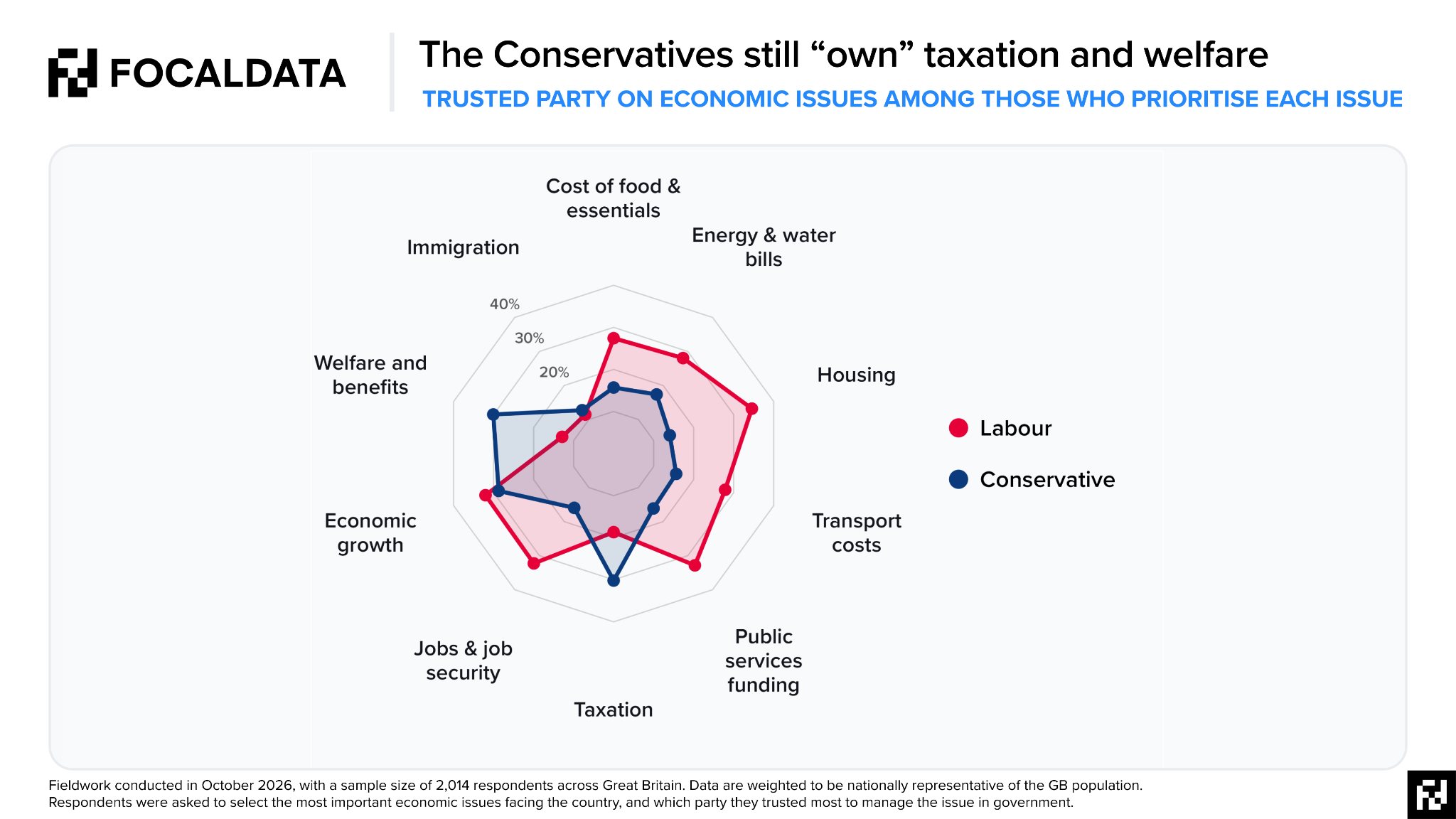
Budgets are always vulnerable moments for governments facing fiscal headwinds – especially Labour governments. Although Labour has regained much of the public’s trust on jobs, public services, and the cost of living, our analysis shows that the Conservatives still have the advantage on taxation and welfare among voters who prioritise these issues. This Budget will inevitably involve political challenges around tax and welfare, and the government is starting on the back foot. Labour’s 2024 manifesto included a pledge not to raise rates of National Insurance, Income Tax, or VAT in an effort to mitigate the party’s brand weakness on taxation. That pledge has severely constrained the fiscal options available to this government, but a majority of the public – including 54% of Labour voters – believe it should keep the commitment, even if that means deeper cuts to spending or more borrowing.
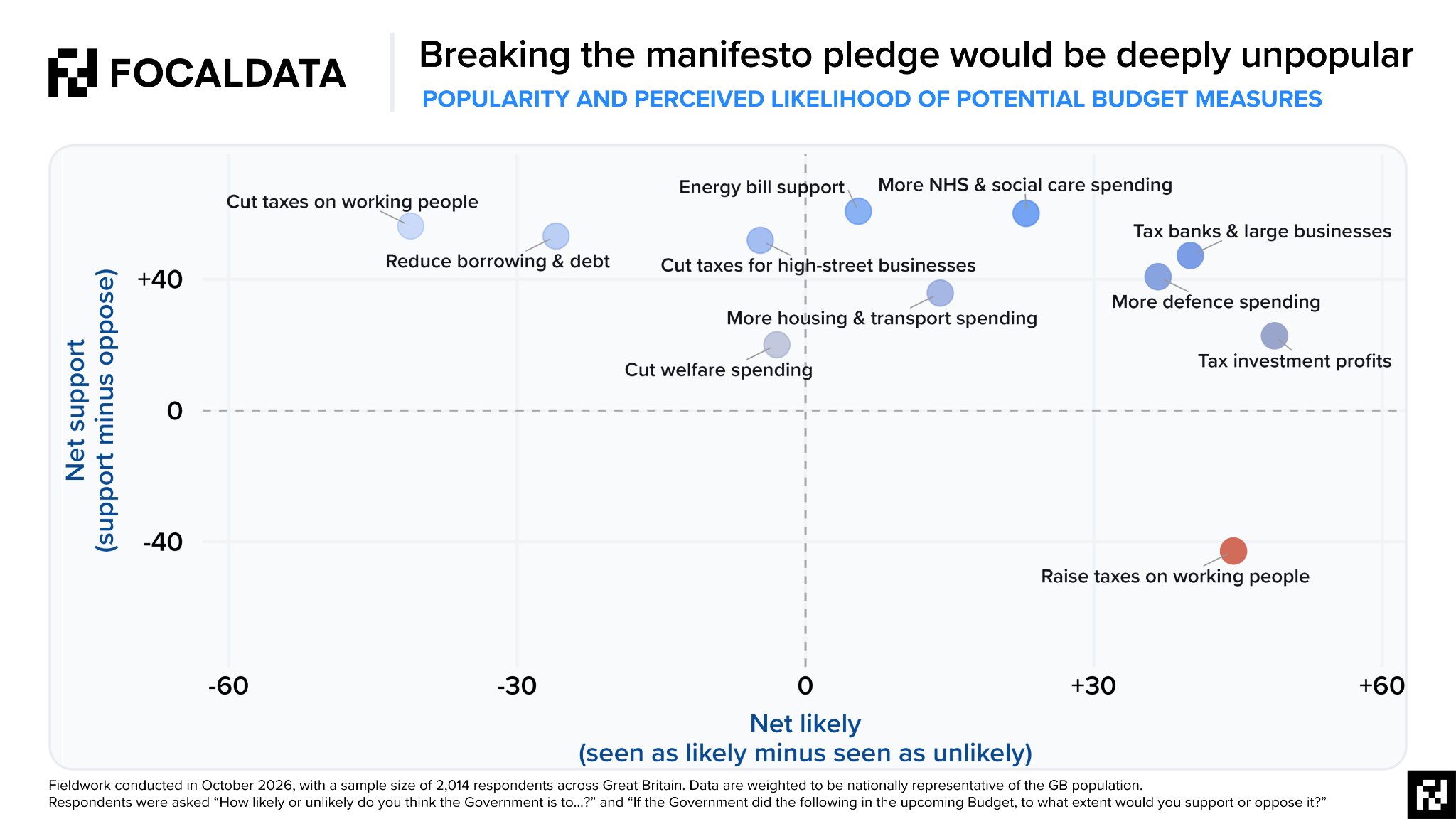
The persistent public perception of Labour as a party of tax and spend is reflected in expectations for the Budget. Of the potential Budget measures we tested, the three seen as most likely to be announced are all tax rises: on investment profits, banks and large businesses, and working people. Meanwhile the measures seen as least likely are tax cuts for working people and high-street businesses, reduced borrowing, and welfare cuts. Many of the policies we tested are popular, but already “priced in”: more spending on the NHS, defence, and energy bill support all fall into this category. The only policy tested which the public opposes is raising taxes on working people, with net support of -43 points. If there’s one thing that goes down worse with the public than raising taxes, it’s breaking promises. It’s best not to do both at once, if you can avoid it.
The three policy areas consuming the most attention in Westminster ahead of the Budget are defence spending, the state pension triple lock, and youth welfare reform. John Healey is likely to gesture at all three in his speech tomorrow, before deferring the trickiest decisions about each of them for another few months. In what follows, we take these long-term fiscal challenges in turn and try to chart potential ways forward for the government that might allow it to balance fiscal and political concerns.
Is there a path to 3%?
Of course, this is not just Andy Burnham’s first Budget as Prime Minister, but also John Healey’s first as Chancellor. After Healey resigned from Keir Starmer’s government over its hesitance to increase defence spending, there is understandably an expectation that he will commit resources to meeting NATO’s target of spending 3% of GDP on defence by 2030. The public would appear to be behind this ambition, with 58% in support of increasing defence spending even at a likely annual cost of £15 billion. Preparing the UK for armed conflict (38%) and protecting against threats from Russia (36%) are seen as the strongest reasons for spending more on defence.
But higher spending on defence has to be paid for somehow – and this is where the public consensus breaks down. When pitted against alternative priorities – like welfare, debt reduction, tax cuts, and the NHS – support for increasing defence spending falls to less than a majority in each case. That means even though the public clearly favours defence spending in the abstract, there is no single way of paying for it which commands the support of more than half of voters. The choice of how to fund higher defence spending is made even more politically fraught by partisan divides: voters on the right want to slash welfare, Labour’s own base would rather borrow through “war bonds”, and the Greens see no need to invest more in defence at all.
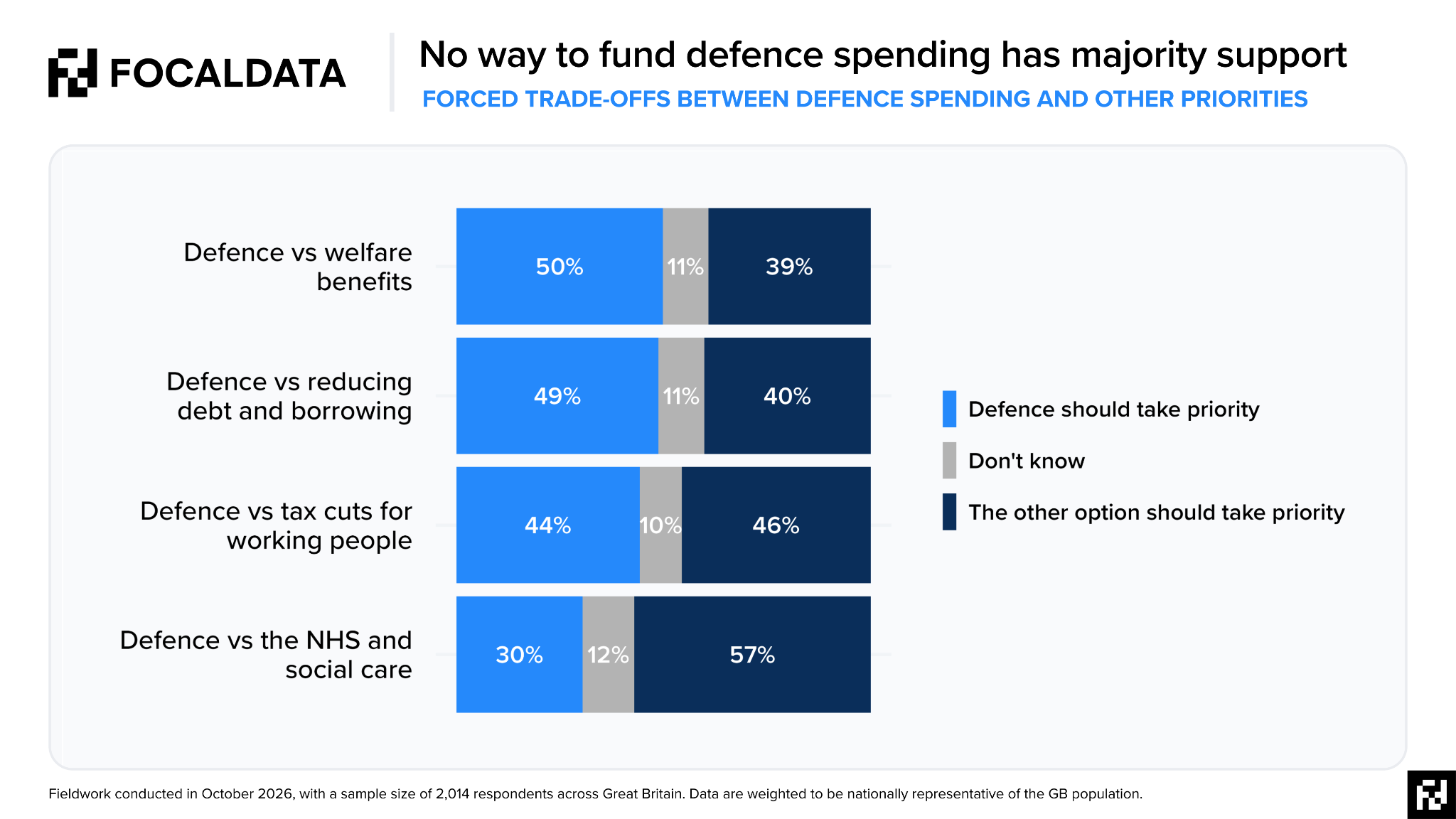
The option which comes closest to winning the approval of a majority of voters is to prioritise defence spending over welfare. Ironically, this is also the only option which the Prime Minister has explicitly ruled out, saying that “National security can't come at the expense of social security”. As soundbites go, it could hardly be more divisive: our poll finds that 41% agree while 42% say the converse better represents their view. In any case, Burnham has already signalled a willingness to reform the social security system – for both young and old Brits.
How toxic is tweaking the triple lock?
Ahead of this Budget, Burnham seems to be positioning himself as a Prime Minister who is unafraid to take difficult decisions for the good of the country. His proposal to reform the triple lock – one of the few sacred cows of British politics – is a clear example. Despite arguments from wonks across the political spectrum that the triple lock is fiscally unsustainable, voters tend to tell pollsters they support it. In our research, 55% want to keep the current state pension triple lock, including majorities from all major parties except the Greens. On the surface, it looks like a risky fight for Burnham to pick.
Digging deeper, however, voters are more open to “adjusting” the triple lock than many assumed. When presented with Burnham’s plan to tweak the state pension system to help fund a National Care Service, close to half of voters (48%) are supportive. Although overall support is softer than backing for keeping the triple lock, the structure of support is striking. Labour voters of all ages are united behind Burnham’s plan, with older Labour voters actually the most supportive. In contrast, the Conservatives and Reform UK divide along generational lines, with younger voters on the right in favour of the plan and older right-wing voters opposed. This creates a headache for the parties of the right, who risk alienating their younger supporters by criticising the plan.
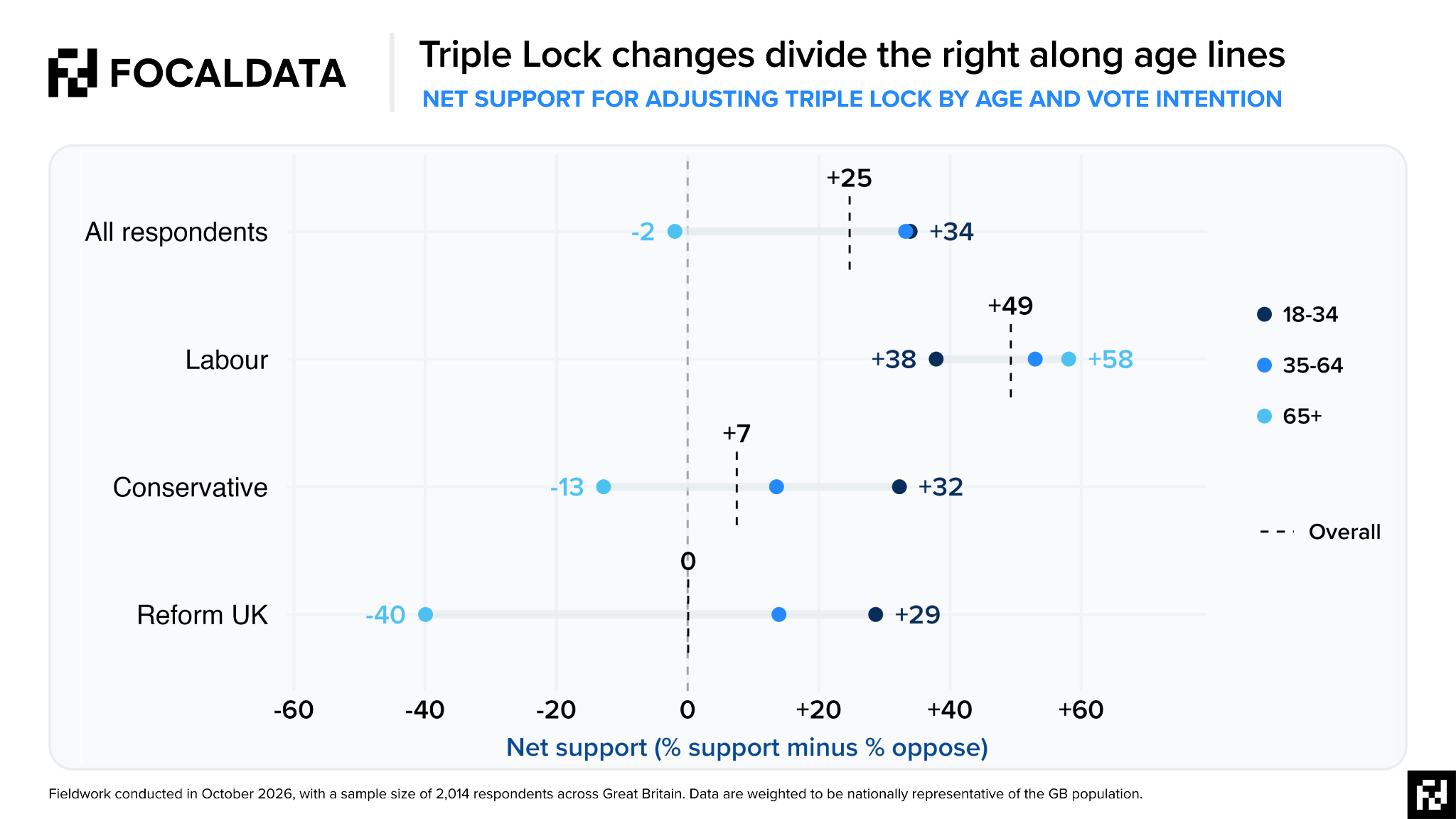
The key to the popularity of Burnham’s proposal is that it connects something voters want – a National Care Service – to something they are reluctant to give up – the triple lock. Presenting voters with a trade-off like this forces them to prioritise between policies which both test well in isolation. But most economists agree that a modest adjustment to the triple lock will not be enough to fully fund a National Care Service like Burnham envisages. Instead, the government will need to look elsewhere for cost-saving or revenue-raising policies. One approach under consideration – not without its own complications – is welfare reform.
What to do about NEETs?
At Labour Party Conference, Burnham set out his approach to youth inactivity: “Either we invest in our young people, or we pay for failure through the benefits system.” His proposal to cut benefits and use the savings to fund guaranteed training, work placements, and mental health provision has attracted broad public support, with 66% agreeing with the plan in our poll. The scale of the problem is also widely recognised, as 32% correctly estimate that almost one million young people are out of work, education or training, and a further 16% think it’s even more.
This combination of public concern and support for reform appears to give the government license to act. Yet behind this apparent consensus lies a sharp divide over the causes of youth inactivity. Those on the left point to limited opportunities, low wages, and crumbling mental health support, while those on the right blame an unwillingness to work and an overly generous benefits system. By combining investment in young people with tighter benefit conditions, Burnham’s approach could appeal to both sides. However, this appeal may prove fragile when challenged. We presented some voters with the case for welfare reform (based on cost savings) and others with the case against (based on the risk of rising poverty). We found that support for the government’s proposed reforms is highly contingent on whether voters are primed to consider the upside or the risks.
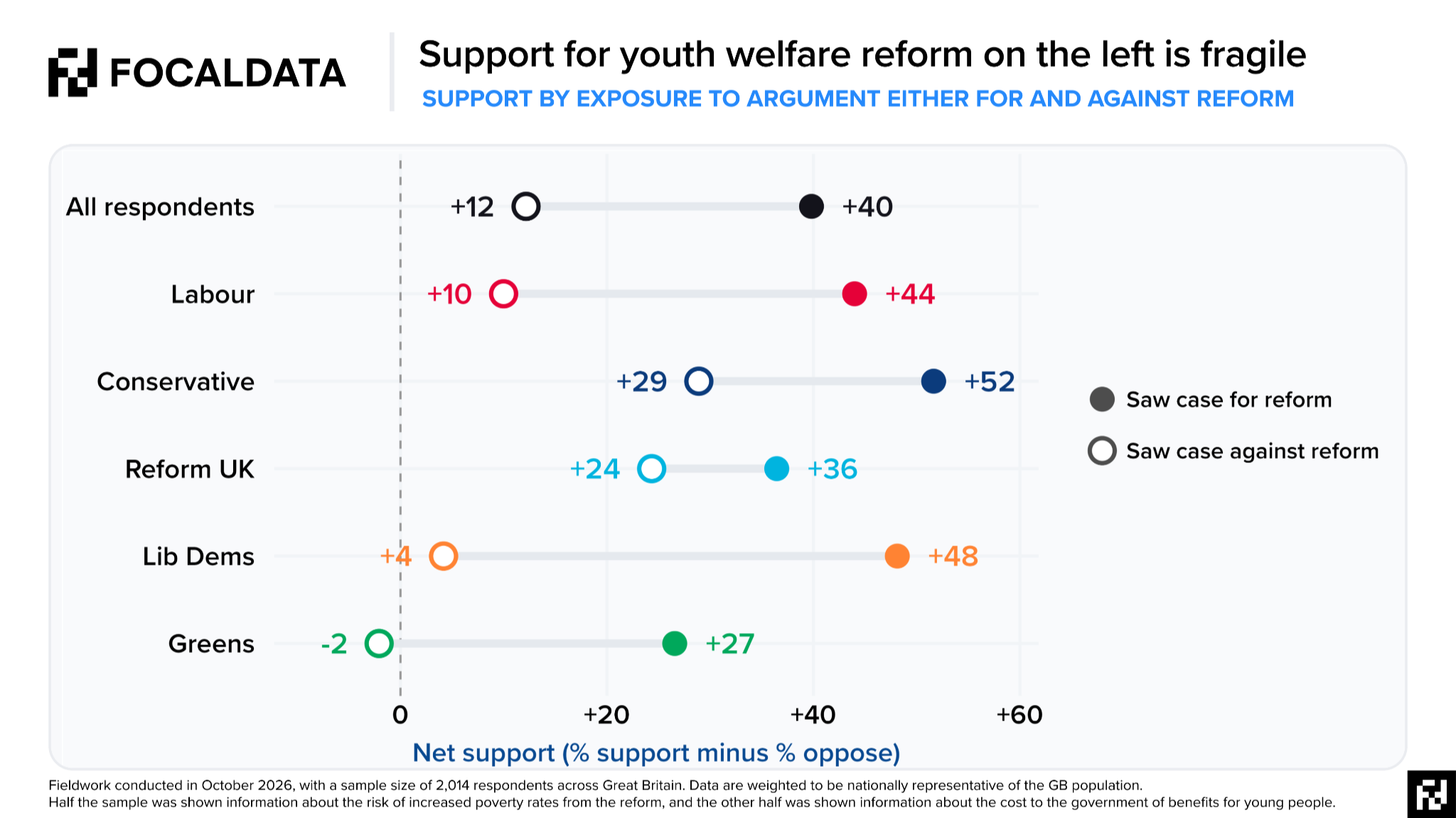
For Labour, the immediate political risk lies on its left, where the case against welfare cuts almost eliminates net support and gives the Greens an opening among progressive voters. Yet the vulnerability extends well beyond this group, with support falling sharply across the political spectrum when potential harm to vulnerable families is raised. Burnham has so far emphasised what young people stand to gain, rather than the benefits they might lose, but with the Milburn Review delayed until after the Budget, that approach has yet to face sustained opposition. Unless the government can demonstrate that cutting benefits is both necessary and fair, a rare consensus on welfare reform could quickly unravel.
Room for manoeuvre
All three of the policy areas examined above represent significant challenges for the government, politically as well as fiscally. But in each case, public opinion is less settled than it may appear at first glance. Time and again, voters show themselves to be responsive to arguments, sensitive to trade-offs, and open to changing their minds. That means the government has a chance to win public support for the policies it wants to pursue, but only if it can tell a compelling story about why its plan for the country is the right one.
The temptation to minimise risk by turning the Budget into a non-event is understandable, but that may be a political misstep. Andy Burnham has proven to be skilled at political storytelling, capable of shaping public opinion as well as reflecting it. That’s only possible when voters are paying attention, as they will be tomorrow. Budgets can be stuffy affairs, but they are also opportunities for persuasion and political theatre. The government should not let this one go to waste.
Focaldata has prepared a private briefing on the Budget. Fill out the form below to access it for free.
Data Tables can be accessed here.