Blog/Company
Insight is a translation job
Translating data into valuable insights has always been the hardest skill to cultivate within insights teams. In the past, production has made up the bulk of the team’s work. Building quality surveys, cleaning and analysing data, identifying audiences, segmenting them.
This leaves little time for teams to think about the most valuable part of the role: creating insights. Insights are created when data interacts with the business’s priorities and shapes what should happen next.
This task was hidden because manual production work filled every week and nobody could isolate it. AI removing production doesn't create a new role: it highlights the one that was always valuable and makes it the whole job.
Silos are a translation problem
Most companies already have all the customer and data they need to make 90% of decisions. What they don’t always have is a way to connect that knowledge to drive decisions. In my experience, three or four functions hold a different slice for the customer:
- Internal data and analytics [WHAT]: knowledge of what customers do: purchase history, product usage, lifetime value.
- Marketing insight [WHY]: knowledge of who customers are and what moves them within the business's own audience: segments, brand perception, campaign response.
- External and market research [CONTEXT]: knowledge of what's happening beyond the business's own customer base: category trends, competitor movement, audience behaviour bought in or run separately from internal teams.
- Engineering and product teams [CORE]: knowledge of what customers need: UX research, usability findings, feature validation.
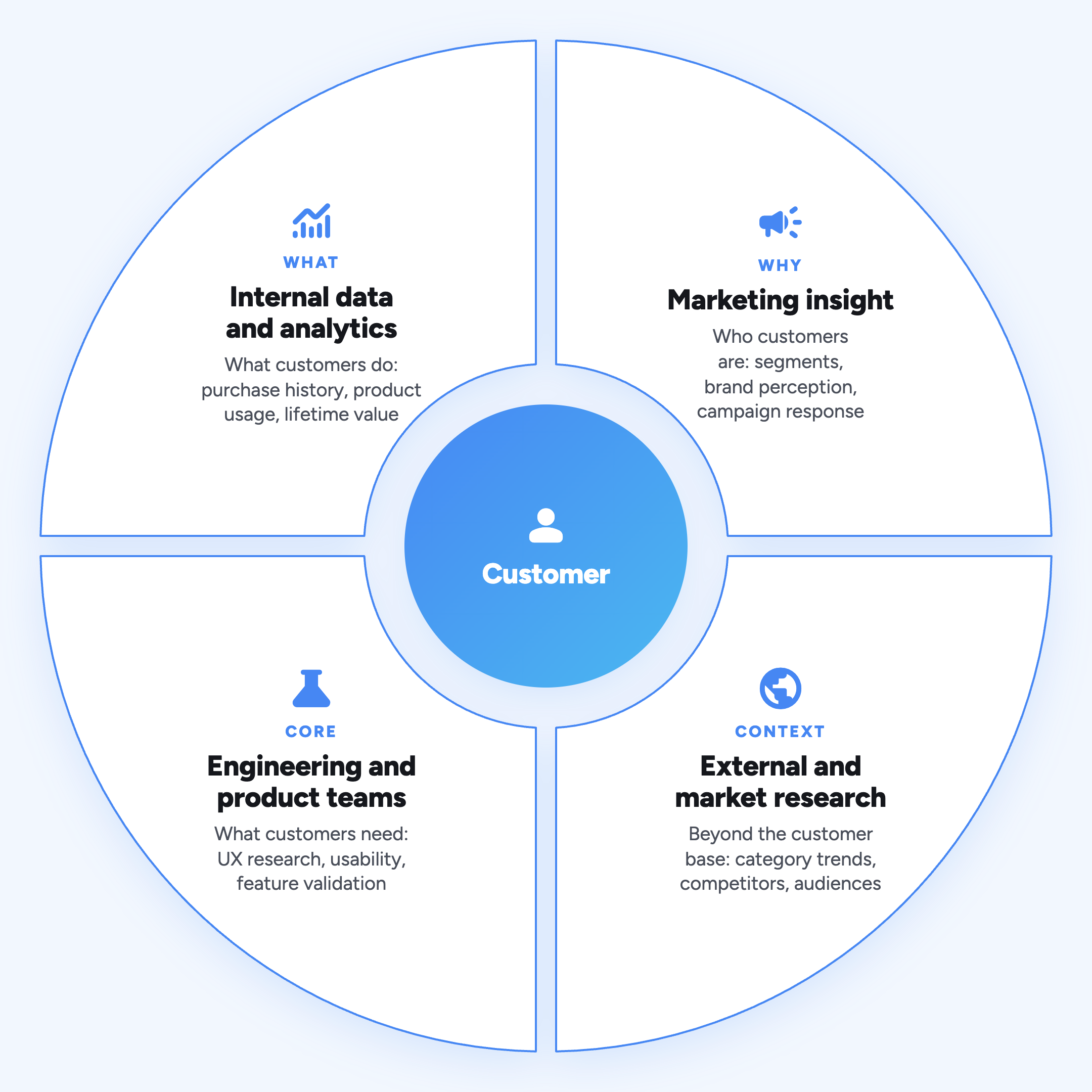
Each function produces useful insight in its own domain. However, this data is often not shared readily between functions in a form others can use. This isn't a data quality or quantity problem, and it isn't solved by more data or better dashboards. It's a translation gap, and it shows up in different shapes across organisations:
- Multi-brand multinationals, where each brand or product line runs its own insight function with no shared view across the portfolio.
- Tech companies, where engineering, marketing and sales each hold a piece of the customer picture and rarely connect them.
- Companies sitting on rich internal data: usage, behaviour, transaction history that isn’t set against external signals: category trends, competitor movement, what's happening with the audience the business is trying to reach.
Guardrails come before access
You could conclude from this that the fix is to open everything up: give every team access to every other team’s data and assume alignment will follow. It won’t.
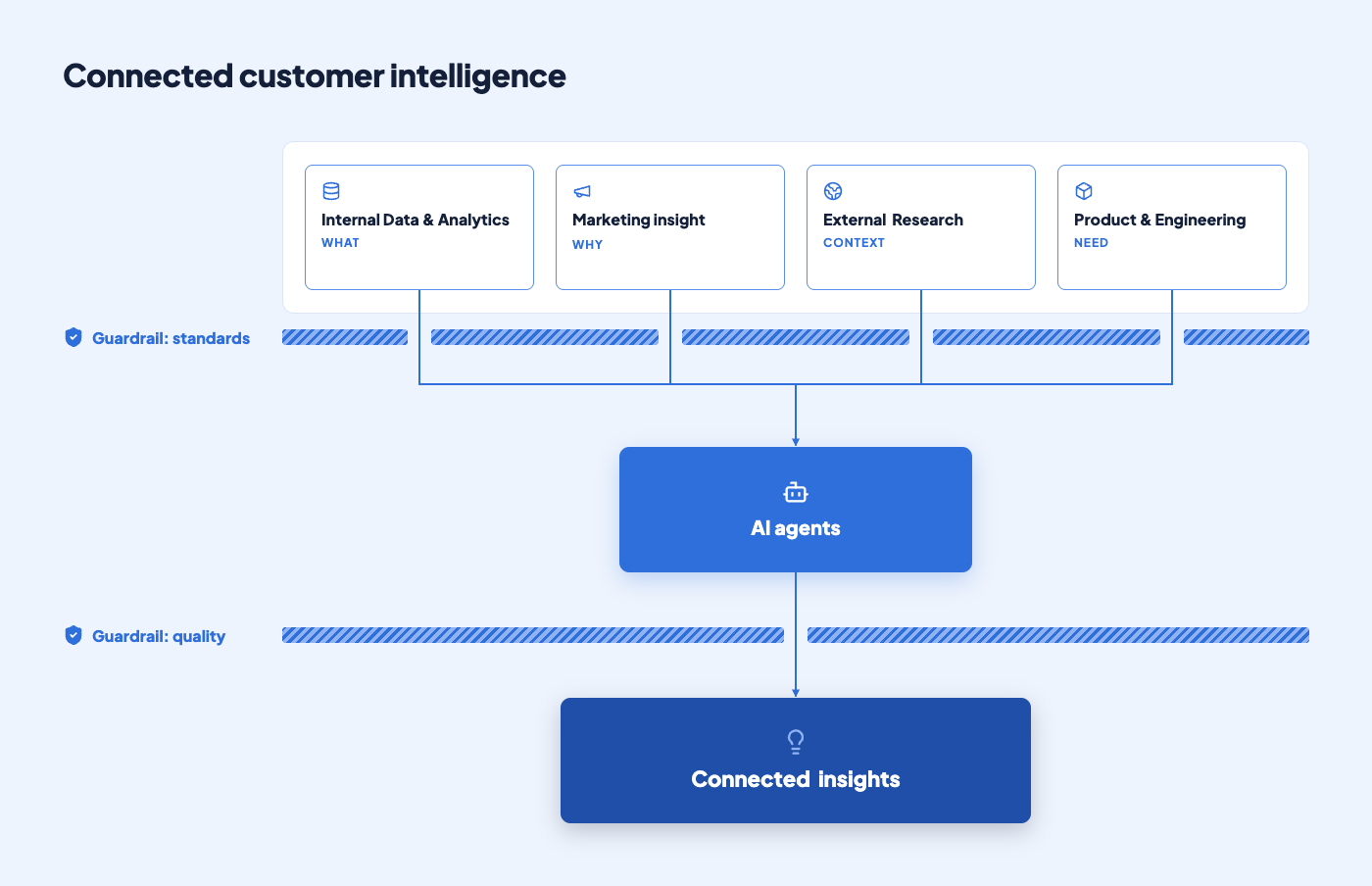
Access without standards produces noise and overwhelm, and you still need experts to calibrate what’s worth acting upon. Worse, bad decisions get made from partial or misread data, because the people using a dataset don't know how it was collected, what it leaves out or where it breaks down.
So the fix begins with guardrails. The people who own each source sets the standards for how it’s collected, validated and used. That means the analytics team for internal data, and researchers for external and qualitative data. They can provide the quality control no one else can.
Once the guardrails exist, access can open up. The result should be able to draw on customer intelligence directly rather than wait for a report to be handed down.
This is also where AI earns its place: once the standards are set, agents can do the production work of turning raw data into usable outputs at a scale and speed no team could match manually, without the errors that come from every team improvising its own approach to the same dataset.
Insight teams set the rules
AI elevates insight teams from producers to translators. But once production is handled and the guardrails are in place, they're doing more than ferrying findings between functions.
They're defining the rules of the game: which questions are worth asking, which analytical approaches are appropriate, and what counts as evidence to act on versus a caveated finding.
One business might treat a shift in brand perception as enough to redirect spend, while another wants it confirmed in sales data first. Those thresholds used to be set informally, project by project, in individual judgement calls. Now the insight team decides and governs them as a system, on behalf of the whole organisation.
Together, these rules become the insight language of the business. Marketing, product and leadership all speak it, and because it's shaped by business priorities, it sounds different in every organisation.
AI takes on production tasks. Insight teams set the rules.