Blog/Polling
Pop Culture Politics: Martin Lewis and Big John for Prime Minister?
The British public aren’t the biggest fans of politicians at the moment. Every major party leader falls well into the negative when it comes to approval ratings, so we ran a poll of 1,060 Britons in collaboration with the Rest is Entertainment podcast and their Vibe Check bonus series to find out how some of the UK’s most well-known celebrities, TV personalities, and sports stars would fare in a directly-elected contest for Prime Minister. Who would fare better than the current party leaders, and who would fare worse?
Who fares best: Max Diff Analysis
We gave the British public the names of 25 celebrities, TV personalities, politicians, and sports stars. We then pit them against one another in groups of five asking in each round: who would you most want as Prime Minister, and who would you least want? Every name appeared twice for each respondent across a total of ten rounds. We then scored each candidate for PM by subtracting how often their name was selected as least-wanted PM from how often it was chosen as most-wanted PM. This technique, known as MaxDiff/best-worst scaling, is designed to force real choices, producing a ranking showing who the public really wants in power and who they really want kept out of it.
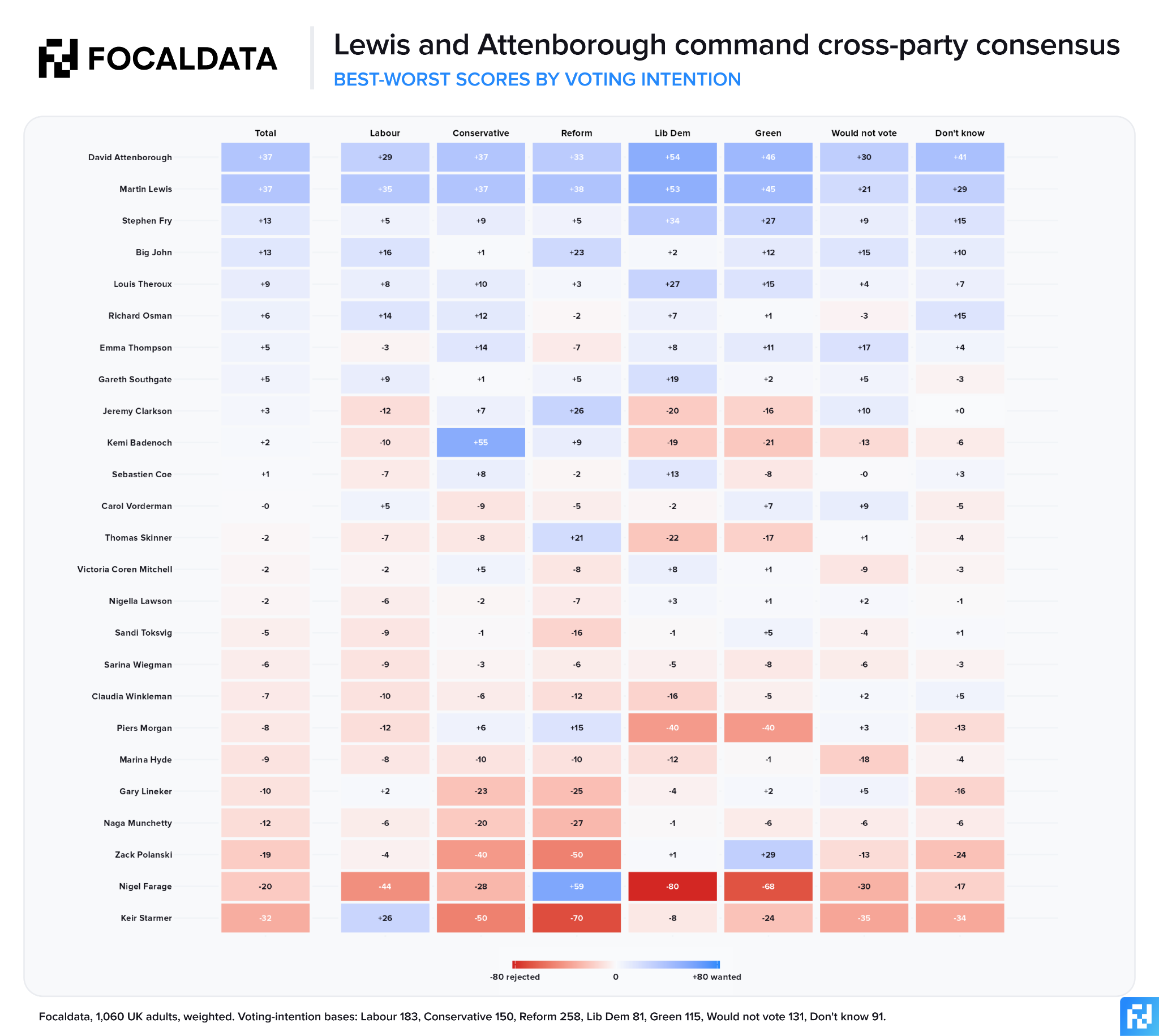
Most of the party leaders fare very badly here, with Starmer, Farage, and Polanski stacked on top of one another in the bottom three, a pointed reminder of how disillusioned most Britons are with their political leaders. Kemi Badenoch, however, does noticeably better and scrapes a net positive at +2. She is the only party leader chosen more often as most-wanted PM than least-wanted. Unsurprisingly, every party leader commands a healthy positive best-worst score among their own respective voter bases.
Martin Lewis and David Attenborough, who would immediately surpass William Gladstone’s record for oldest serving Prime Minister, are the breakout leaders. They sit head and shoulders above everyone else with best-worst scores of +37 apiece, practically putting them in their own “national treasure status” sub-quadrant. Both command cross-party consensus, recording positive scores across every voting intention group. Stephen Fry, Big John, and Louis Theroux also have positive best-worst scores across every major party.
Piers Morgan, Jeremy Clarkson, and Gary Lineker, somewhat unsurprisingly, varied a lot from party to party. While Piers Morgan and Jeremy Clarkson are viewed positively by Conservative voters, Reform voters, and those intending not to vote, they are viewed negatively by parties on the left. Gary Lineker is almost the exact opposite, doing better among Green, and Labour voters although he is still viewed as a good candidate for PM by those saying they won’t vote.
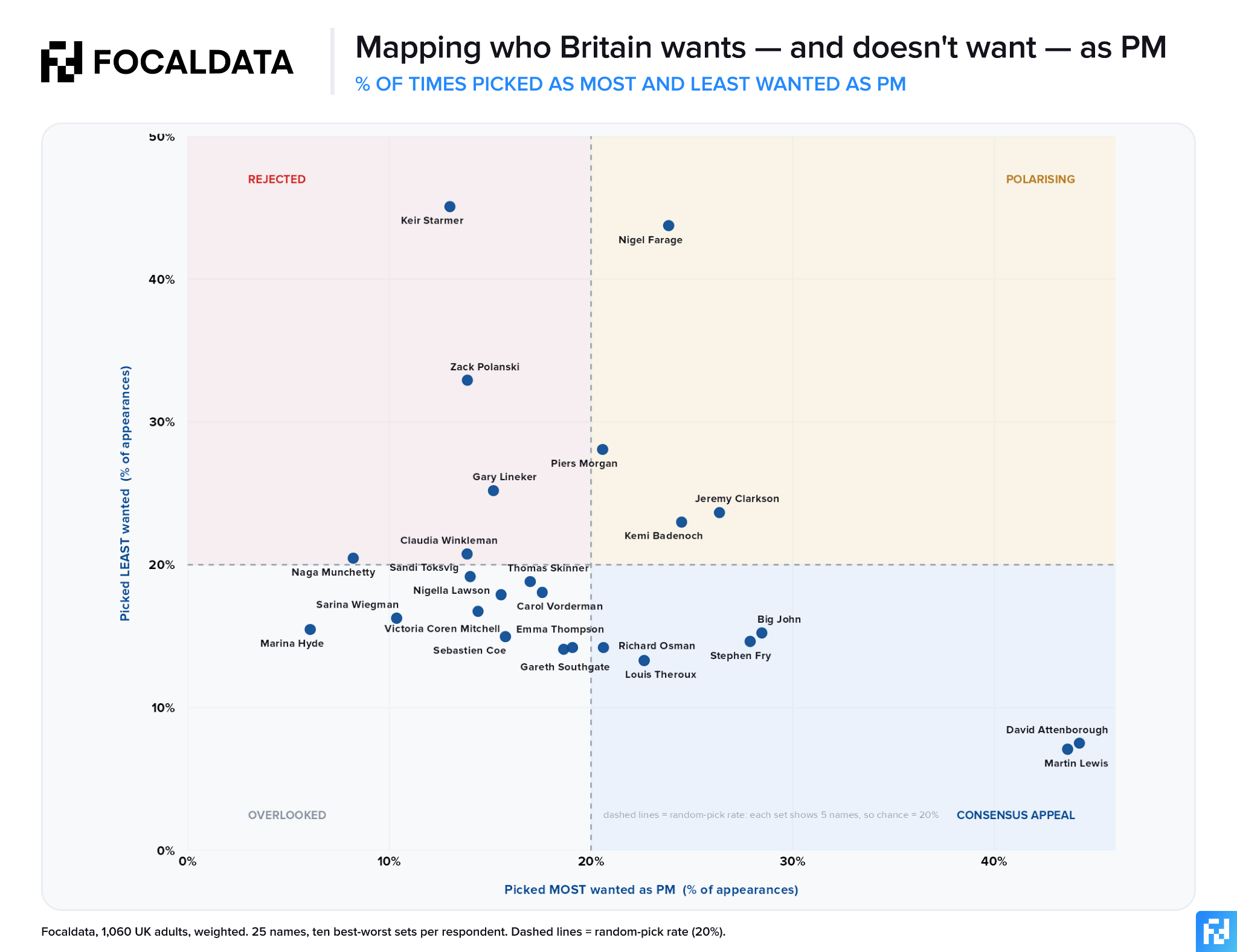
When the 25 candidates are plotted by how often respondents chose them as most-wanted PM against how often they chose them as least-wanted PM, the field splits into four camps. Those who are widely viewed as bad choices for PM (Keir Starmer, Zack Polanski, Gary Lineker), those who are polarising (Jeremy Clarkson, Nigel Farage, Piers Morgan), those who are simply overlooked as the public doesn’t pick them as most or least wanted (Sarina Wiegman, Nigella Lawson, Sandi Toksvig) and those have widespread appeal (Martin Lewis, David Attenborough, Stephen Fry, and Big John).
Most of our 25 candidates cluster in the bottom left “overlooked” quadrant, they are neither strongly wanted nor strongly rejected as PM. Much of the public is either indifferent about them or simply doesn’t know them well enough to have a strong view. David Attenborough and Martin Lewis are in a league of their own, being picked as most-wanted PM in over 44% of their appearances. Starmer and Farage are picked as least-wanted PM in over 43% of appearances, but Farage is picked as most-wanted PM in 24% of appearances compared to Starmer’s 13% which lands him in the "polarising" quadrant as opposed to the “rejected” one.
Clarkson v Lewis v Vorderman v Lineker
Who would win in a hypothetical runoff election between former Top Gear host Jeremy Clarkson, former Match of the Day presenter Gary Lineker, former Countdown presenter Carol Vorderman, and Martin Lewis of Money Saving Expert?
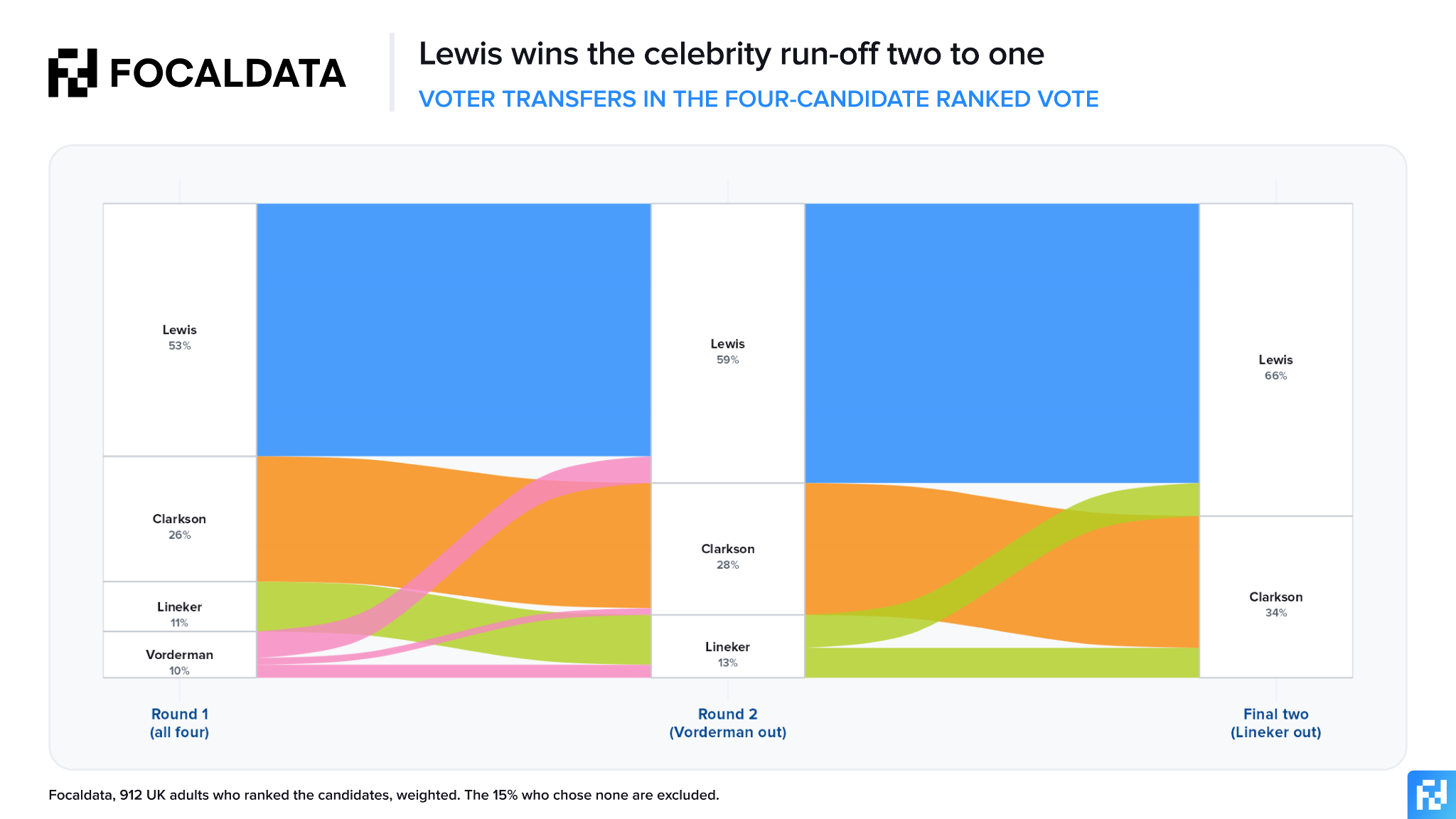
As it turns out, Lewis wins comfortably with a two-thirds to one-third victory over Clarkson in the final round, reminiscent of Macron's margin of victory over Marine Le Pen in the 2017 French presidential election. Yet in a real run-off he wouldn't even need the final round: his 53% in the first round is a majority (over 50%), enough to elect him outright.
The first round sees Vorderman eliminated on 10%, with her votes going overwhelmingly to Lewis who takes nearly 6 in 10 of them (58%). The second round sees Lineker eliminated with 58% of his voters going to Lewis and 42% going to Clarkson.
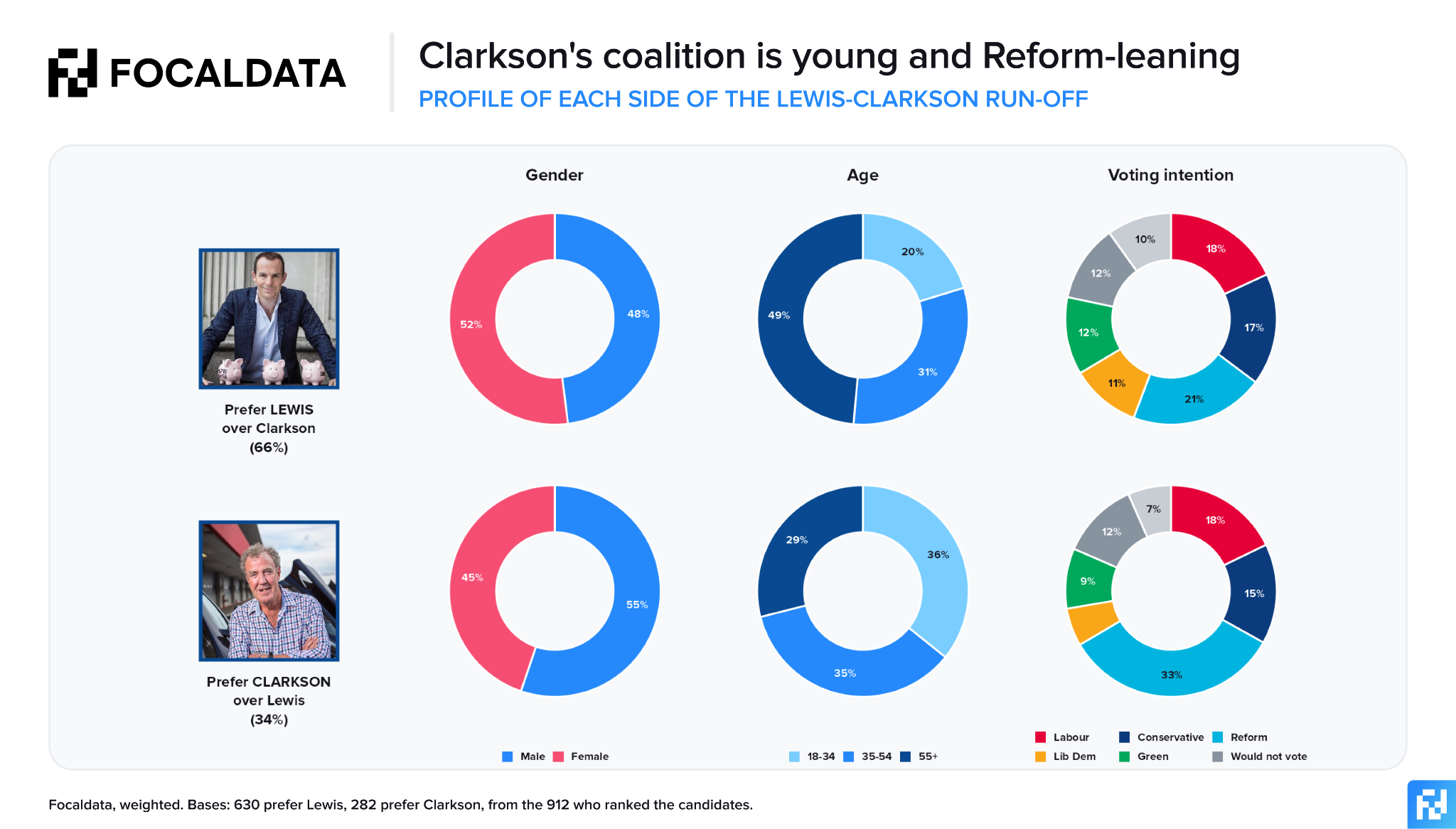
When you dig deeper into Clarkson and Lewis’ respective voter coalitions, you see that Clarkson’s support skews more male, younger, and more concentrated among those who intend to vote for Reform whilst Lewis’ is older and clearly cross-party. This said, Lewis still wins out among Reform voters overall (Clarkson gets 46% to Lewis’ 54%) and the only group that Clarkson actually carries is the 18-24 age group which he wins by 62% to Lewis’ 38%.
The Bosh-off: Tom Skinner vs Big John
We also put another hypothetical two-person face-off to respondents. We asked whether Big John or Thomas Skinner was a better representation of ordinary Britain.
Big John is an internet celebrity from Romford, famous for his love of Chinese takeaways and for coining the "BOSH" catchphrase, which has earned him the internet nickname "Big John the Boshfather”. Thomas Skinner, also from Romford, is a former candidate on The Apprentice who has since built a large social media following. He is mostly known for his “Essex boy” persona and his own frequent use of the "bosh" catchphrase.
To help respondents, many of whom likely would have not been familiar with either man, we also gave some background information on both men in the question which was worded as follows: “Big John (John Fisher) is a food influencer from Romford, famous for Chinese takeaway reviews and the catchphrase "BOSH!" Both Keir Starmer and Nigel Farage approached him for meetings, and he turned both down. Tom Skinner is also from Romford, has a similar following, and has expressed support for Donald Trump and Reform UK. Both have been described as rival symbols of British working-class identity. Who do you think better represents ordinary Britain?”
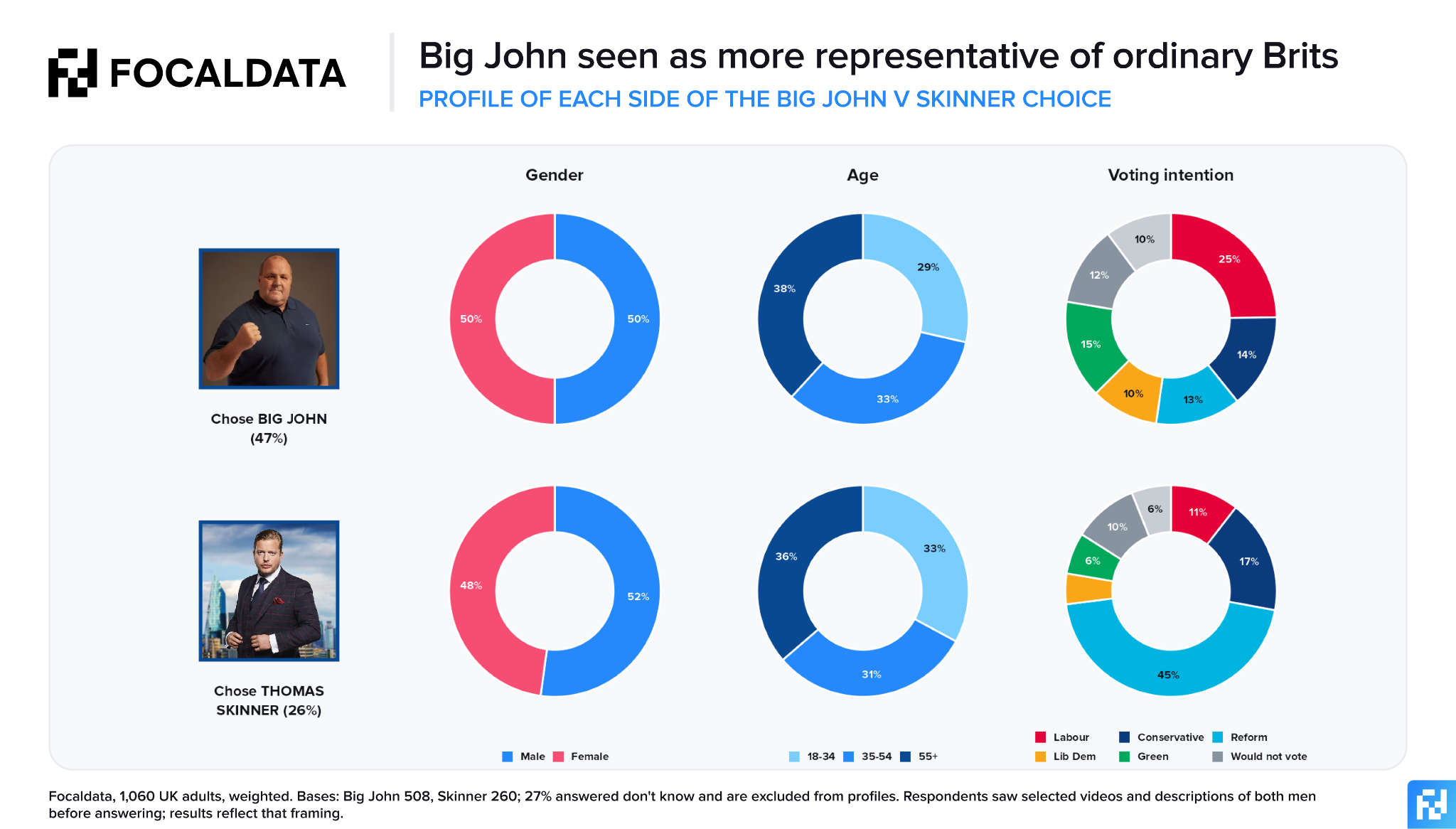
While 27% selected "don't know", among those who did make a choice the result closely mirrors the Lewis-Clarkson split: Big John on 64%, Tom Skinner on 36%. Tom Skinner’s voter base also skews younger, more male, and is more concentrated among those who intend to vote for Reform. Given that much of the public were likely unfamiliar with both Big John and Tom Skinner these results should, however, be read with caution given the question’s framing explicitly linked Skinner to Trump and Reform while stating that Big John had rebuffed approaches from both Starmer and Farage.
Celebrities, Politicians, or Neither of the above?
We asked respondents who they thought best represented them and understood ordinary life — celebrities, politicians, or neither of the two.
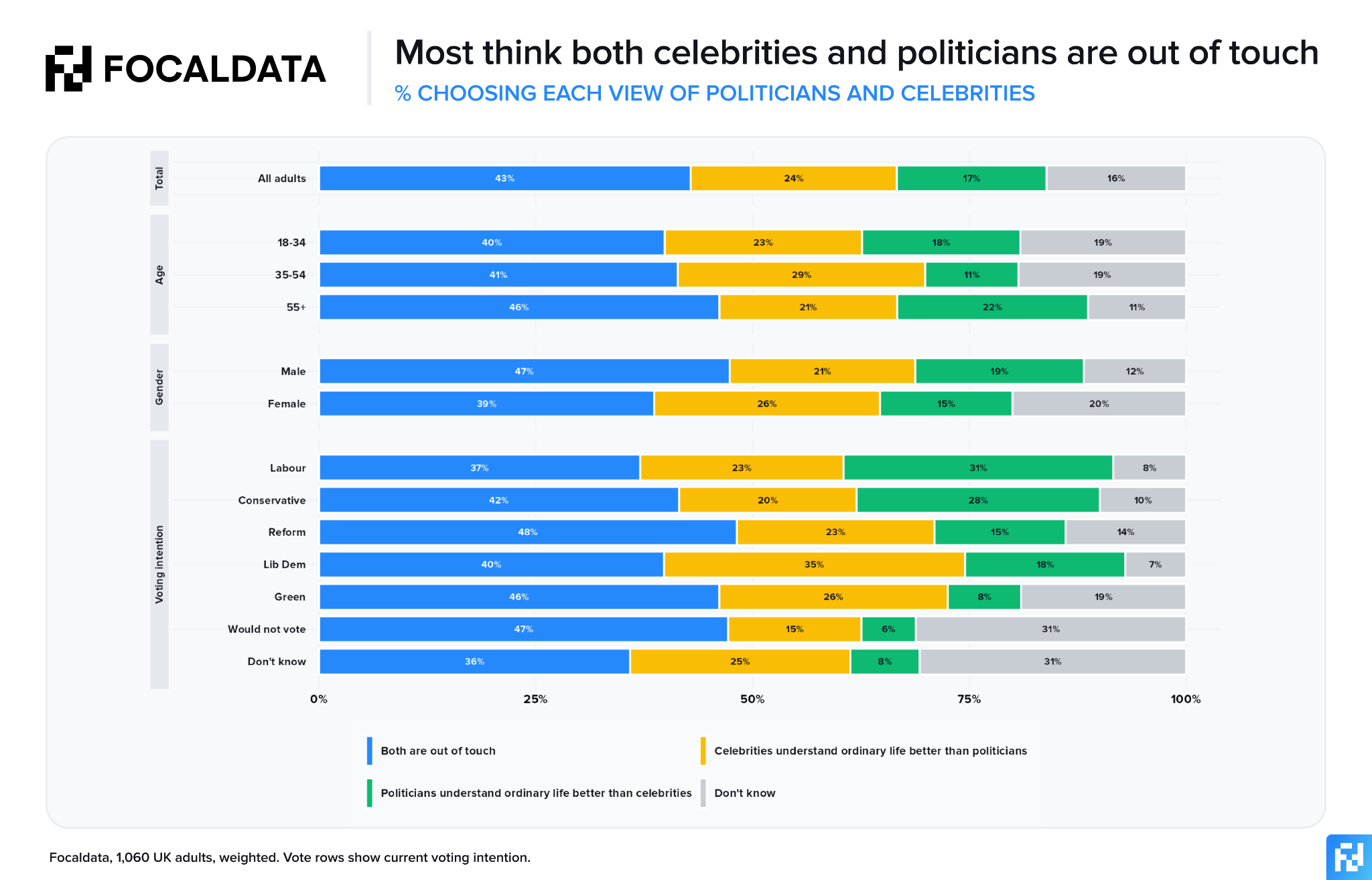
Whilst a plurality of respondents (43%) said both celebrities and politicians are out of touch, a view that prevailed across all ages and voting intentions, there was some notable variation. Lib Dem voters and women were more likely to say celebrities understood ordinary life better than politicians, while older people and those intending to vote Labour or Conservative leaned the other way. Those intending to vote Green or Reform, along with those who said they would not vote, were the most likely to say both were out of touch.
You can listen to the episode of the Vibe Check on this topic (Can 'Big John' Become The First BOSH PM?) with a subscription to the Rest is Entertainment podcast. The Vibe Check series is co-hosted by our Chief Research Officer James Kanagasooriam who has written on this subject before, you can read his article from 2024 for The Times here.
Data tables for this survey can be downloaded here.