Blog/Polling
What Courage Means to Britain Today
When trust in political leadership is low and public life feels divided, courage can seem like a quality in short supply, but new Focaldata research suggests Britons and Americans still believe it matters. What differs between the two countries is how they recognise it, and how politics shapes who gets called courageous.
Commissioned by With Honor ahead of the UK launch of Courage Can Save US, the survey of 2,176 adults in Great Britain explores how people define courageous leadership, whom they recognise as courageous, and how their views compare with those in the US.
A shared belief, shaped by different landscapes
Courage matters in both Britain and the US. Nine in ten Britons (91%) say everyday courage is important for the country’s future, as do 96% of Americans. The difference is in the landscape people see around them, and in whom they recognise as courageous within it.
Previous research for With Honor found that 69% of Americans say their leaders show less courage over time, compared with just 12% who say they show more. In Britain, 48% say leaders show less courage and 20% say more. The direction is the same; the US simply feels it more sharply. Yet Americans are more likely to find reasons for hope. Asked what makes them feel optimistic about their country’s future, their most common answer is people willing to stand up for what they believe is right (26%). In Britain, “nothing” is the most common response (18%).
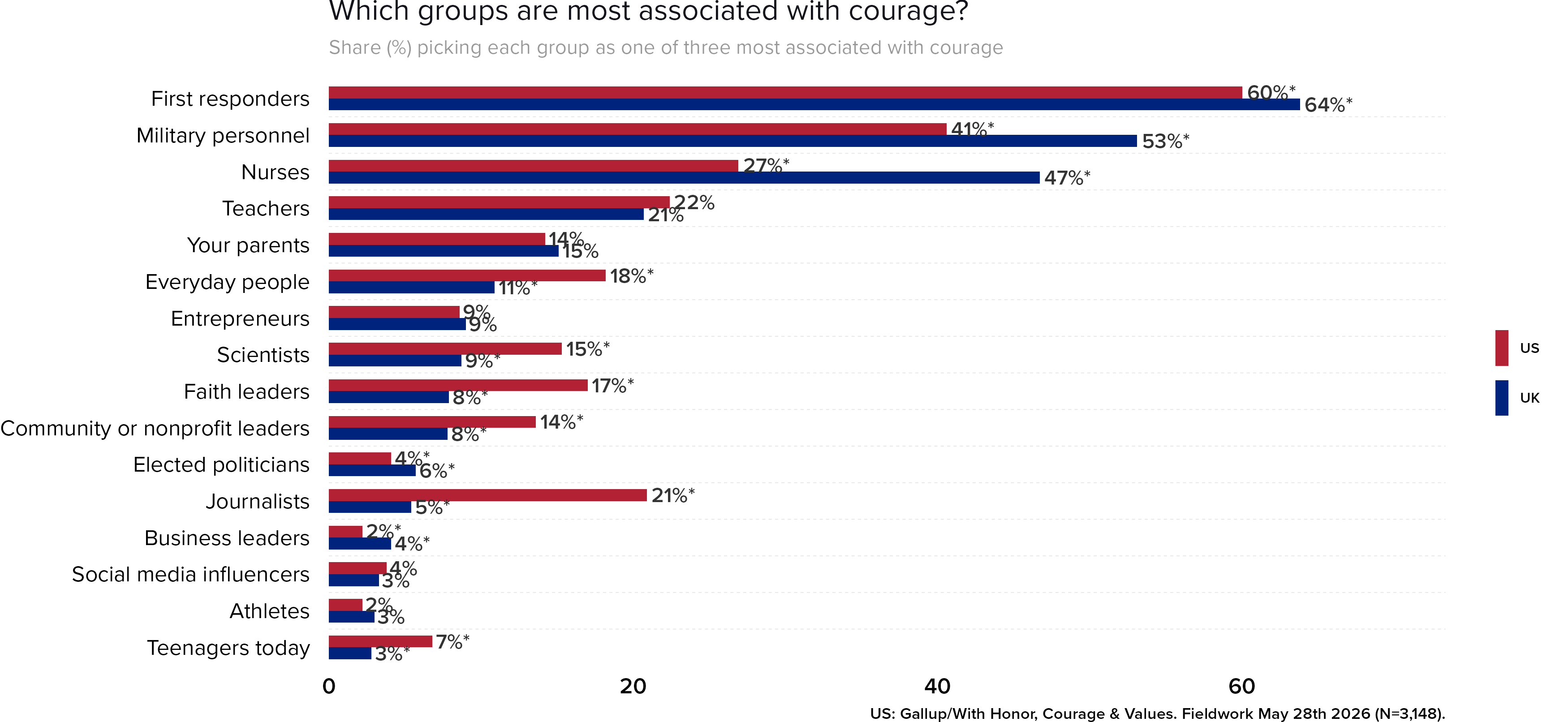
People in both countries most often associate courage with the same groups, but the strength of that association varies by group. For example, nurses are third in both countries, but 47% of Britons associate them with courage, compared with 27% of Americans. Journalists show the sharpest contrast: 21% of Americans name them, compared with just 5% of Britons. This reflects a broader difference in emphasis: American ideas of courage lean more towards individual heroism, while British responses favour sacrifice and care for others.
The countries’ different landscapes and views of courageous groups are also reflected in how political the idea of courage becomes. Americans are more divided over whom they see as courageous. Two-thirds of Republicans (67%) name military personnel, compared with a quarter of Democrats (24%). In Britain, the gap between Conservative and Labour voters is around a third of that size (63% vs 48%). Groups such as scientists, which divide Americans sharply (26% of Democrats vs 2% of Republicans), barely register a party difference in Britain.
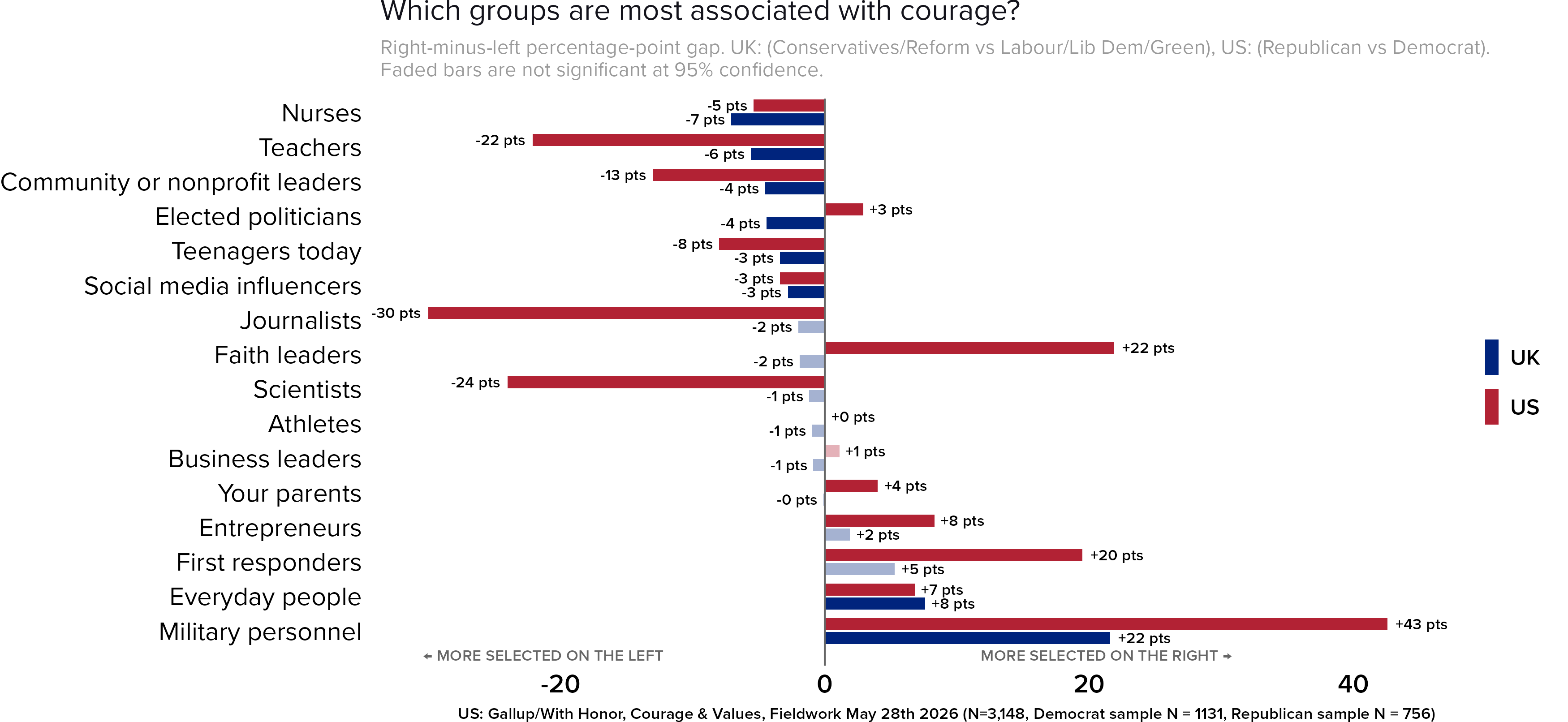
Yet despite Americans’ divisions, they still value bipartisanship: seven in ten (70%) say it is very important that leaders work across party lines, even when doing so could harm their political career. In Britain, courage is something shared rather than partisan. Majorities of every party’s supporters name first responders as courageous, from 56% of Green voters to 72% of Liberal Democrats, and most other groups tested show a similarly consistent pattern across parties. Britons may disagree about politics, but they largely agree on what courage looks like.
A British idea of courage
The most consistent answer in the research came when respondents chose between four definitions of courageous leadership. A third (33%) chose a leader who feels responsible for serving others and is willing to endure hardship to fulfil that duty. It was the top choice in every age group and among supporters of almost every party. The other definitions attracted less support and split opinion more, especially by age. Taking risks and making difficult decisions (18% overall) appealed to 25% of under-35s but just 10% of over-65s. Working across disagreement despite personal risk (22%) rose with age, from 19% of 18-24s to 27% of over-65s.
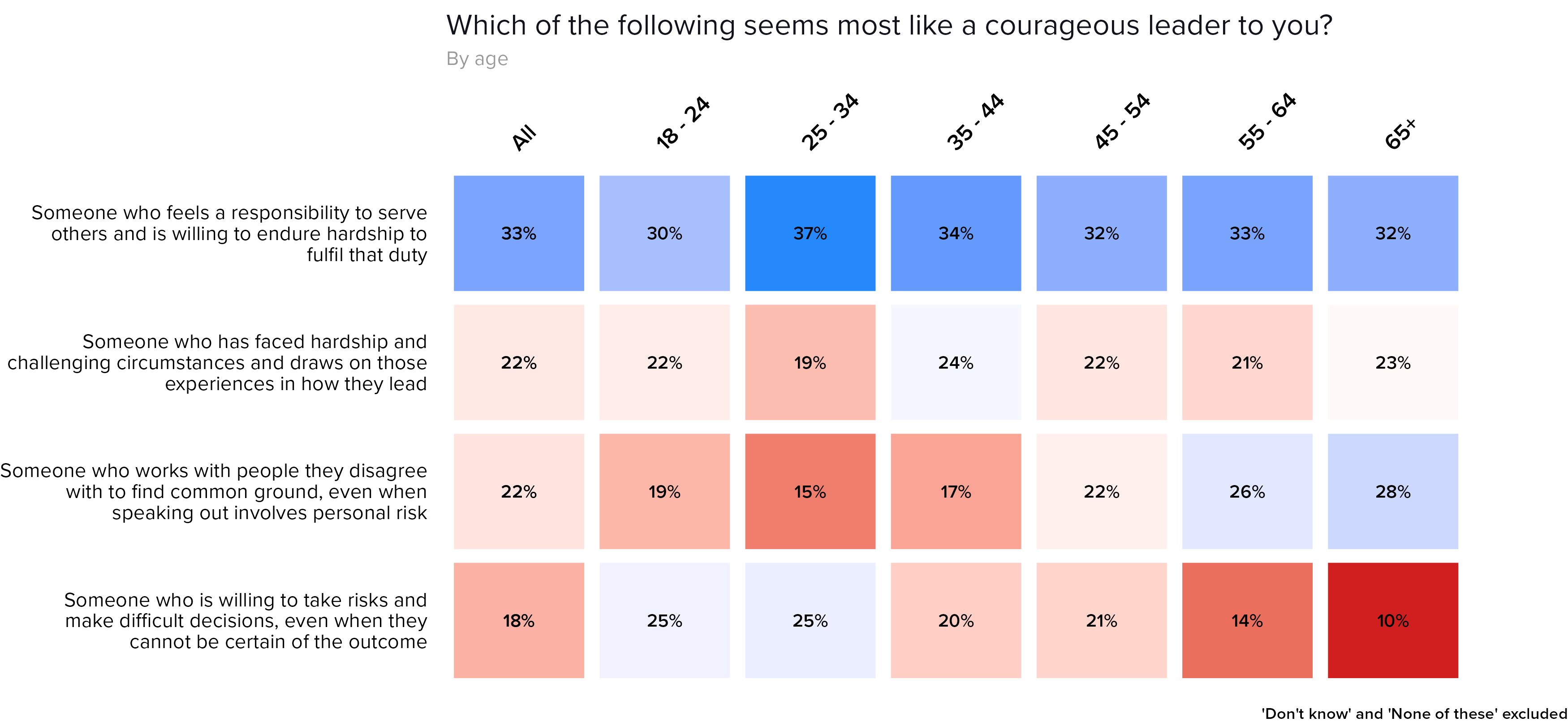
The preference for a responsibility-to-serve definition suggests that, in Britain, courage is less about individual heroism than a steady sense of responsibility. The people most associated with courage reflect this: first responders (64%), military personnel (53%) and nurses (47%) are among the groups most often selected. Their work is understood through service to others, often in difficult circumstances.
The qualities Britons most want from leaders tell a similar story. Respect (34%) and honesty (30%) rank highest among important values. Humble actions, such as praising a rival for doing something well or giving credit to their team rather than taking it for themselves, also come near the top of the leadership traits tested.
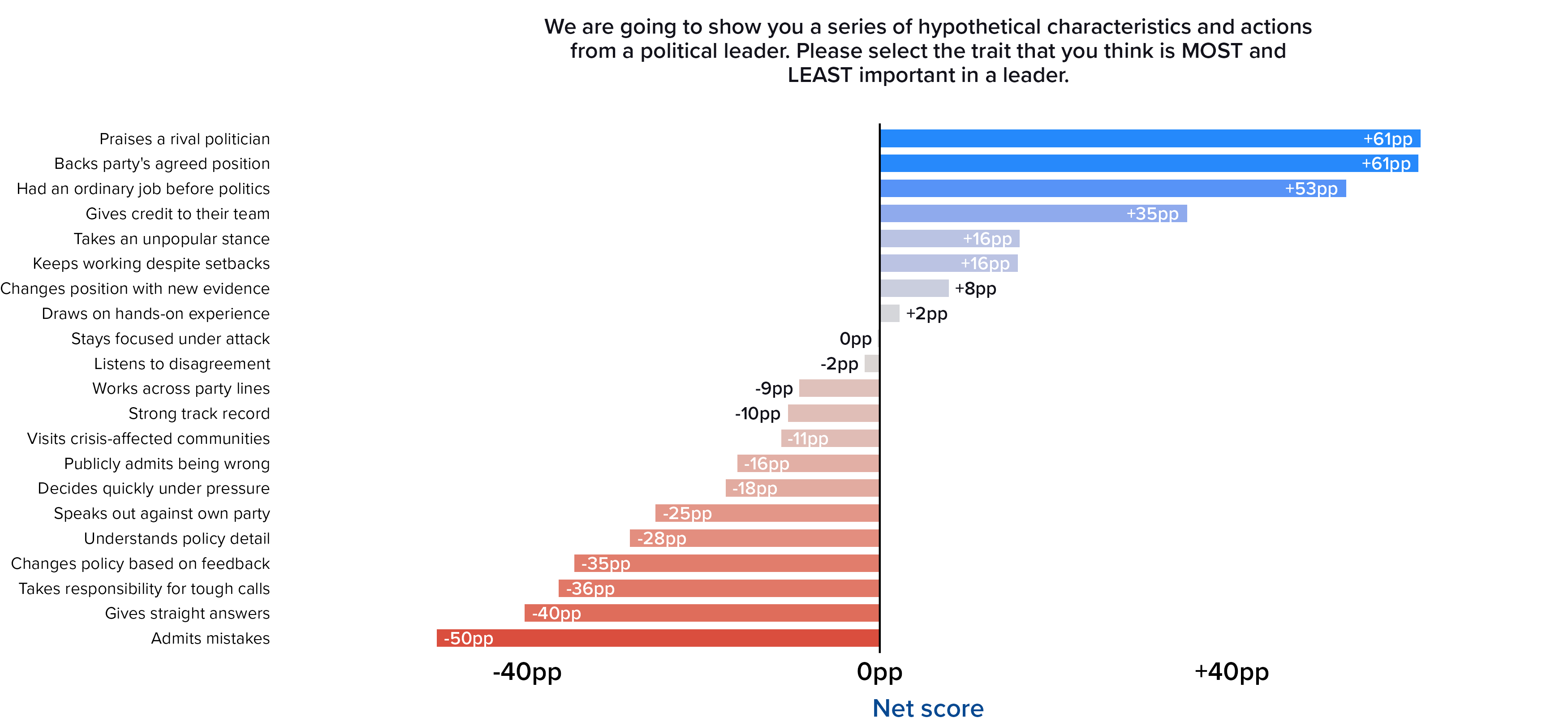
There is a tension, though. While honesty ranks highly as a value, behaviours such as admitting mistakes or giving straight answers rank low when set against other leadership traits. Additionally, 64% believe a politician who takes an unpopular stand within their own party risks losing support, influence or votes. In this climate, courage may mean accepting a personal cost to do what one believes serves the wider good. For Britons, that is what courage ultimately comes down to: a steady sense of responsibility to others, rather than a quality to claim for yourself.
These findings bring a British perspective on themes explored in Courage Can Save US by Rye Barcott, With Honor co-founder and CEO. The book profiles nine veterans and a former FBI agent, five Democrats and five Republicans, who acted for the common good despite personal risk.
This poll was conducted between 10 and 14 September 2026, with a sample size of 2,176 GB adults. Results were weighted by age, gender, region, education, ethnic group, and past vote. The American statistics can be found in three press releases of With Honor/Gallup. Two of them (article 1 and article 2) can be found on Gallup’s website and the third one (article 3) on With Honor’s one.