Blog/Polling
Cost of living fuelling Democrat strength in new midterms polling
Donald Trump’s 2024 presidential election victory was in no small part down to his perceived economic competence and voters’ dissatisfaction with Joe Biden’s handling of inflation. Trump won a commanding 81% of the vote among the one-third of voters who said the economy was the most important issue facing the country.
Across the world, the cost of living continues to punish incumbent governments. Electorates of the 2020s have high expectations, and governments elected on promises of change that fail to deliver rapid economic improvement face swift electoral retribution. Our polling indicates the Democrats are on course to take back the House of Representatives in November’s midterms, with economic concerns about to punish the incumbent once again.
We have conducted two midterms polls so far this year, one in late January and one earlier this week. The most recent survey gives the Democrats a 5-point lead in the generic House ballot among registered voters, rising to 7 points when our likely-voter turnout model is applied. Our turnout model is trained on validated voter panels and converts self-reported likelihood to vote to actual behaviour (those who say they will ‘probably’ vote only actually turn out about a third of the time!)
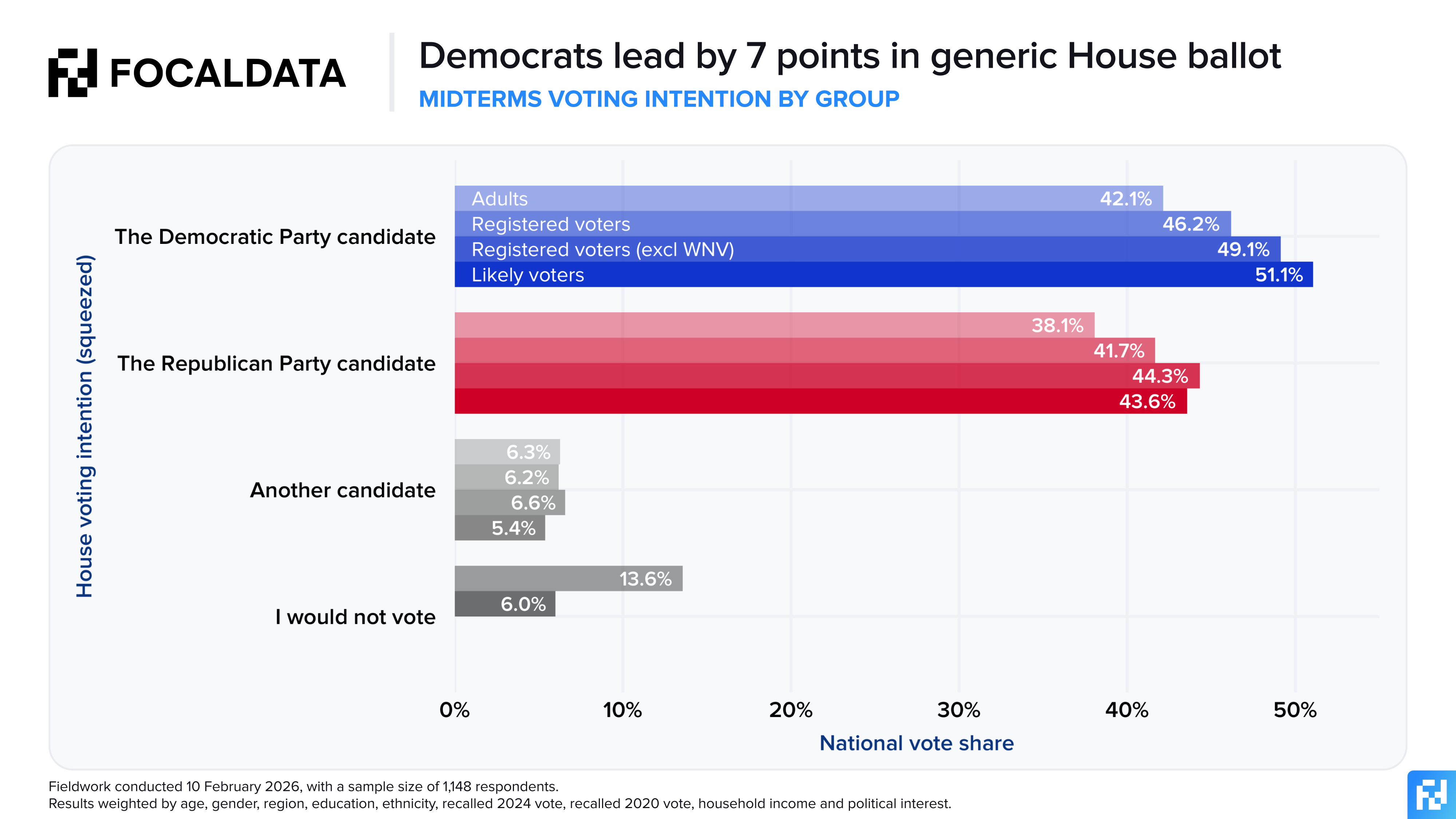
In the two-party choice – when voters are forced to choose between the two major parties – the Democrats lead by 53% to 47% with likely voters. The Democrats currently have the enthusiasm advantage, driven mainly by turnout differentials among softer supporters.
Inflation drives voter sentiment
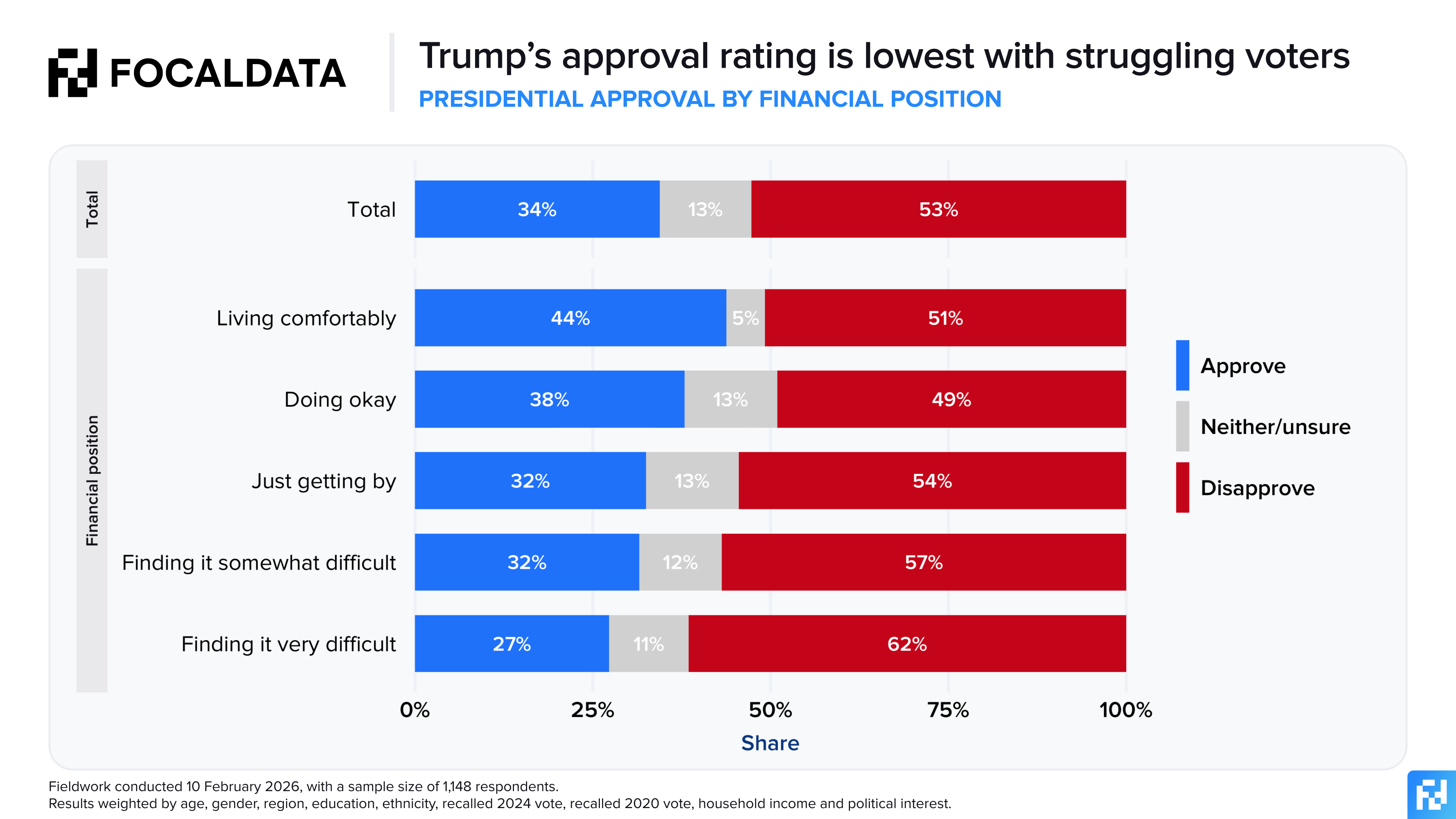
Donald Trump’s overall net approval sits at -18 percentage points (34% approve, 53% disapprove). Our January poll also tracked approval by issue, and found that the president’s net score was almost 10 points lower for both inflation/prices and the economy in general than it was overall.
Breaking the numbers down by voters’ self-described financial positions, we find Trump’s approval rating is sharply correlated with their financial situation. The president is closest to net-zero approval with those ‘living comfortably’ (-7 points), falling to -22 with those ‘just getting by’ and -35 with respondents who say they are ‘finding it very difficult’.
This is not simply a thermostatic shift in Democratic voters self-reporting financial struggle when a Republican president is in office – the pattern holds with Trump’s own voters.
Just 5% of those who voted for Trump in 2024 and are financially comfortable disapprove of his performance, but this rises to around one in five among his voters finding things difficult.
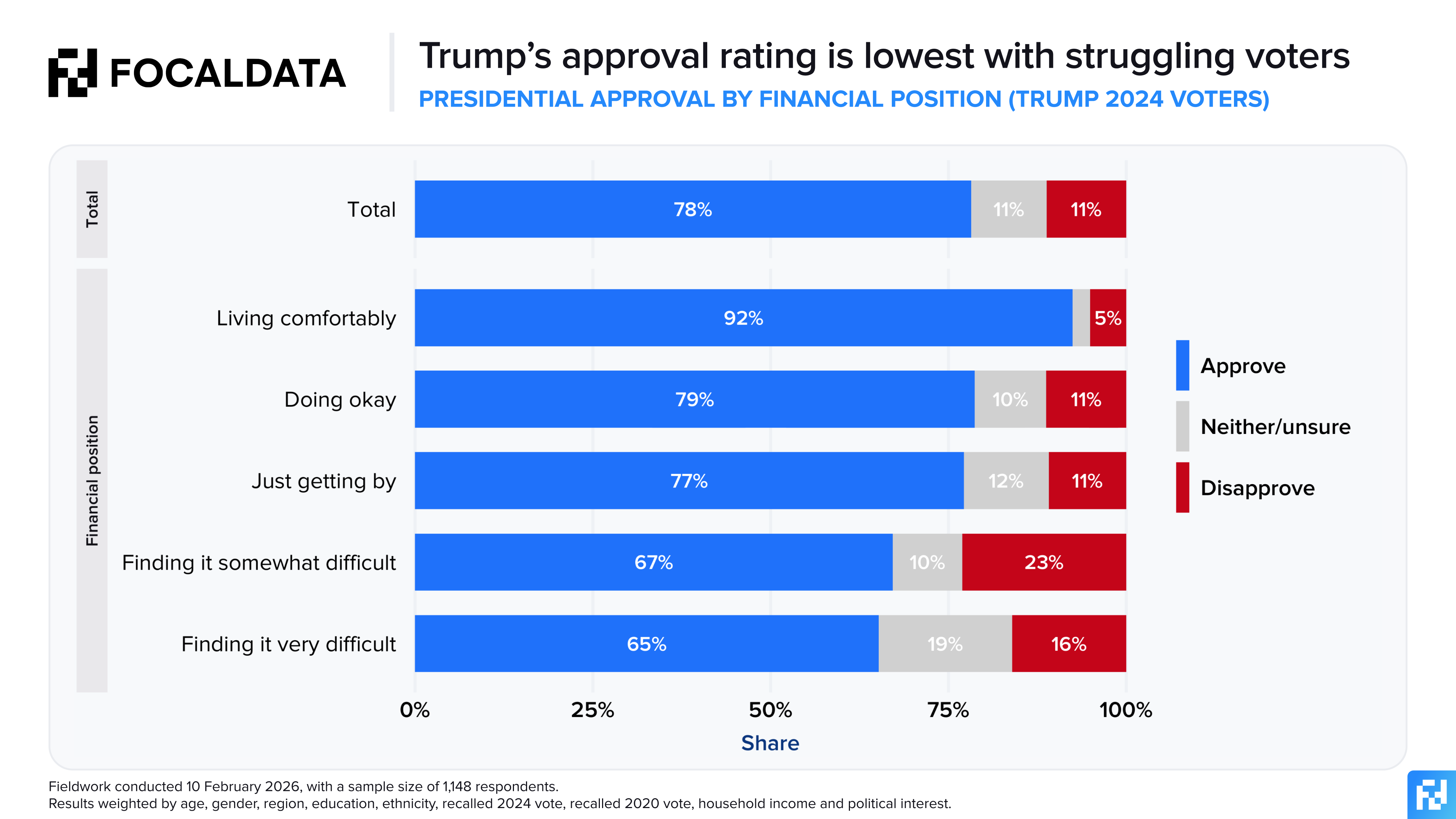
These same voters who punished the Democrats’ handling of the economy to give Trump a second term are now turning their backs on the president.
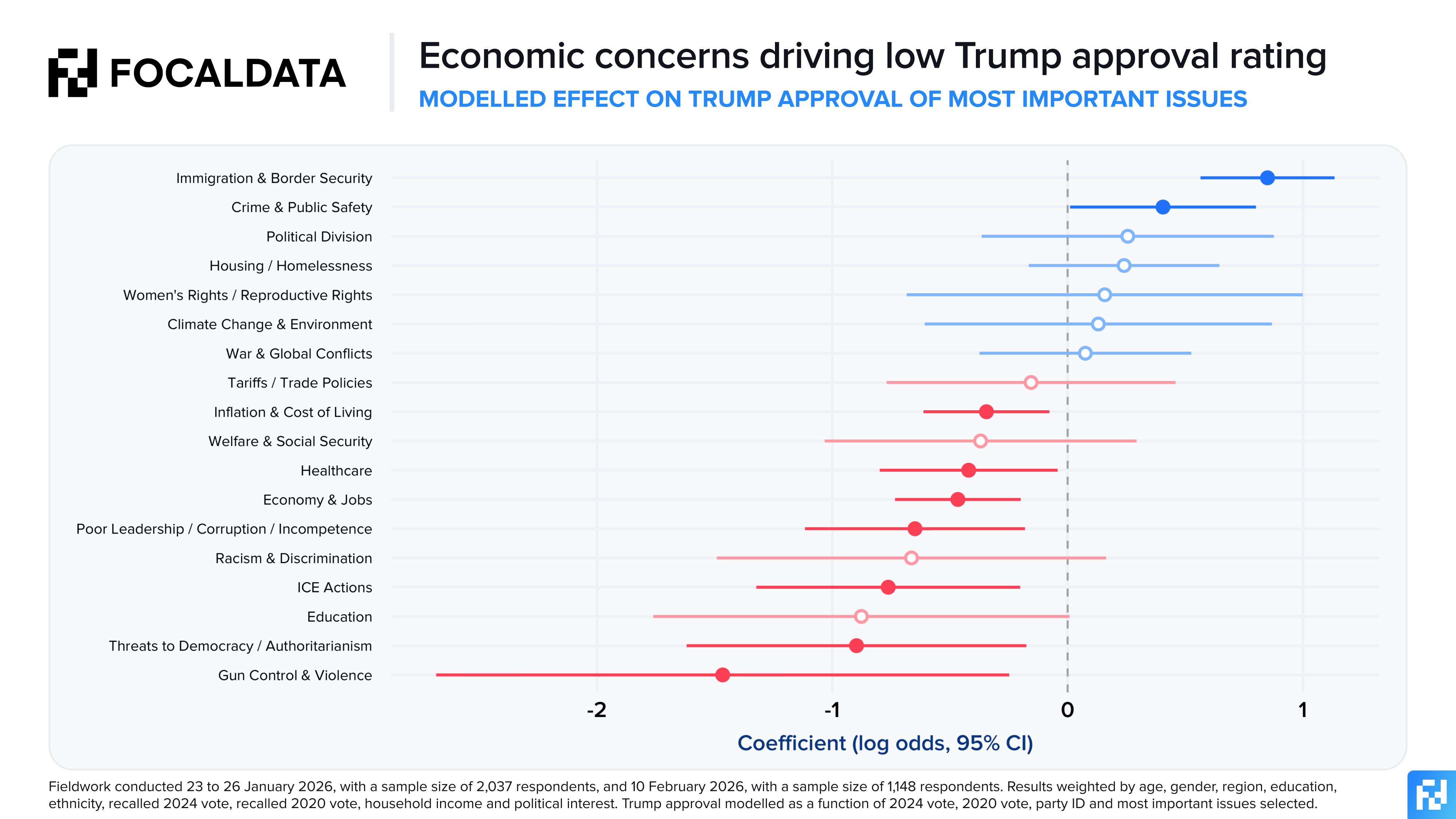
Statistical modelling shows that concern about the cost of living is by far the biggest factor propelling the Democrats towards a midterm victory in November.
We gave voters an open text question to describe the most important issues facing the country, and used text categorisation tools to group their views. Even after controlling for party identification, 2024 presidential vote and 2020 presidential vote, we find that both ‘economy and jobs’ and ‘inflation and cost of living’ are statistically-significant factors depressing the president’s approval rating, with respondents who mention these issues more likely than average to grade his performance poorly.
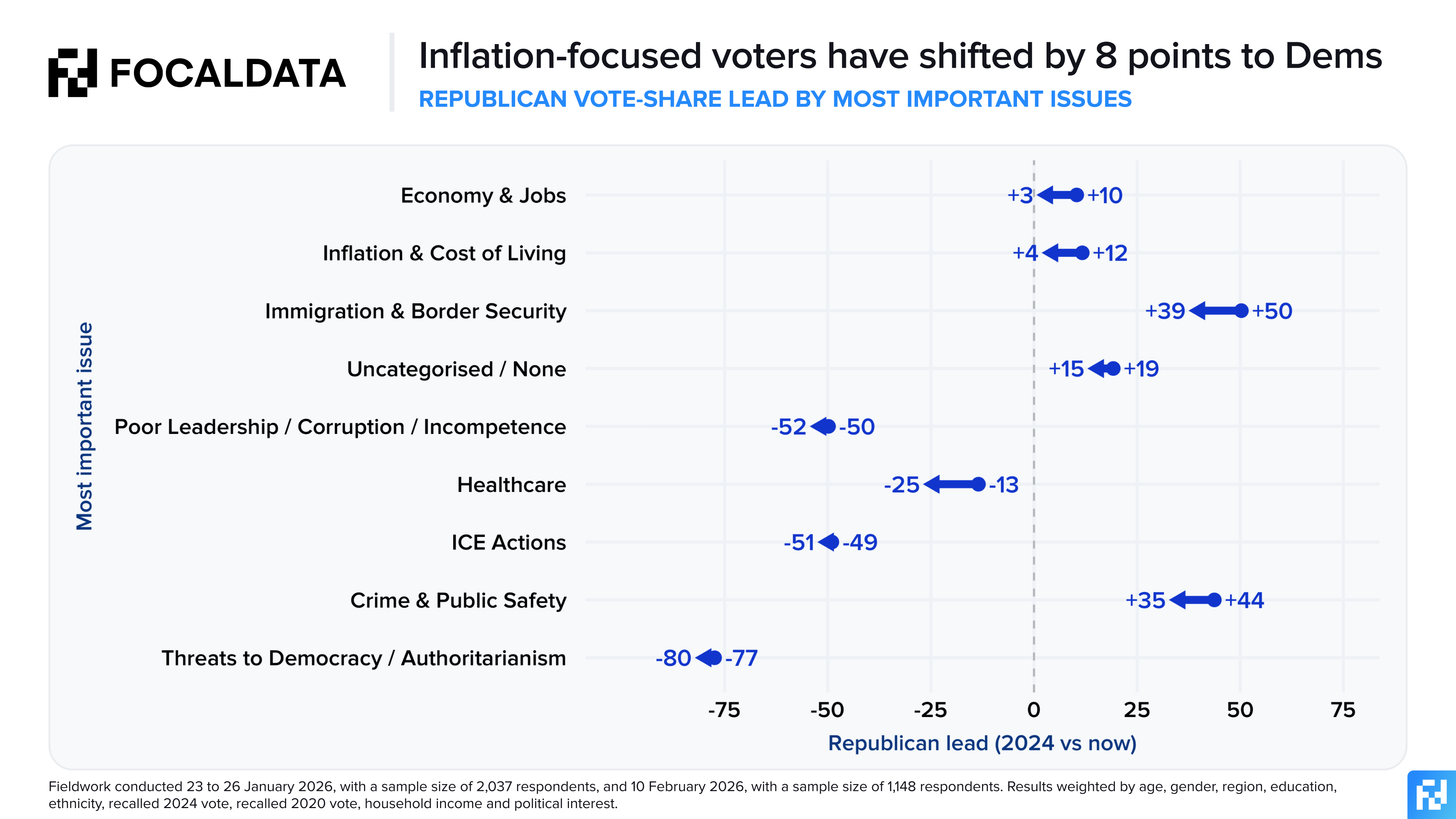
The voters in our survey who currently say inflation is one of the country’s biggest issues voted for Trump over Kamala Harris by a 12-point margin in 2024. As of today, the Republicans hold just a 4-point lead in the House generic ballot with these voters – an above-average 8-point shift in under 18 months.
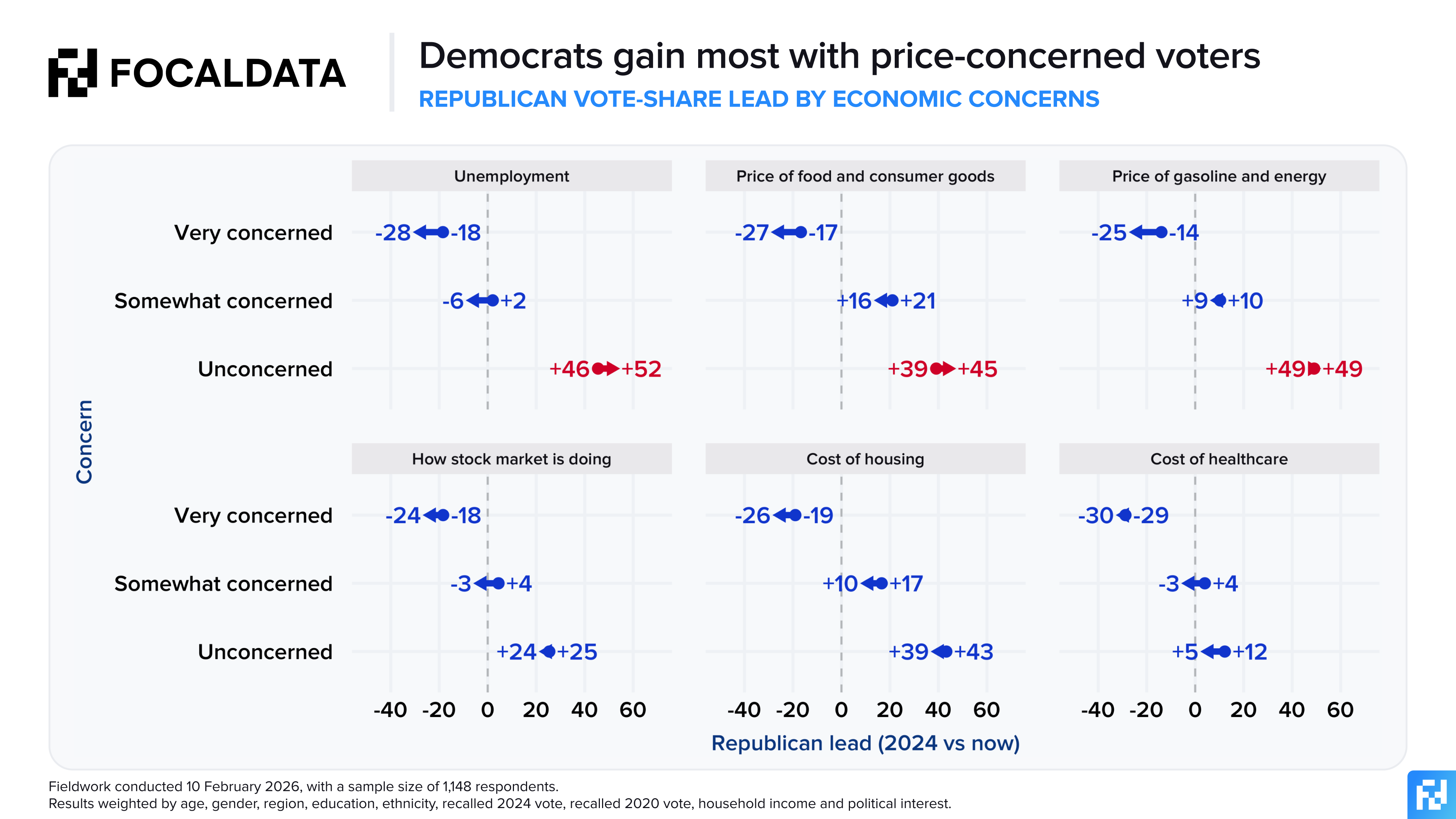
Looking at specific economic concerns, the Democrats have gained most with voters who say they are ‘very concerned’ about unemployment (10-point shift), the price of food and consumer goods (10-point shift) and the price of gasoline and energy (11-point shift).
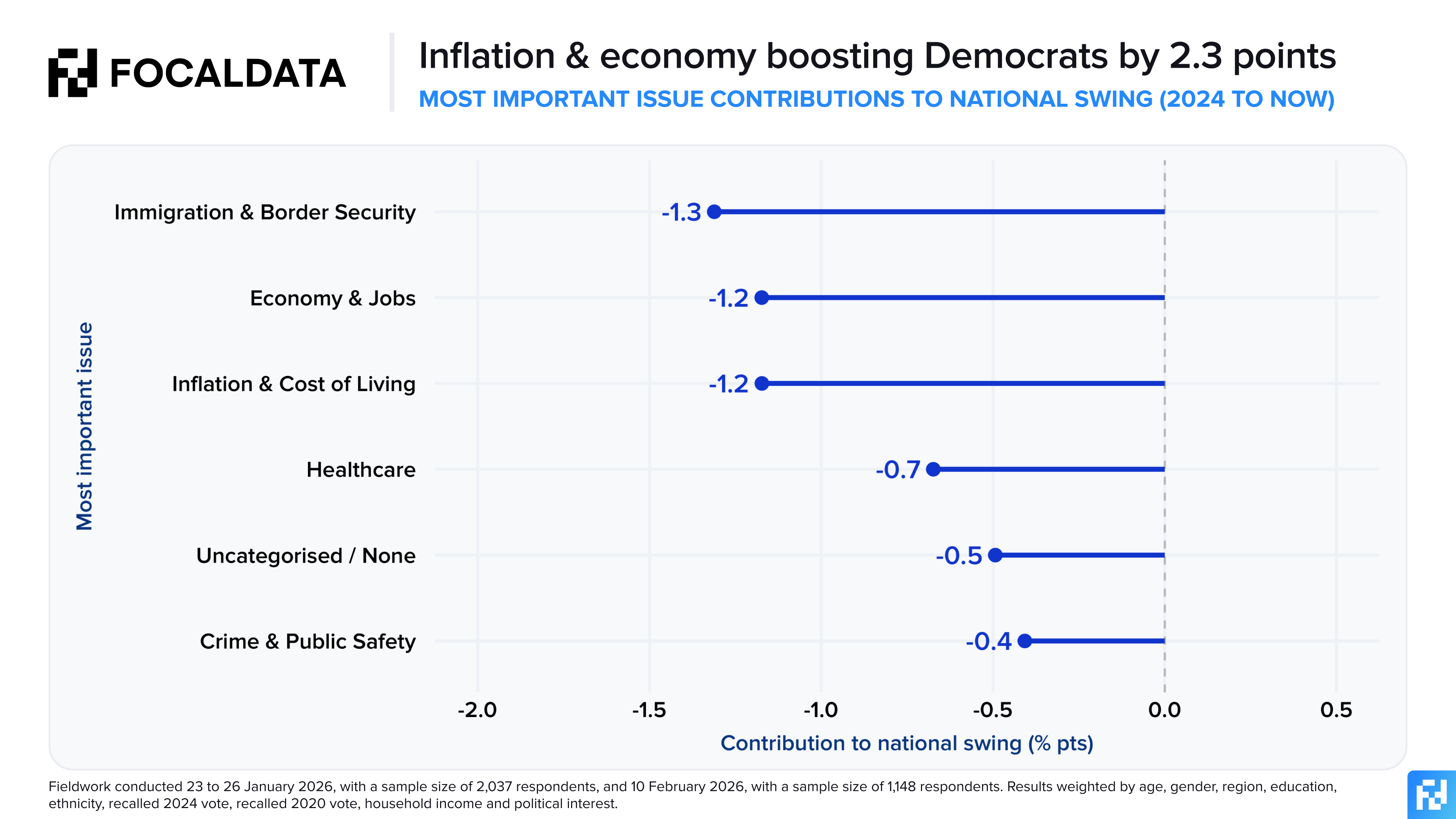
Our modelling also indicates that the economy and cost of living are directly responsible for a 2.3-point shift towards the Democrats since 2024. Put another way, if the Republicans had maintained Trump’s 2024 lead with economy-concerned voters, the Democratic lead in the House ballot would be two points lower. The combined impact of inflation and economic concerns is more than twice the size of any other issue, accounting for around 2.5 million votes in the Democratic direction.
2028 outlook
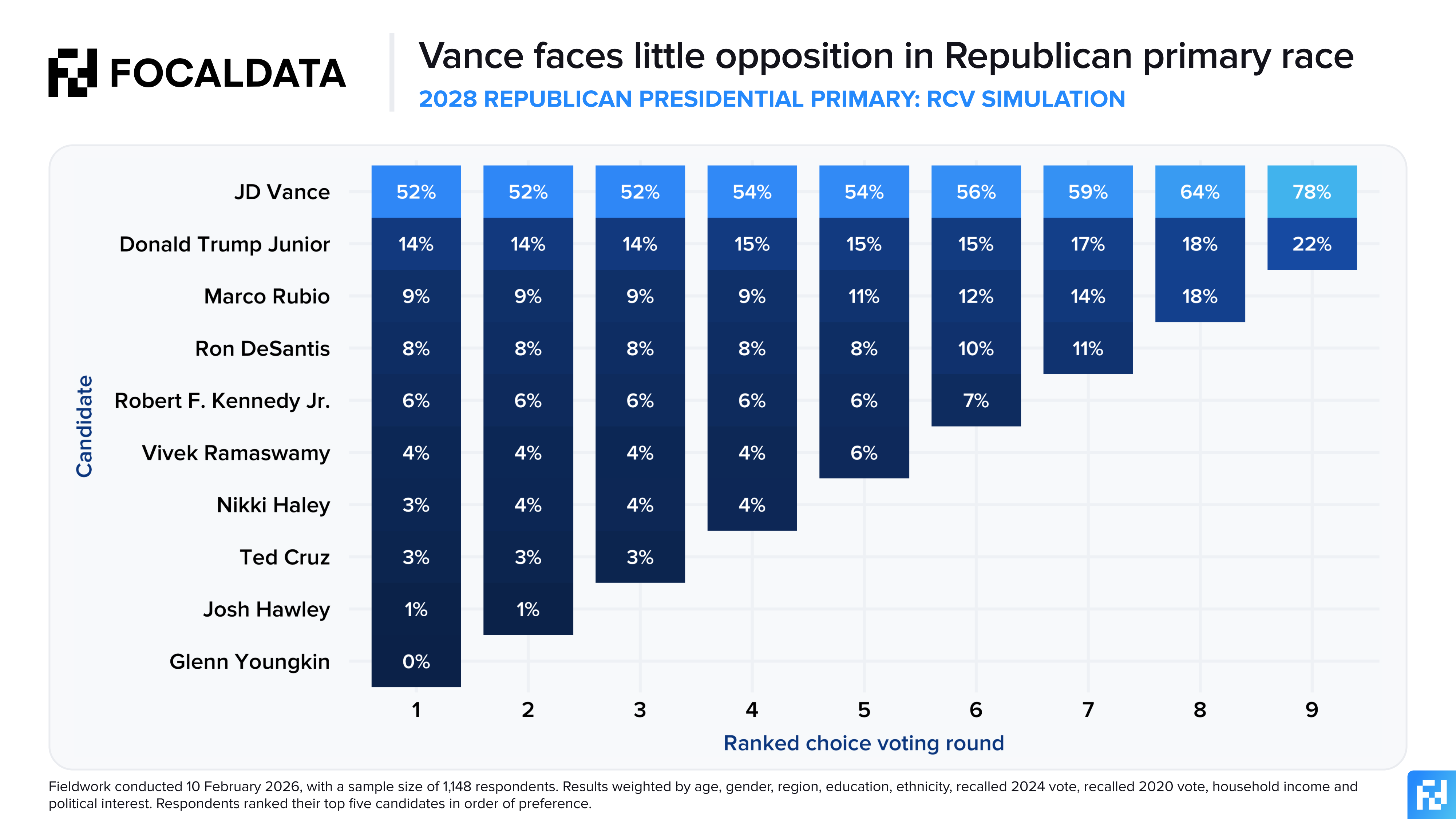
We have also taken a very early look ahead at the 2028 presidential primary race. Respondents decided which party’s primary they would vote in and then gave us their top five choices in each race, from which we have imputed a run-off estimate for both major parties. The party primaries are not conducted using an explicit preferential system, but we believe having an overview in this way is more sensible than a hypothetical ballot of 15 candidates, when we know most would no longer be in the race when most voters cast their ballots. A run-off scenario model can show the kinds of candidates who can win over supporters from other campaigns.
Despite her 2024 loss, Kamala Harris leads the early race with 39% from a 10-candidate prompt in the Democratic primary, before beating Gavin Newsom 56-44% in a head-to-head. Pete Buttigieg finishes third, and Alexandria Ocasio-Cortez places fourth.
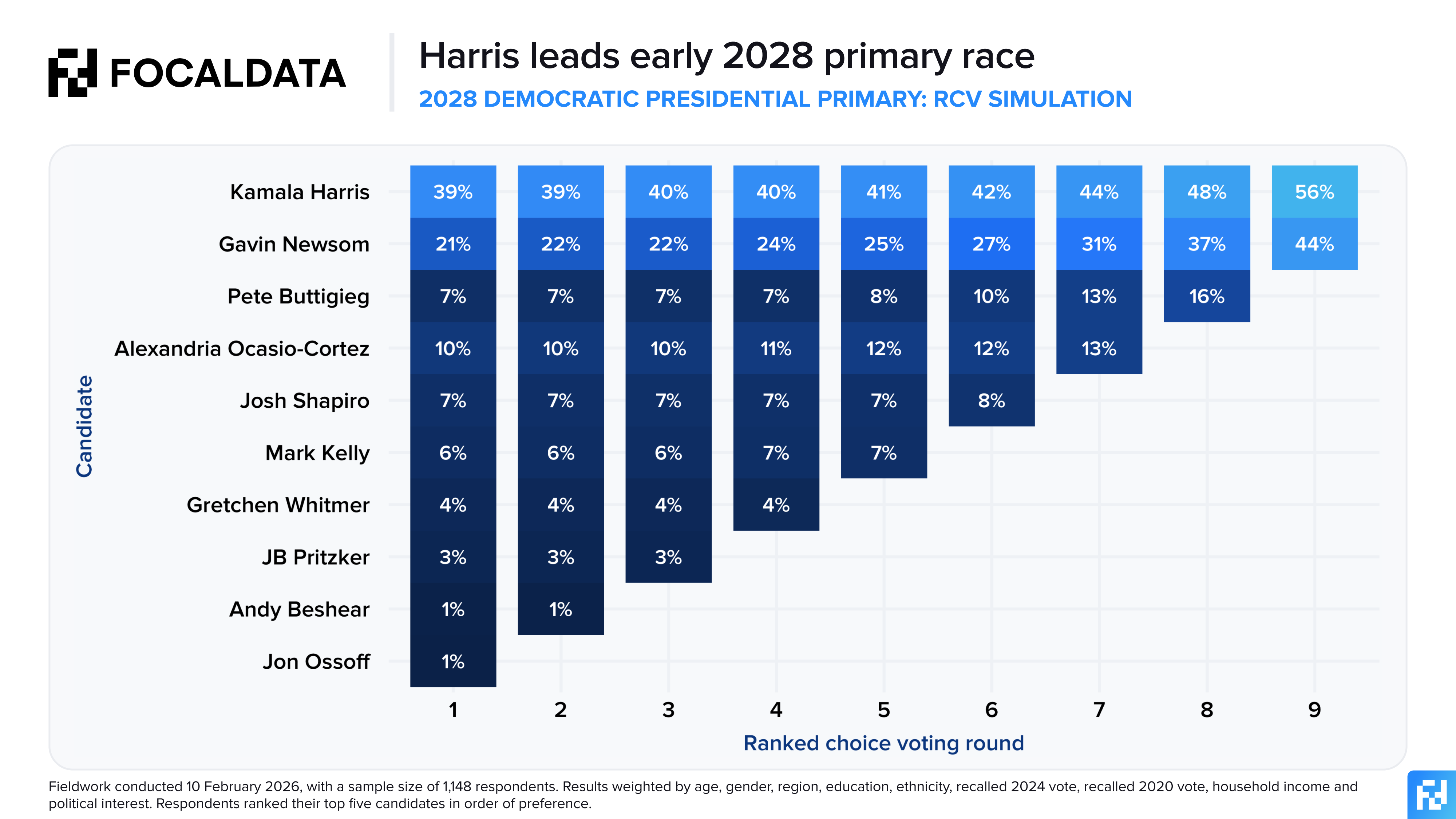
In a race without Harris, AOC would pip Buttigieg and Josh Shapiro to the post to reach the final two, before losing 65-35 to Newsom.

On the Republican side, JD Vance currently faces very little opposition, winning a majority of the vote in a six-person ballot, and beating every other candidate handily. Our poll finds that Vance would beat Donald Trump Jr 78-22% in a head-to-head.
Throughout 2026, we will be tracking voter sentiment towards the potential 2028 candidates and testing video content to assess which candidates have the greatest potential, beyond the name-recognition dynamics which tend to drive early presidential primary polling. We will also be tracking the House of Representatives and Senate races, including monthly MRP projections and new interactive dashboards.
Data tables for our January and February polls can be downloaded here.
--
Notes:
- We have introduced since the 2024 election a new panel of US respondents and made changes to our methodology, including weights for political interest and more sophisticated turnout modelling. We have also added a number of new team members for 2026, including Callum Hunter (formerly of JL Partners, who was one of the only pollsters to correctly predict a Trump victory in 2024) and US native Cora Fagan (formerly of the Leadership Now Project).
- We prompted Donald Trump Jr using the fully spelled-out format “Donald Trump Junior” to try and minimise the number of respondents who may mistake him for his father.