Blog/Polling
Data Centres Have a Black Box Problem
More than £100 billion is heading to the UK in data centre investment. It's driven by the international AI boom and a government that wants to make Britain a leader in the sector. Developers are scouting a huge number of sites from Slough to Scotland.
And yet nobody has seriously tried to answer a fairly basic question: what do British people actually think about all of this?
It's worth asking because we've seen what happens when you don't. In the US, data centres have become a genuinely live political issue, turning up in congressional primaries and local planning battles from Virginia to Oregon. Ireland effectively imposed a moratorium on new grid connections in the Dublin area. Without a careful public communication strategy there’s a risk that data centres become a political minefield.
We carried out a poll of 1,000 UK adults to find out where things stand. The short version: the British public is not hostile to data centres. But it hasn't really formed a view either. Data centres have what you might call a “black box” problem: most people don't know what's inside them, and they just look like big grey boxes.
Datacentres are a perfect example of a broader problem facing Western democracies: the difficulty of building strong public support for projects that have immediate, visible and local costs but diffuse, long-term and hard to understand benefits. This is the same trade-off that faces housing, energy and transport development, but with data centres the benefits are even more invisible.
Most people don't know what a data centre is
Only one in five Britons (20%) say they know what a data centre is and could explain what it does. Over half (55%) have heard the term but aren't sure what it means. A quarter have never heard of them at all.
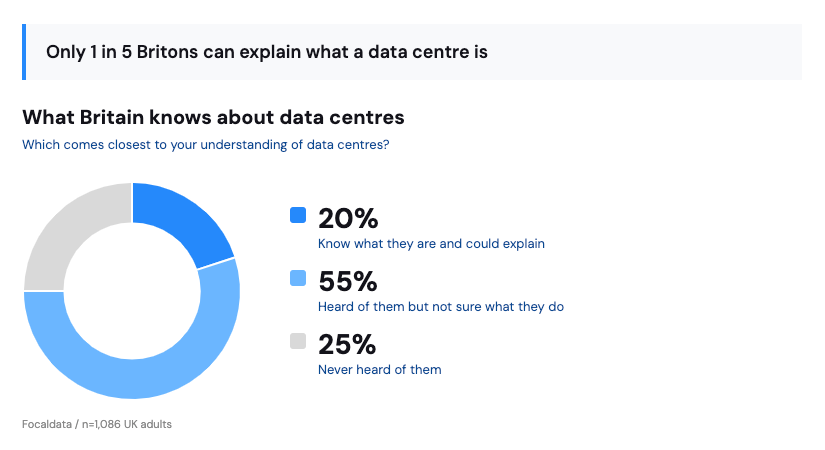
Women are more than twice as likely as men to say they've never heard of data centres (34% vs 16%). And young people, who are the heaviest users of the services these facilities actually power, are the least likely to understand what's behind them: 42% of 18-24 year olds have never heard of data centres, versus 11% of over-65s.
This is important for everything that follows. When someone says they're "neutral" about a data centre near their home, it’s just as likely to be because they don’t know enough to care as it is genuine indifference.
Permissive, but shallow
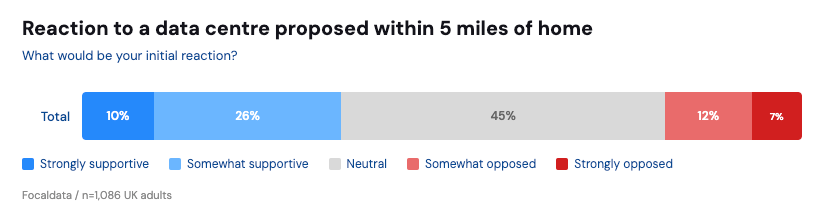
We asked people to imagine a data centre proposed within five miles of their home. Just over a third (36%) said they'd be supportive. Only 19% were opposed. The remaining 45%, almost half the country, said they were neutral.
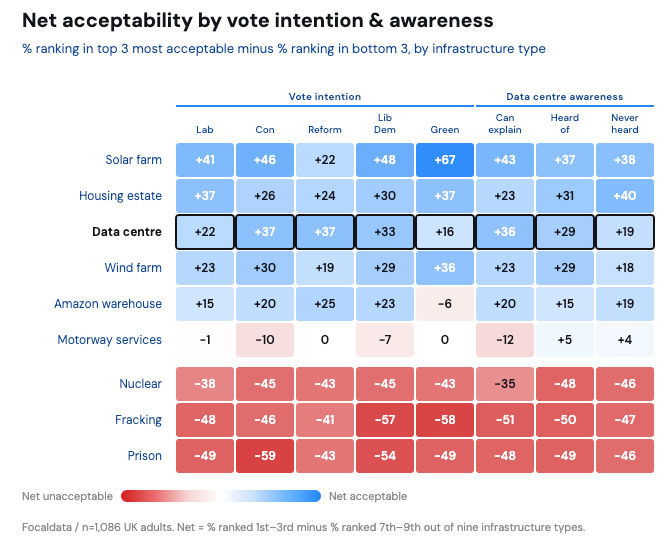
How does that compare to other types of development? We asked people to rank nine infrastructure projects by how acceptable they'd find each one within two miles of their home. Data centres came in at 4.1 out of 9 - sitting in the same cluster as solar farms and wind turbines, comfortably ahead of Amazon warehouses, and a long way ahead of the bottom tier of nuclear, fracking, and prisons.
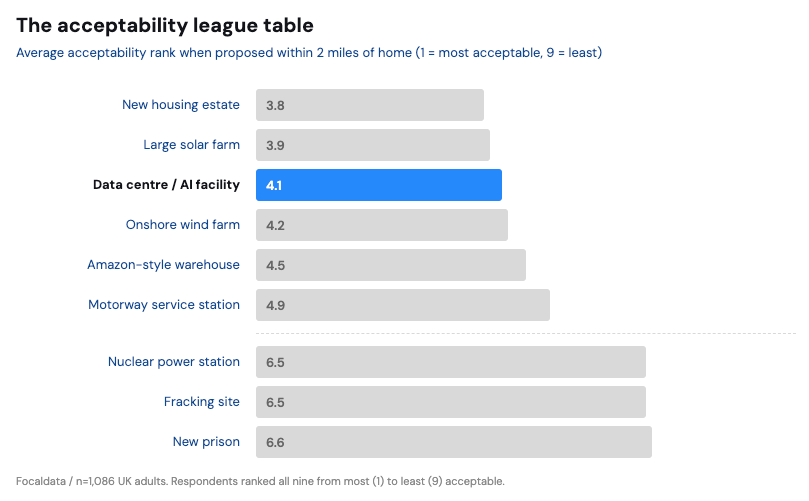
In public perception terms, a data centre sits closer to green infrastructure than to heavy industry. The people who worry about planning backlash should look at these numbers.
Data centres are also not sharply polarised by political party. Conservative, Labour, and Reform voters are all net supportive. The only group with net negative sentiment is Green voters, and even they are more neutral than opposed. The partisan range on data centres (0.6 points across parties) is about the same as nuclear and wind, and smaller than solar.
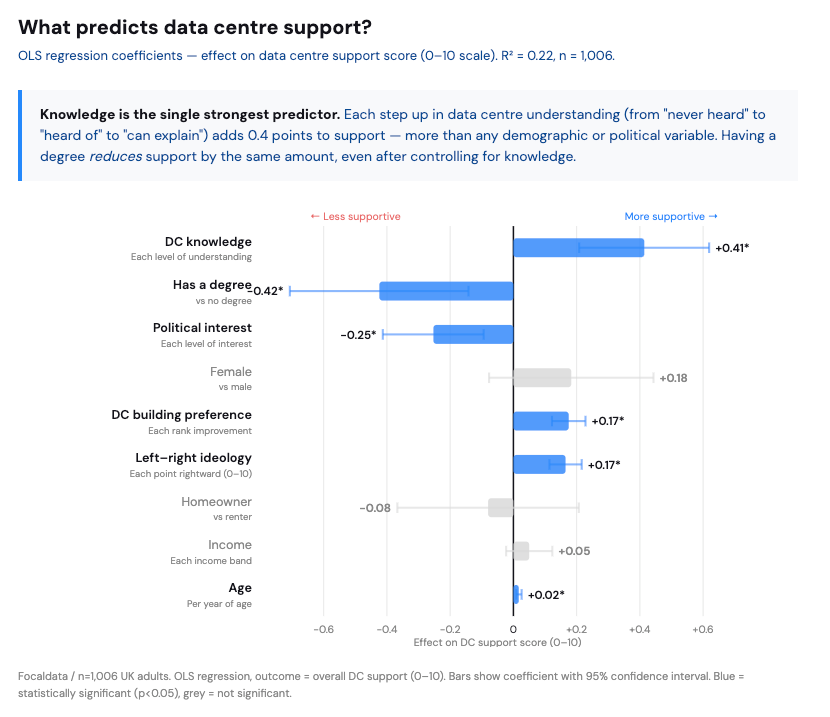
To fully understand what drives support and opposition to datacentre building we carried out a regression analysis. The most striking finding confirms something we’ve already discussed: understanding of data centres increases support for their development. Those who know the most about what data centres are for, are the biggest supporters.
There are other interesting findings. Although in the raw data it appears that young people are much less supportive of data centres, this turns out to be a function of awareness rather than genuine opposition. And while it’s true that views on data centres are not party political, they are somewhat ideological. Data centres are “right-coded”, with support increasing among those expressing philosophically rightwing views.
But none of this should be mistaken for settled opinion. A 45% neutral bloc and 80% who can't explain what a data centre does tells you that the public hasn't decided what it thinks. Opinion is very soft.
What should a data centre look like?
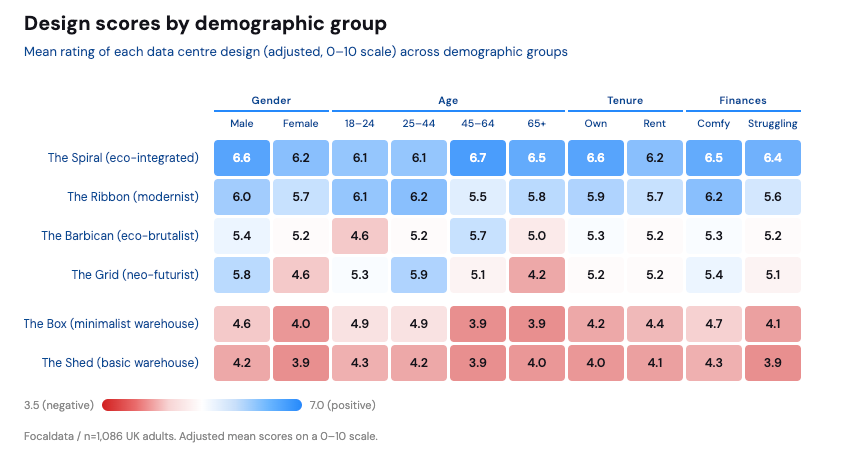
We tested something a bit unusual: how do people respond to different architectural designs? We showed respondents six AI-generated mockups, from a circular eco-design set into the landscape through to a standard industrial warehouse, and asked them to rate each one.
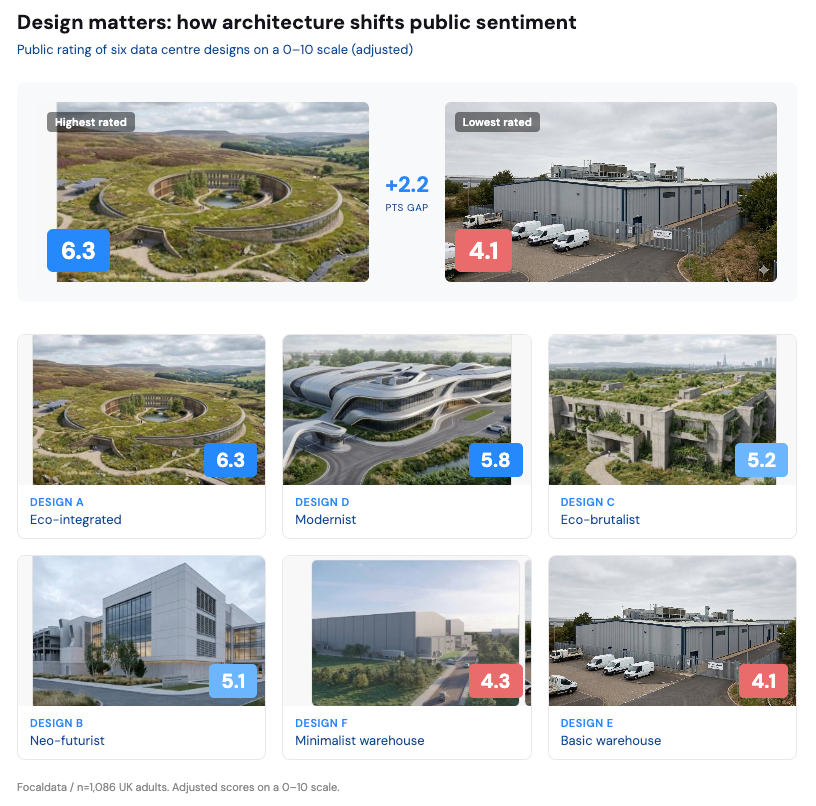
We found a 2.2 point difference on a 10-point scale between the top and bottom designs. That’s a large gap for something the industry almost entirely controls.
The designs that scored highest are the ones that look like they belong somewhere: integrated into the landscape, or carrying some sense of civic purpose. The ones that scored lowest look like what most data centres actually look like in practice. The eco-integrated circular design (6.3) gets a solidly positive reaction. The basic warehouse (4.1) gets a mildly negative one.
Nobody is suggesting that every data centre can or will look like something from Architectural Digest. But the finding does suggest something worth paying attention to: because most people have no existing image of what a data centre looks like, the first thing they're shown will set the template. Right now, the default image is a black box. That's the option that polls the worst.
Sovereignty and local services
We tested eight different arguments for building more data centres and asked how much each increased respondents' support.
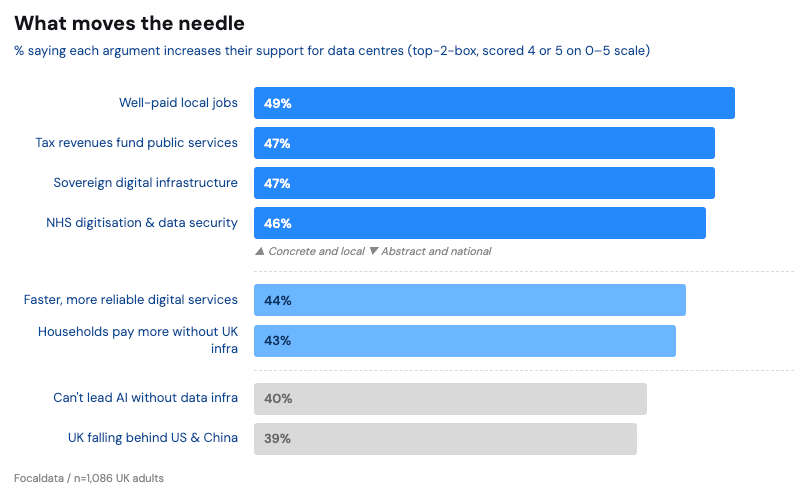
The pattern won't surprise anyone who's spent time looking at infrastructure polling: tangible beats abstract, local beats national, protective beats aspirational. Jobs, tax revenue, sovereignty, and NHS data security all persuade roughly half the public. Arguments about winning the AI race or staying competitive globally land with fewer than two in five.
When we forced people to rank these, sovereignty and NHS data security came out on top. AI competitiveness came bottom. If you're making the case for a data centre, "this keeps British data on British soil" works better than "this helps us compete with China."
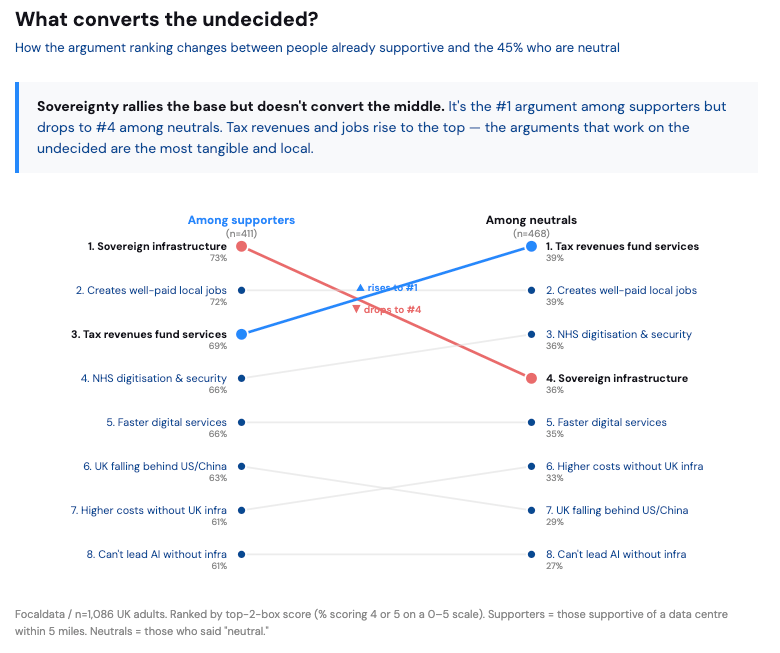
However among the “undecided”, those who are currently neutral on data centres, sovereignty performs less well. Instead neutrals respond best to arguments about the positive impact tax revenues from data centres can have for local services.
We also asked what single local benefit would matter most. The top three were direct: a cash payment to local households (24%), lower energy bills (21%), and jobs and apprenticeships (19%). Community funds, input into planning, and council ownership stakes all scored in single digits. People want material benefit, not consultation processes.
Opening the black box
The overall picture is fairly clear. Data centres don't have an opposition problem in the UK. What they have is a black box problem, in both senses. Most people don't know what a data centre does, and the ones they can picture look like featureless warehouses. The issue isn't polarised. Data centres are seen as roughly as acceptable as solar farms. All of that is good news.
But undefined is not the same as safe. Someone is going to shape what the British public thinks about data centres, whether that's the industry itself, opposition campaign groups, or a few bad planning battles that make the local news. The fact that opinion is soft right now is an argument for getting ahead of it, not for assuming it'll stay friendly.
The data is suggestive about what "getting ahead of it" should involve. Lead with sovereignty and jobs, not AI and competitiveness. Take what these buildings look like seriously, because people notice more than you'd think. Offer communities something concrete. And probably most importantly: open the black box. Help people understand what a data centre actually is and what it does for them, because right now almost nobody knows.