Blog/Research
Europe's Digital Future
The introduction for this white paper is presented below. The full white paper can be downloaded here.
In December 2025, we published a white paper detailing why the topic of tech sovereignty could become the next major political divide in the United Kingdom. We found that while direct awareness of the concept was low, the British public expressed consistent preferences for policies which limited foreign ownership of digital infrastructure. The report also noted that US-based technology companies faced reputational challenges linked to distrust of the United States government during the second Trump presidency.
Since the paper’s release, the UK government has launched the Sovereign AI Fund, and has appointed Kanishka Narayan as the Cabinet’s first Minister for Artificial Intelligence.
We had always planned to conduct a follow-up study on the topic once the debate began in earnest. On the continent, major events have already occurred. In April 2026, the French government pulled its national health database off Microsoft Azure and onto the French provider Scaleway. That same week, the German AI firm Aleph Alpha, which had built relationships with the German government, was acquired by the Canada-based Cohere. A month later, the Dutch government blocked US firm Kyndryl’s attempted acquisition of Solvinity, the domestic provider running the country’s digital ID system.
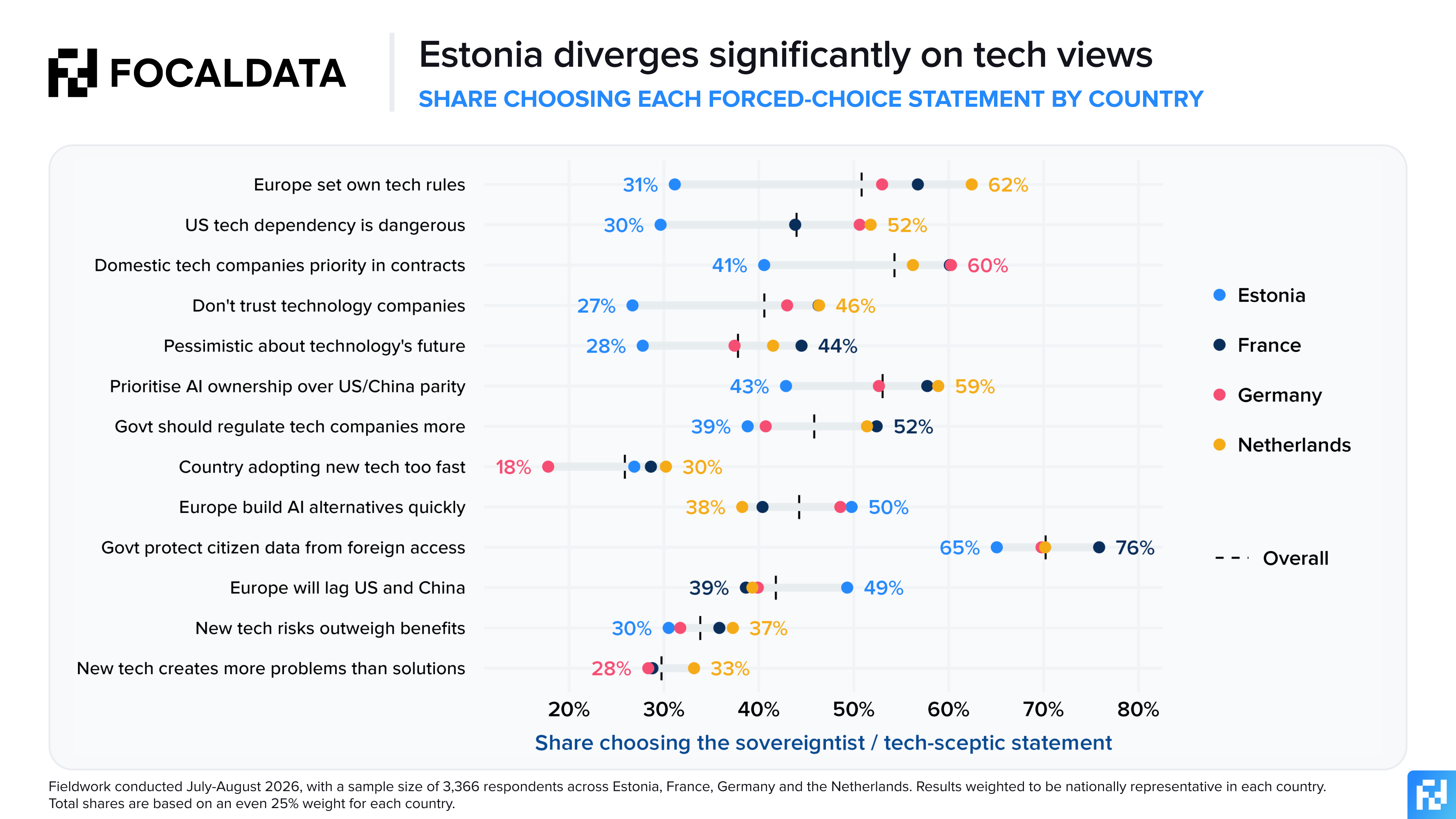
In September 2026, Estonia, the small Baltic state situated on the Russian border, which has faced increased threats since the Russian invasion of Ukraine in 2022, marks the first full year of its AI Leap programme. The scheme is designed to integrate AI tools and improve AI literacy in the education system, and relies entirely on commercial US models rather than sovereign EU alternatives. Estonia’s approach cuts against the anti-US mood driving policy elsewhere in Europe.
Given these events across Europe over the last six months, we felt that a second study focused on a continental European perspective would provide more depth to the existing research on tech sovereignty than a UK-centric follow-up would. In July 2026, we subsequently surveyed 3,366 respondents across France, Germany, the Netherlands, and Estonia about their views.
The aim of this report is to understand the topic, and more specifically AI sovereignty, as it exists in a European Union context, rather than serve as a comparative study between UK and EU attitudes. As such, while I would of course recommend reading Britain’s Digital Future, what follows can be understood as a standalone piece.
Data tables for this white paper can be downloaded here
This research was commissioned and funded by Focaldata