Blog/Research
Good Neighbours? Polling the World Cup Host Nations
This week, the 2026 World Cup kicks off, jointly hosted by the USA, Canada and Mexico. It's the first men's World Cup shared across three countries, and the biggest ever in terms of number of teams competing.
But it also arrives at an awkward moment. Relations between the three have rarely felt this prickly, with tariffs, border rows and political needling never far from the headlines. The tournament has plenty of its own controversies brewing too: rows over ticket prices, whether Iran will be allowed to take part, and America’s immigration enforcement.
We ran a poll of 1,500 people across the three host nations to find out what they make of the tournament, and of one another. We also asked a question where people could elaborate on their thoughts on the issues we asked about, and have woven their own words in throughout.
We are a British company, and writing "soccer" this many times has not come naturally. But the tournament is in North America, so we’re getting into the spirit.
Good neighbours?
If we start with how each country rates its relationships, the striking thing is the mismatch. None of this is an ideal backdrop for a tournament built on the idea of three countries pulling together.
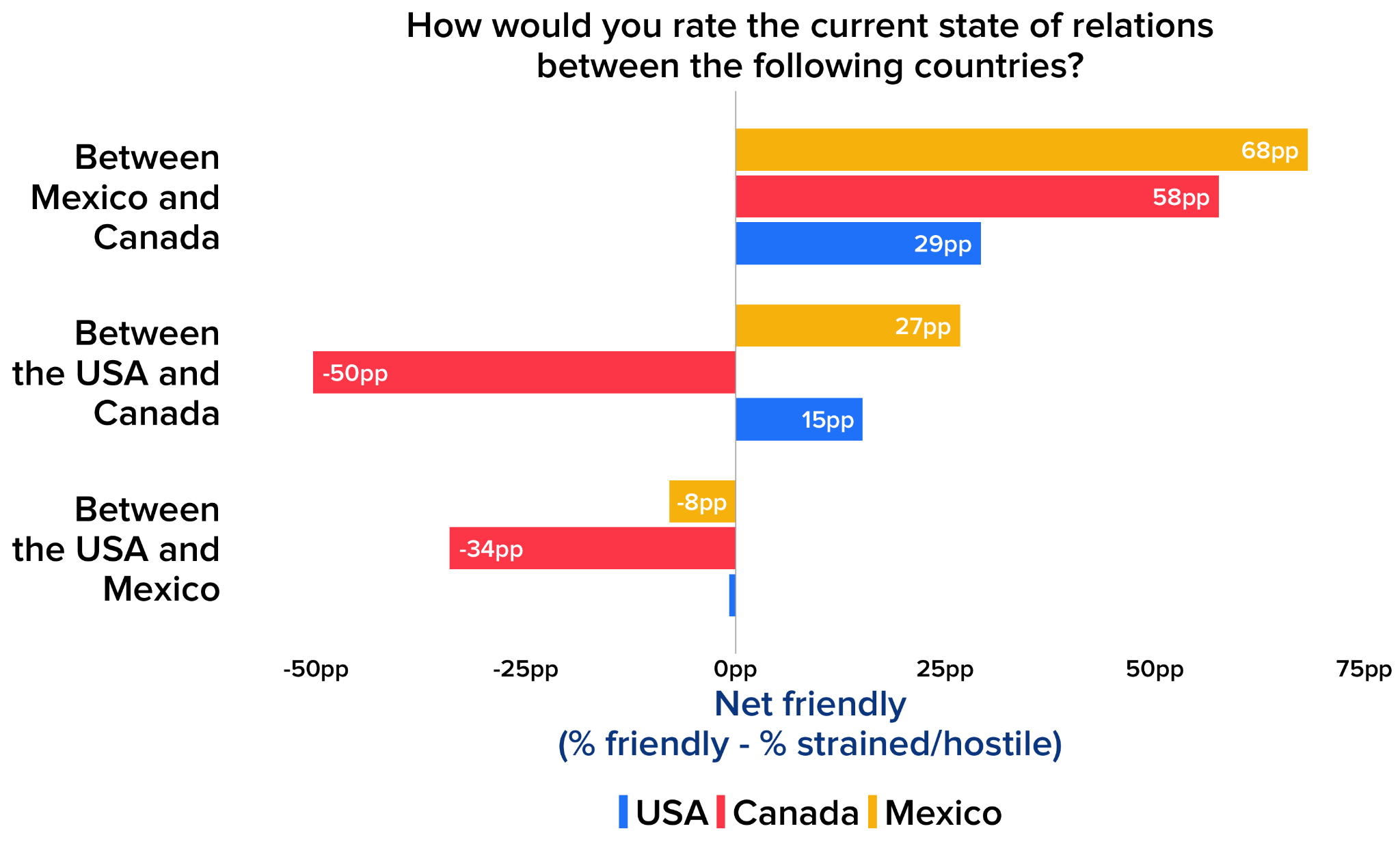
Americans rate the current state of relations with Canada positively (net +15) and see those with Mexico as roughly neutral. Their neighbours do not see it the same way. Canadians are very gloomy about the state of relations with the USA (-50), and Mexicans lean negative on the same question too (-8). The one relationship everyone agrees is healthy is the one that does not involve Washington: Mexico and Canada rate ties with each other warmly.
"I honestly think the tensions are too high between the three of us. The World Cup will not mend what is broken." – Canada, 45, Female
"Given the current geopolitics and the conflicts around the world (and by the way the USA is behind every problem) I do worry that something bad could happen and affect this tournament." – Mexico, 55, Female (translated from Spanish)
One fútbol nation, but not two soccer nations
Then there is the small matter of whether people actually like the sport.
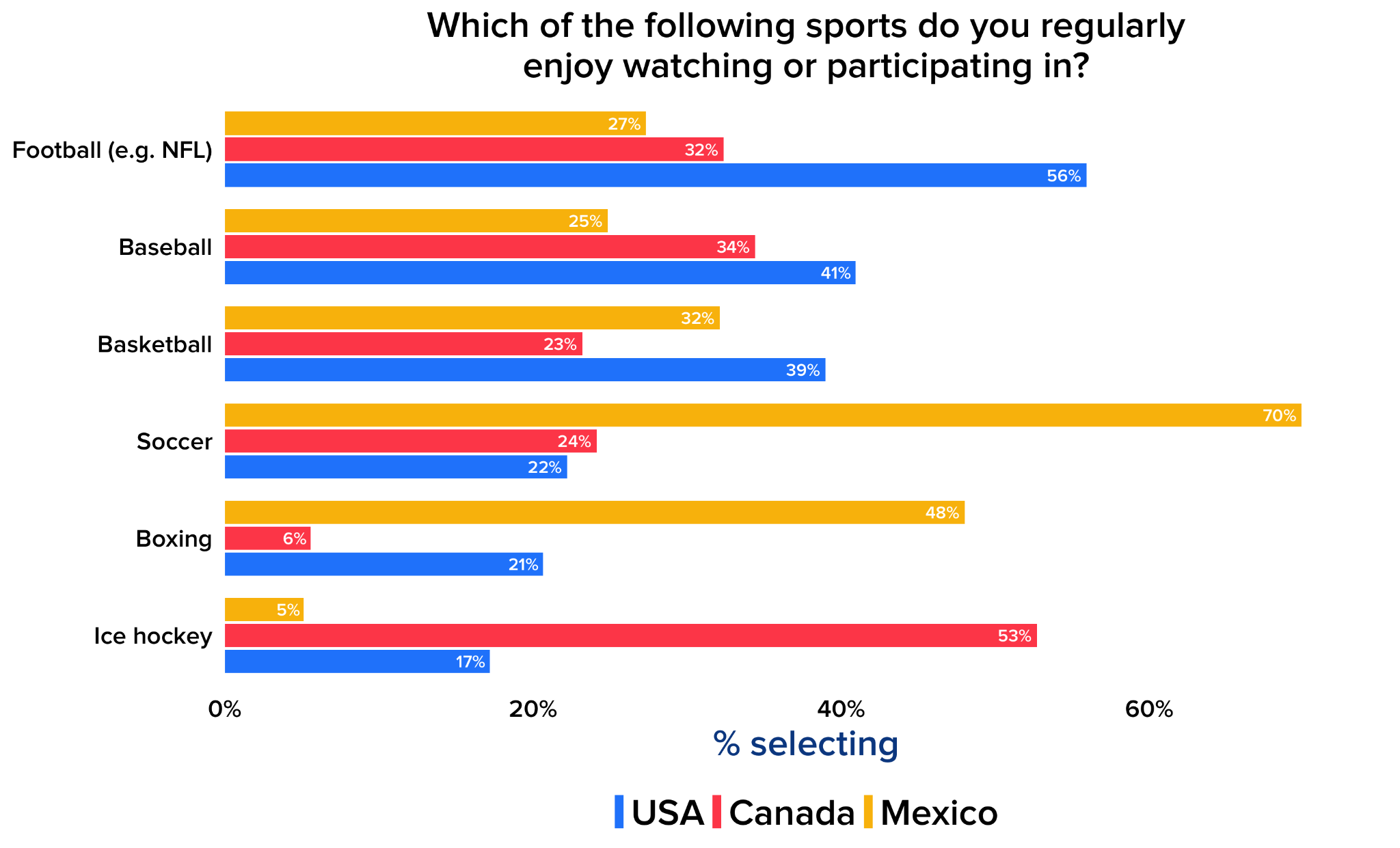
Mexico is soccer mad: 70% say they regularly watch or play. In the USA and Canada, it is closer to one in five (22% and 24%), trailing the NFL, basketball and more. The host nations are, for the most part, not soccer countries.
"I do not care about this in the least. If you like it, that's great, but it's just not for me." – USA, 65, Male
"Soccer is a boring game played with phoney actors." – Canada, 60, Male
That matters for the atmosphere. When we asked how excited people are about the World Cup, committed soccer fans are buzzing everywhere, scoring around 8 out of 10 on average in all three countries.
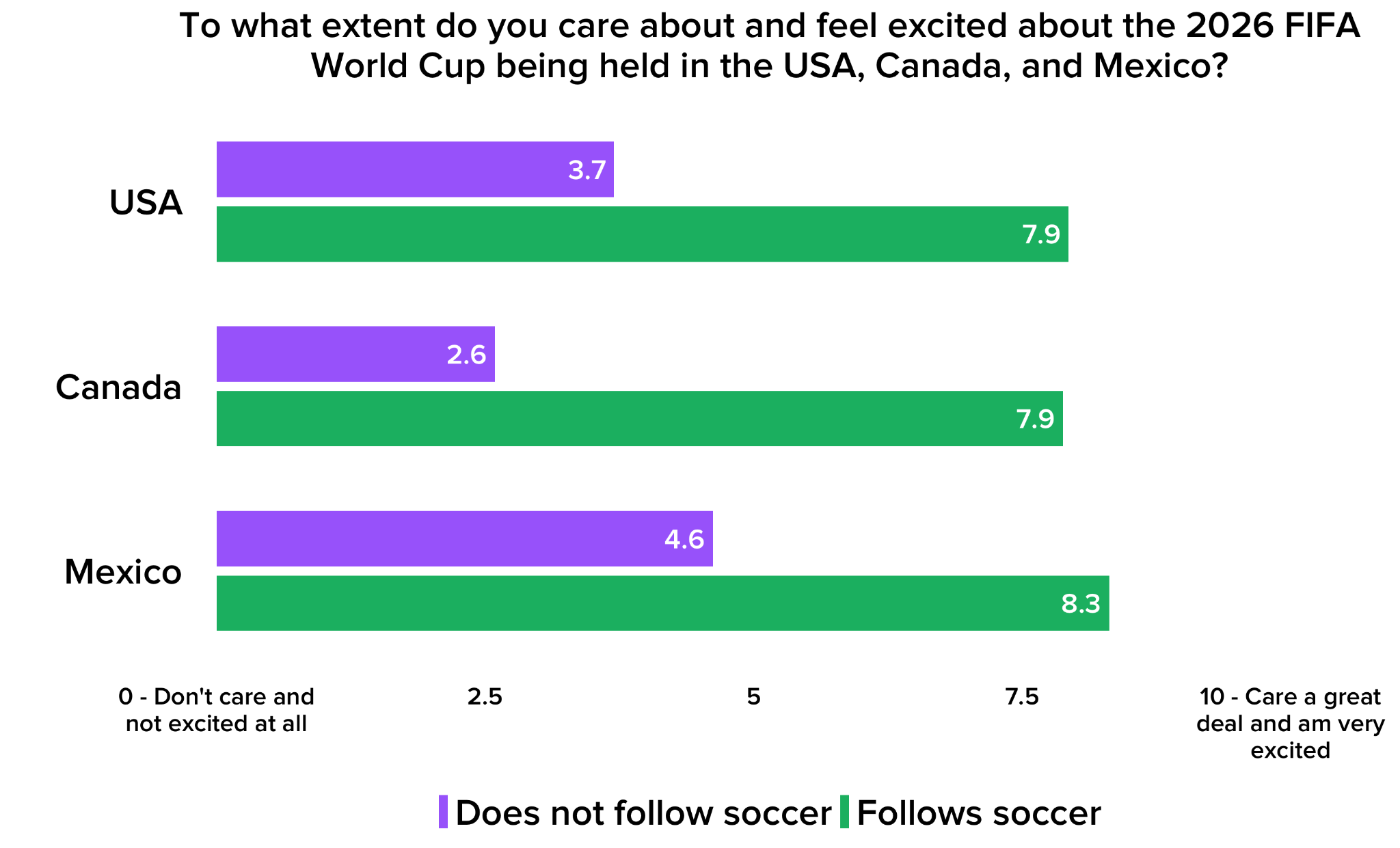
The problem for the USA and Canada is simply that there are not many of them. Among the vast majority of people here who do not follow soccer, excitement drops sharply to 3.7 in the USA and just 2.6 in Canada. Even Mexico's non-fans are warmer than that (4.6).
"It excites me, because the best time for football is coming, and I love watching it." – Mexico, 25, Female (translated from Spanish)
What is the World Cup for?
FIFA does not sell the World Cup as just a month of football. It pitches it as a lasting legacy for the hosts: jobs, investment, infrastructure and a place on the world stage. So it is worth asking what each public actually wants out of it.
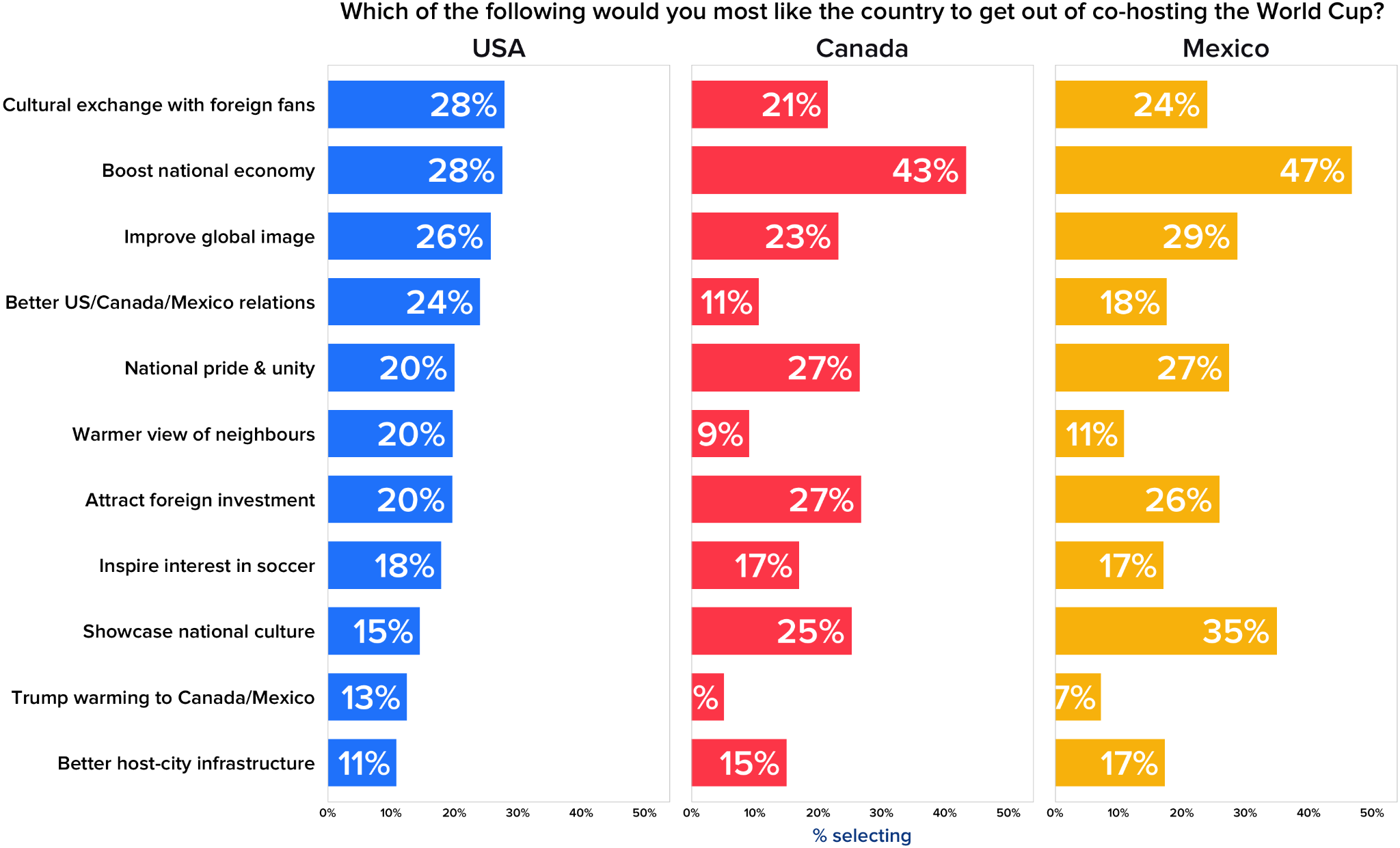
Americans are split, with no single goal commanding the room. Canadians and Mexicans are clearer, and top of both their lists is boosting the national economy (43% in Canada, 47% in Mexico). Mexicans also relish the chance to show off their culture to the world (35%), the sort of soft-power dividend a host gets to enjoy.
"I think it will bring a lot to the economy and to Mexican businesses, and it will boost tourism in Mexico too." – Mexico, 26, Female (translated from Spanish)
There is one further wrinkle in the American numbers. They are the only public to rank improving relations between the three host nations among their top aspirations. It is a notable thing to want from this tournament, given it is largely American policy driving the strain those relations are under.
"I'm very happy the World Cup is coming to America again. When I was a young woman I worked for the World Cup, I think it was 1993 or 1994. It was a lot of fun and I got to meet people from many different cultures. I know it was a boost to our economy and I hope it helps this time too." – USA, 66, Female
Ask what could go wrong, though, and the anxieties come out.
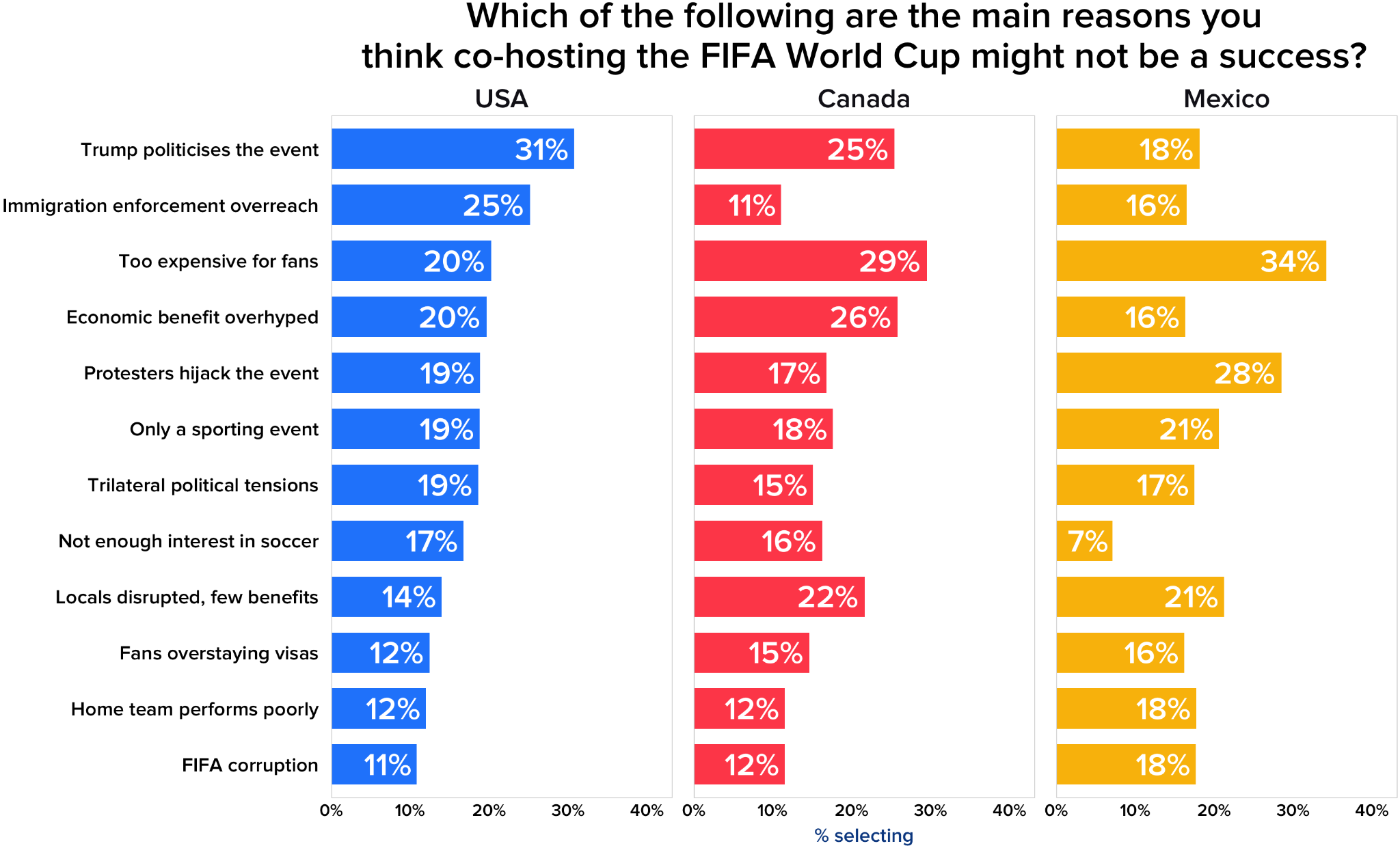
For Americans, the biggest fear is political: that Donald Trump overshadows the tournament or uses it for his own ends (31%).
"Hopefully Trump doesn't ruin it for us." – USA, 44, Male
Canadians and Mexicans are more practical, with their main worry being about costs, that tickets, travel and hotels will simply be too expensive for ordinary fans.
"Too expensive for the average person. It's criminal." – Canada, 65, Male
The off-pitch arguments
Finally, specific controversies are already swirling around the tournament.
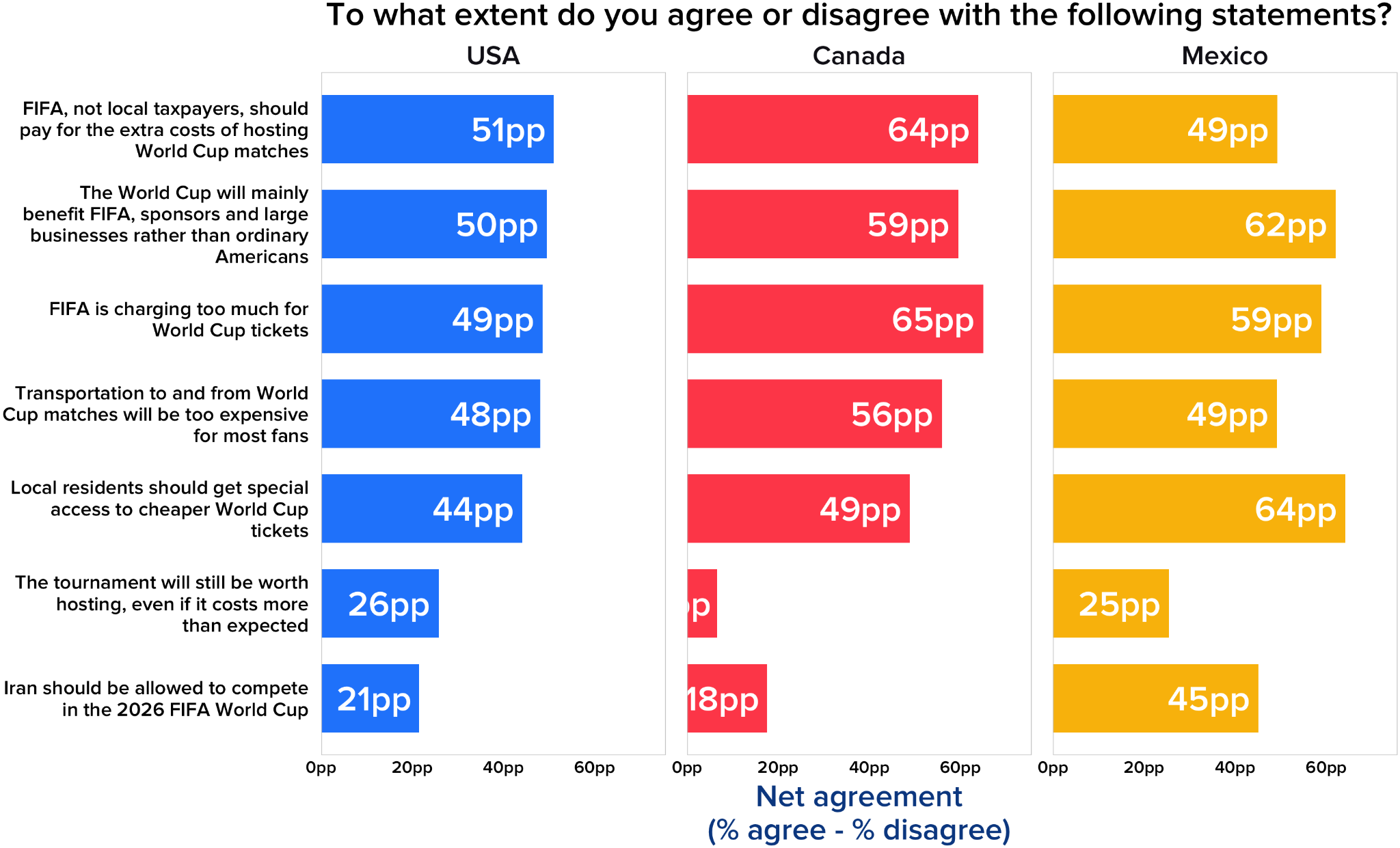
A few things stand out. Mexicans are the most relaxed about Iran being allowed to compete (net +45), though Americans and Canadians still lean in favour. Mexicans are also the keenest on Mamdani-style discounts giving local residents cheaper access to tickets (+64), though this is overwhelmingly favoured by Americans (+44) and Canadians (+49) too.
"It doesn't excite me much, because it has become more about business than about the sport." – Mexico, 45, Male (translated from Spanish)
"I'm glad I don't live close to any of the venues, because the disruption around the games, parking and traffic congestion, will be terrible." – Canada, 71, Female
Canadians are the most insistent that FIFA, not taxpayers, should foot the bill for hosting (+64), and the most sceptical that the tournament is worth it if costs overrun (just +7). On most other statements the three countries land in broadly similar territory: widespread agreement that tickets cost too much, and that the spoils will mainly flow to FIFA and big business.
"It's costing Canadians billions to have some games in Toronto and Vancouver, which is not right, especially when most Canadians cannot afford to buy tickets. FIFA should pay their own way instead of relying on ordinary taxpayers to foot the bill." – Canada, 59, Male
The takeaway
A month of football will not thaw North America's frostier mood, and nobody really expects it to. But there are warmer notes. Mexico arrives excited and proud to host, and with reason. They’ve done this twice before, in 1970 and 1986, and both times it worked. Canada and the USA are more cautious. The Americans have history on their side too: 1994 was a record-breaking tournament that built a professional league from scratch. But Canada has never hosted, and their anxiety about costs and scepticism about who benefits reads like exactly that - first timer nerves.
The World Cup has a habit of winning people over once the whistle blows. With less than a few days to go, it has plenty of converting still to do.
Focaldata polled 514 adults in the USA, 588 in Canada and 521 in Mexico. Results are weighted to be nationally representative.