Blog/Analysis
How we forecasted the Hungarian election
On 12 April, Hungarians turned out in record numbers to deliver one of the most consequential election results in recent years. Péter Magyar’s TISZA ended sixteen years of Fidesz rule with a two-thirds supermajority. Four days before polls opened, our MRP-based forecast had already called the shape of the night: a TISZA landslide, a Fidesz collapse to the rural east, and Our Homeland (Mi Hazánk) squeezing across the 5% threshold.
This post walks through what we built, what the data was telling us, how our final forecast held up against the actual result, and where the models over- and under-performed.
What did we build?
Rather than relying on a single modelling approach, we ran three parallel constituency-level models based on two waves of original polling in Hungary. Each was fitted to every respondent’s party-list choice and weighted to the electorate across age, education, gender, settlement size and region, before being post-stratified to each of Hungary’s 106 single-member constituencies (OEVKs).
The three models were:
- BART (Bayesian Additive Regression Trees): a non-parametric method that captured non-linear interactions between voter characteristics and was particularly good at picking up the education-by-age patterns driving the TISZA surge.
- RFRP (Random-Forest Regression with Post-stratification): a tree-based classifier that put more weight on demographic structure and less on hierarchical priors, acting as a useful stress test for the Bayesian outputs.
- MCMC MRP: a classic multilevel regression with post-stratification, fitted via full Bayesian sampling.
Alongside the vote-choice MRPs, we ran three supporting layers:
- A switching model tracking how 2022 Fidesz, 2022 opposition, and 2022 non-voters were moving between our two waves. This is what gave us early confidence that the TISZA lead was structural rather than a temporary high.
- A trust-and-issue layer correlating perceived party competence on cost of living, corruption and healthcare with vote-intention shifts between waves.
- Constituency-level priors built from the 2022 result and the 2024 European election, anchoring sparse cells in low-response areas to recent observed behaviour rather than national swing alone.
What the data was telling us
Two things jumped out of the waves.
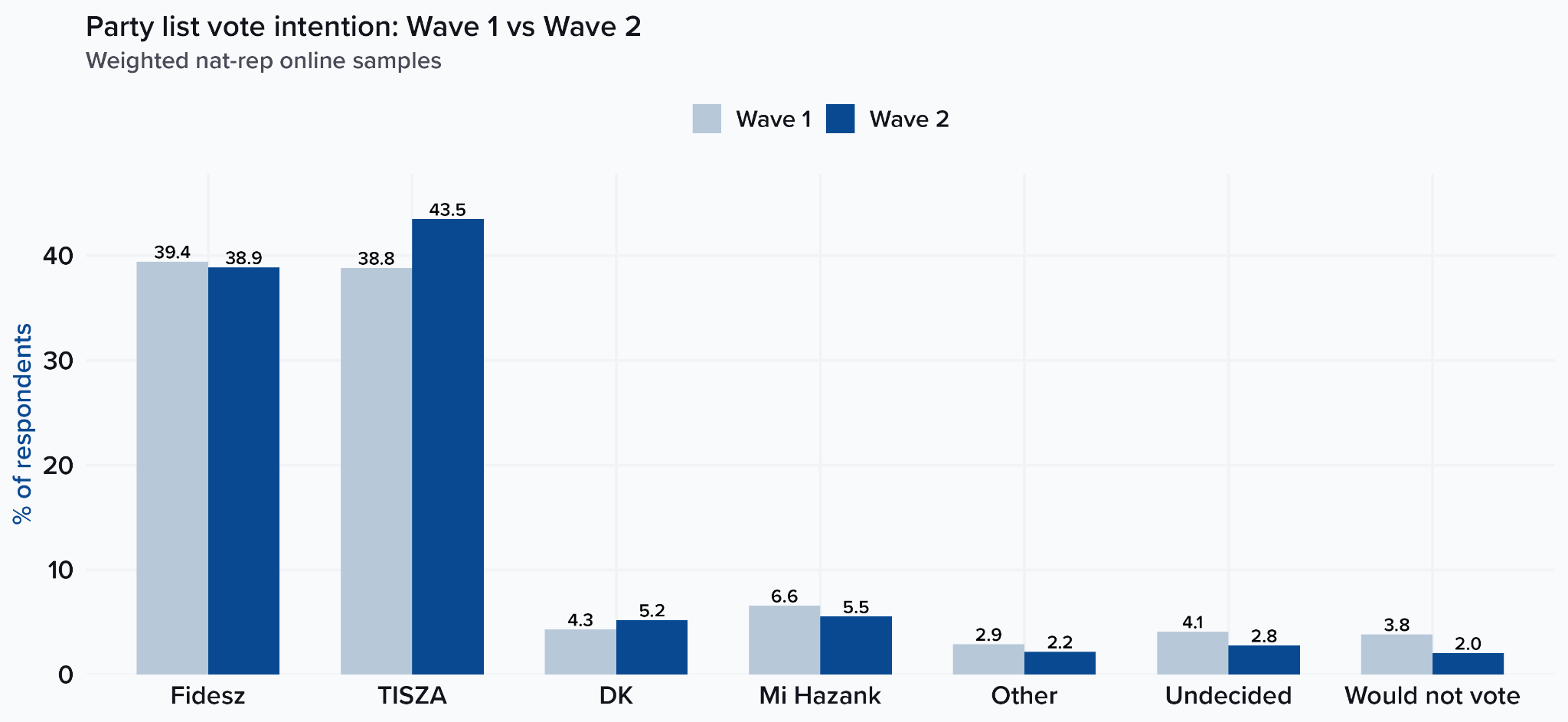
The headline vote intention barely moved, but everything underneath it did. On the party list, Fidesz held 39.4% in Wave 1 and 38.9% in Wave 2. TISZA rose from 38.8% to 43.5% (46% excluding undecideds/non-voters).
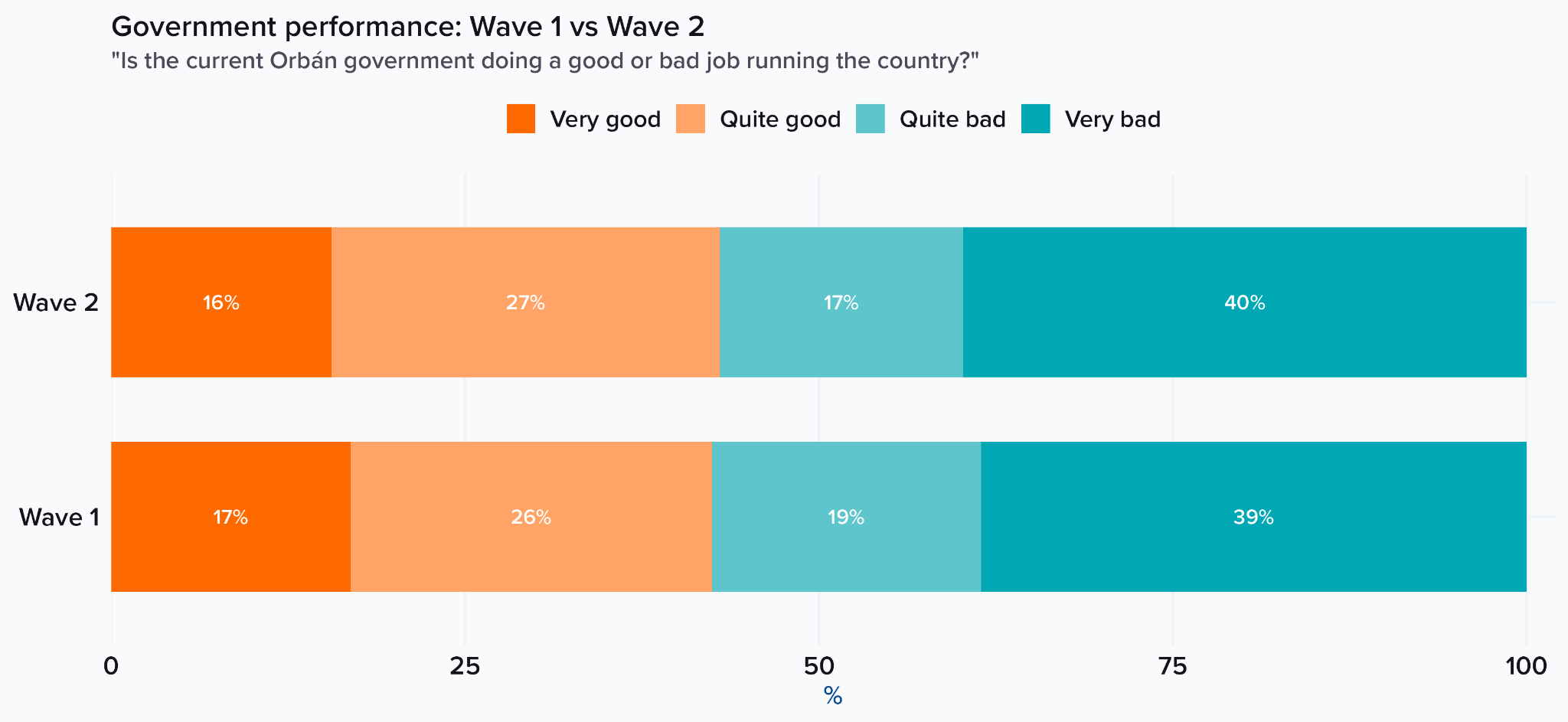
Government approval essentially flatlined (43% good job in both waves) and “direction of country” barely shifted. In a normal election cycle, you’d read those numbers and expect a tight race.
But the internals were moving decisively towards TISZA. Our switching model showed four structural shifts between waves:
- 2022 opposition voters consolidating behind TISZA (80% → 84%)
- 2022 non-voters breaking for TISZA (41% → 48%) and reporting higher turnout intention
- 2022 Mi Hazánk voters defecting to TISZA (63% retention → 51%)
- Fidesz retention steady at c. 77%, but with zero upside from new voters

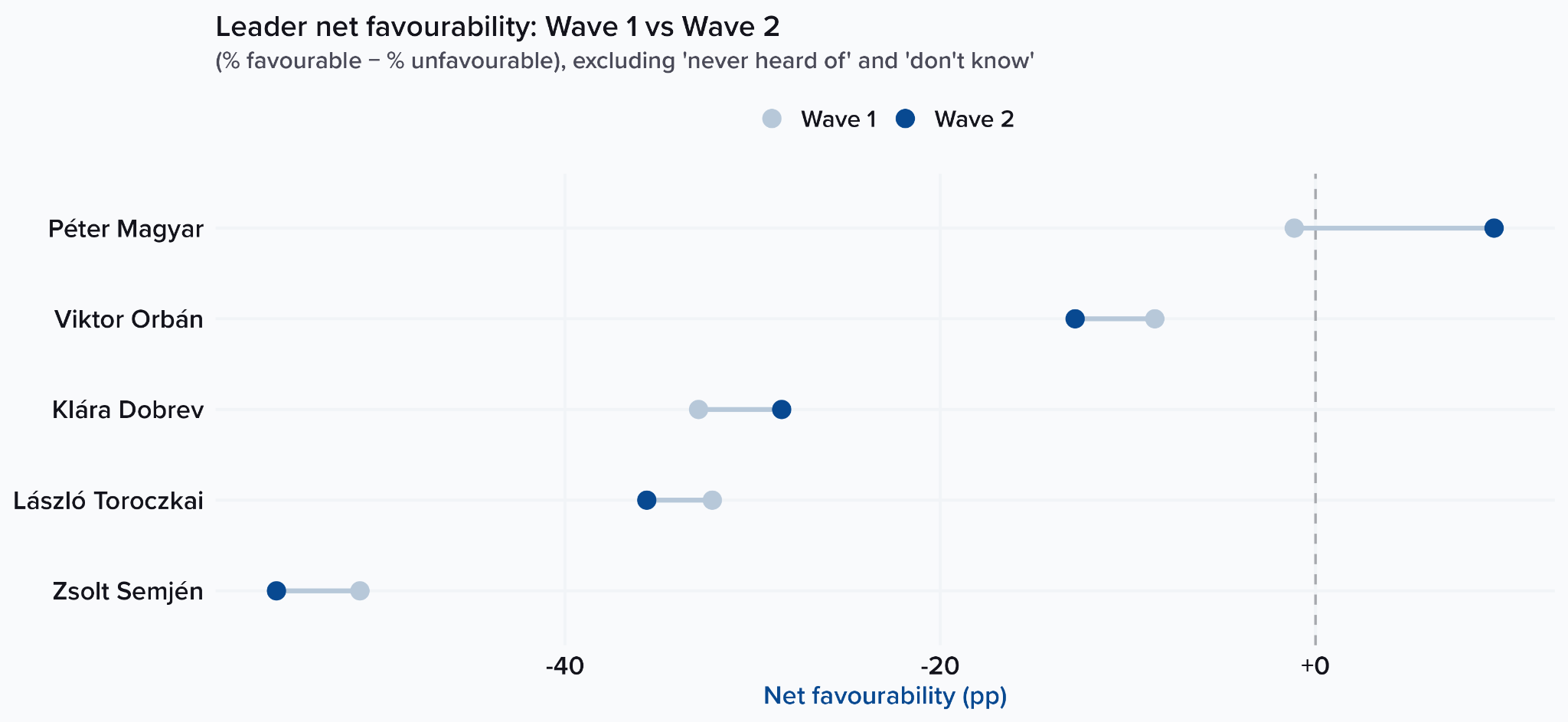
Péter Magyar’s net favourability moved from roughly zero to clearly positive, while Orbán’s drifted further negative.
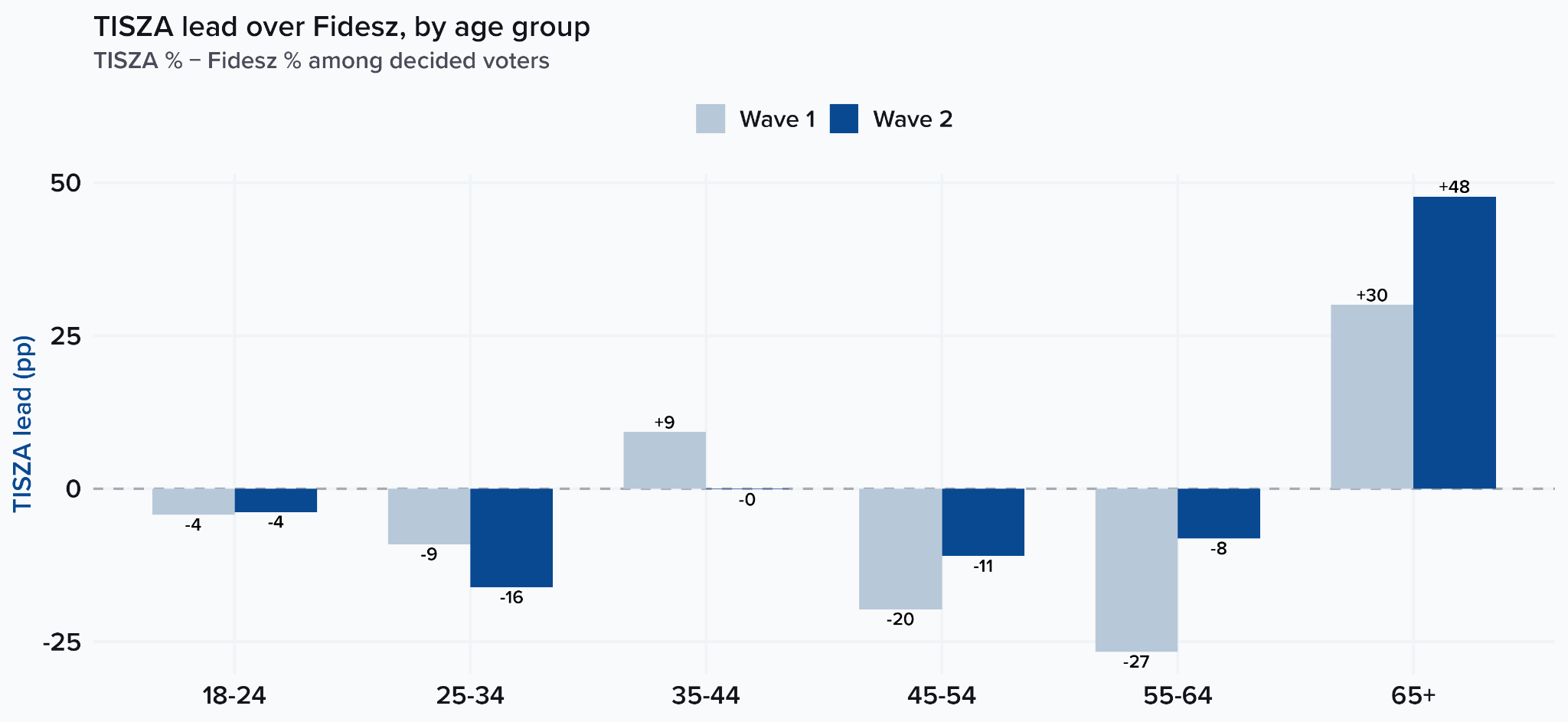
And the demographic divide widened sharply: TISZA’s lead among degree-educated voters went from +35 to +53 points, while Fidesz’s lead among voters with no diploma widened from -31 to -42.
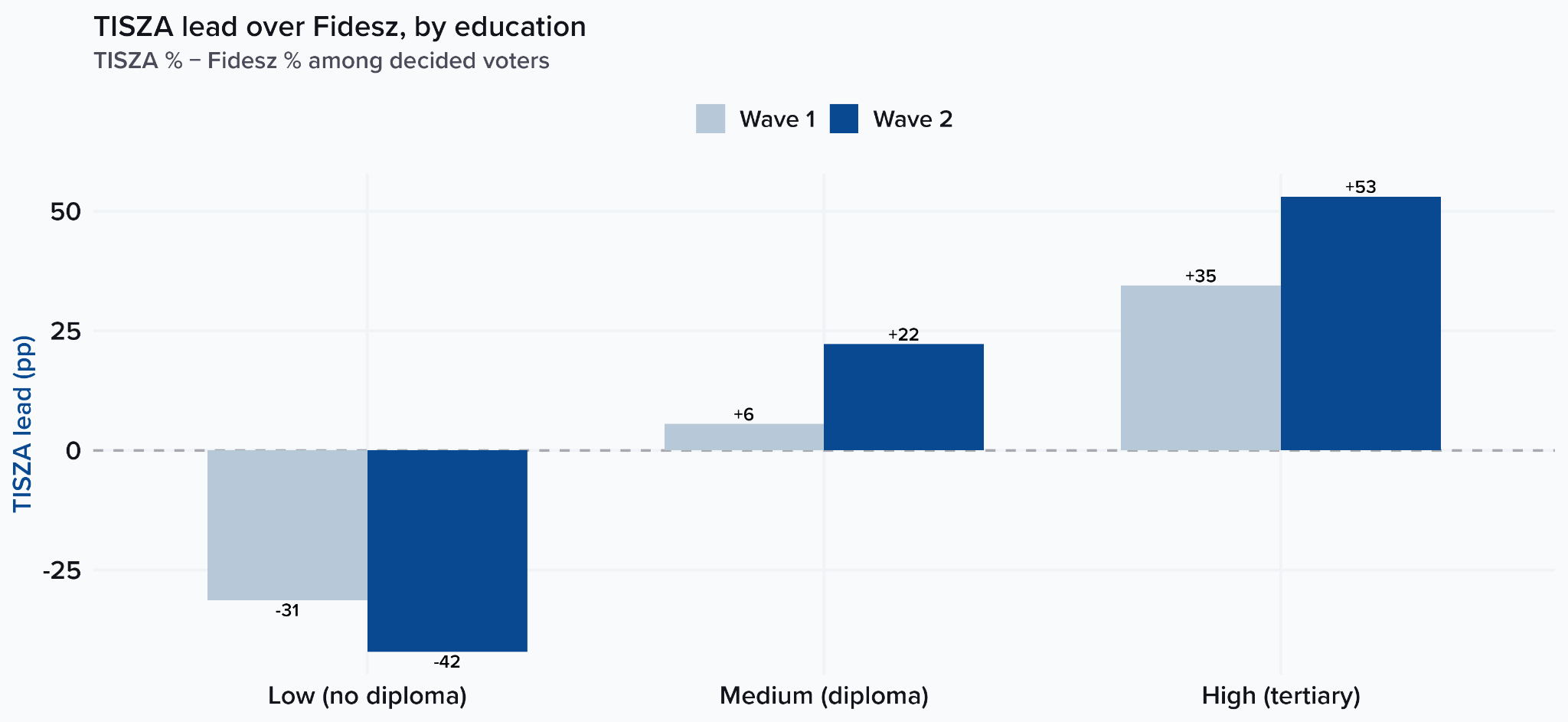
The models picked this up. All three had TISZA ahead on both seats and list vote in the final run.
What did we predict?
Our final BART forecast, locked on 8 April:
TISZA: 123 seats (actual: 141, -18)
Fidesz-KDNP: 70 seats (actual 52, +18)
Mi Hazánk: 6 seats (actual 6, -)
Others: 0 seats (actual 0, -)
Three things are worth pulling out.
We called Mi Hazánk exactly right. The 5% list threshold is where forecasts can often come undone, when a party within the margin either enters parliament with an influential number of seats or disappears entirely. Our model put Mi Hazánk at 5.8% on the list vote with a 70% probability of crossing, and they finished on 5.63% for six seats.
We beat the field. Five public seat projections were published across the window our fieldwork ran. The average of those projections put Fidesz on 79 seats and TISZA on 113. Our 70 and 123 were closer to the actual result on both counts, and our overall projection beat four of the five individual estimates. In a campaign where most projections were converging on a narrow TISZA win, our model was alone in consistently pointing to something closer to the landslide that actually happened.
We under-called the scale of the TISZA landslide. TISZA’s final list vote share (53.2%) came in about 2.8 points above our central estimate, and that translated into more OEVKs flipping than our posterior medians implied. The final result sat within our 95% credible interval for TISZA but above our 66% interval. The mechanism, visible in hindsight, was late turnout asymmetry: overall turnout rose 8 points on 2022, and the incremental voters broke disproportionately for TISZA in the western and central marginals — exactly the segment our switching model had flagged as “likely TISZA, uncertain to turn out.”
How did each model perform?
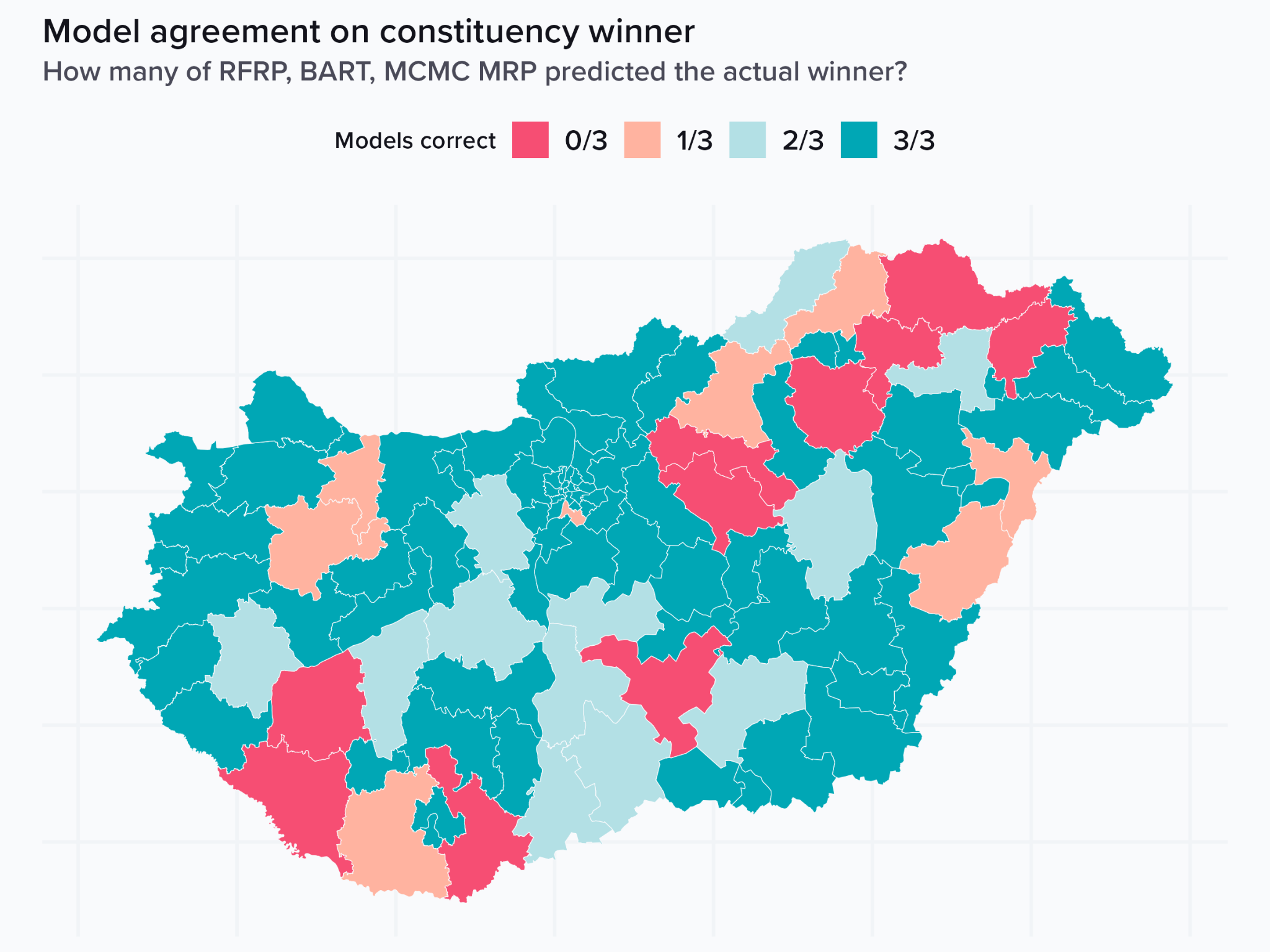
Across the 106 OEVKs, all three models predicted TISZA to win the national seat count and all three correctly called Mi Hazánk clearing the threshold. They diverged most on the tightest marginals — the band of western and central seats where TISZA’s late surge was strong enough to flip seats our models had as leaning Fidesz.
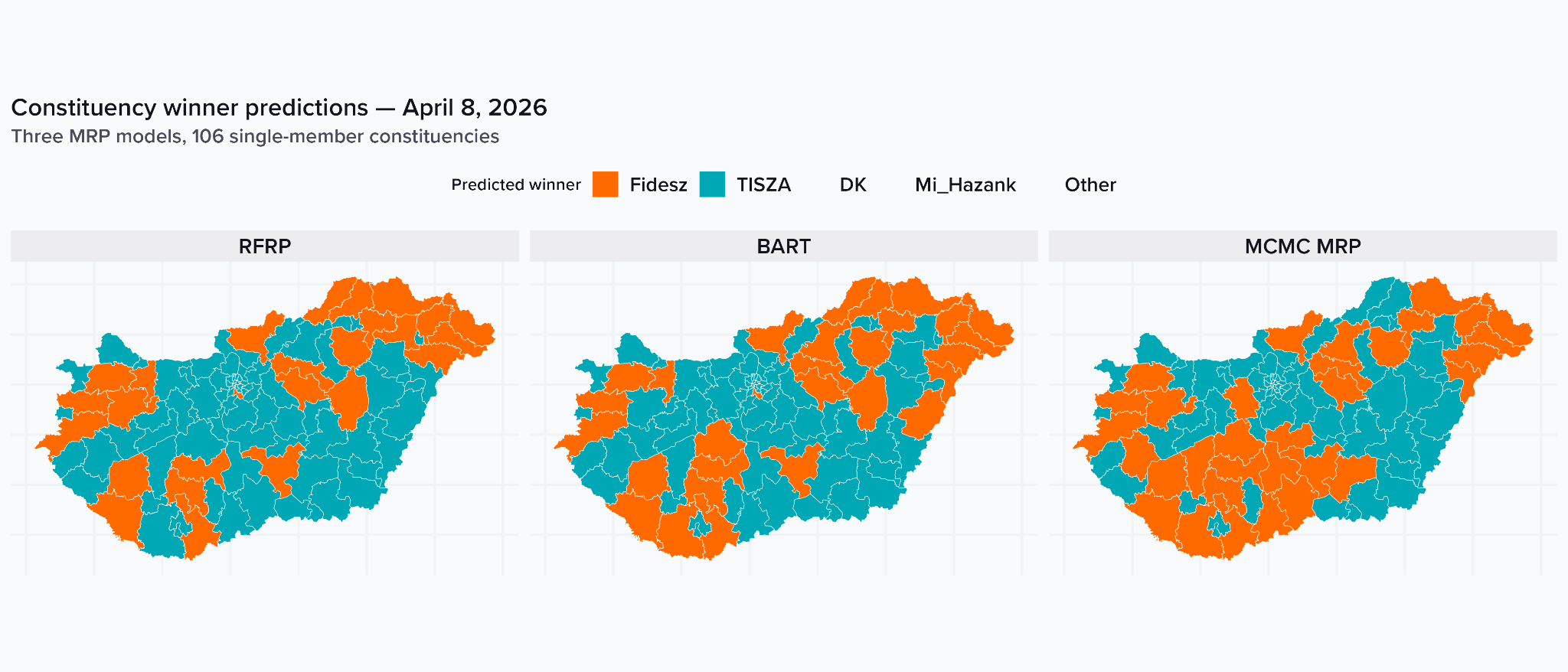


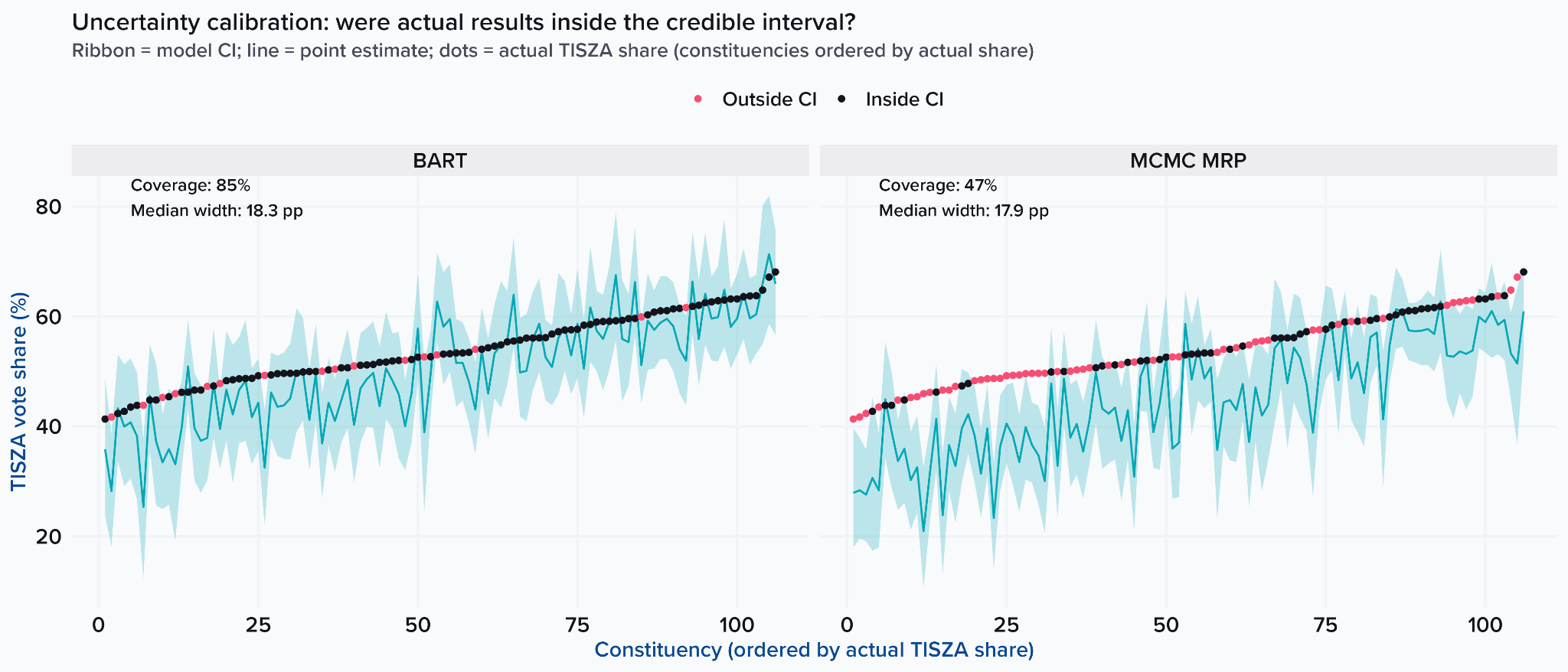
BART was the strongest model on every metric. It had the lowest error, the highest R² between predicted and actual TISZA share, and confidence intervals that were well calibrated. It called 87 of 106 constituencies correctly (82%), with all misses in the same direction: seats where BART gave Fidesz an edge and TISZA took them on the day.
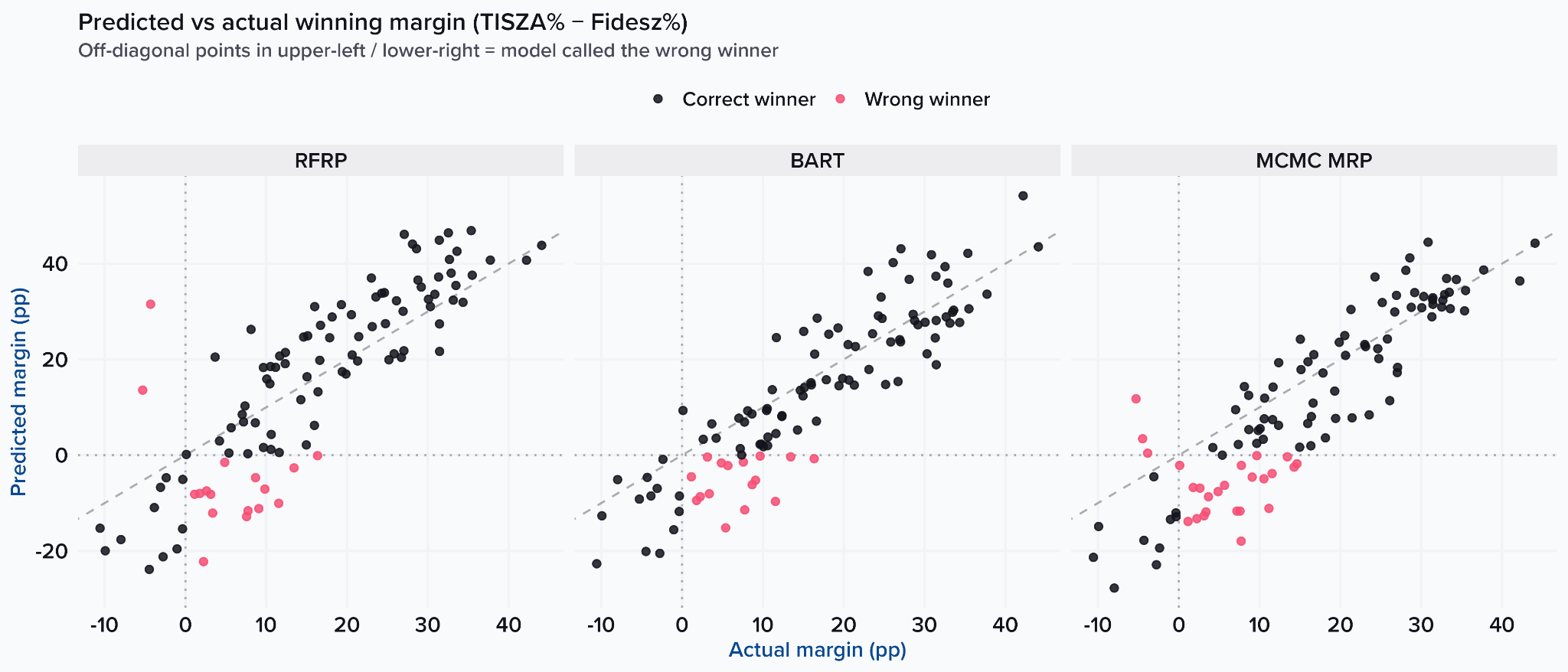
RFRP and MRP were close behind but not quite as clean. RFRP called two seats for TISZA that TISZA didn’t win; MRP called three. In both cases the large majority of misses still ran in the under-called-TISZA direction, but the error pattern was less strictly one-directional than BART’s. That’s consistent with what the vote-share error maps show: RFRP systematically under-predicted TISZA in the south-west, while MCMC MRP ran a little hotter for TISZA in pockets of the far east.
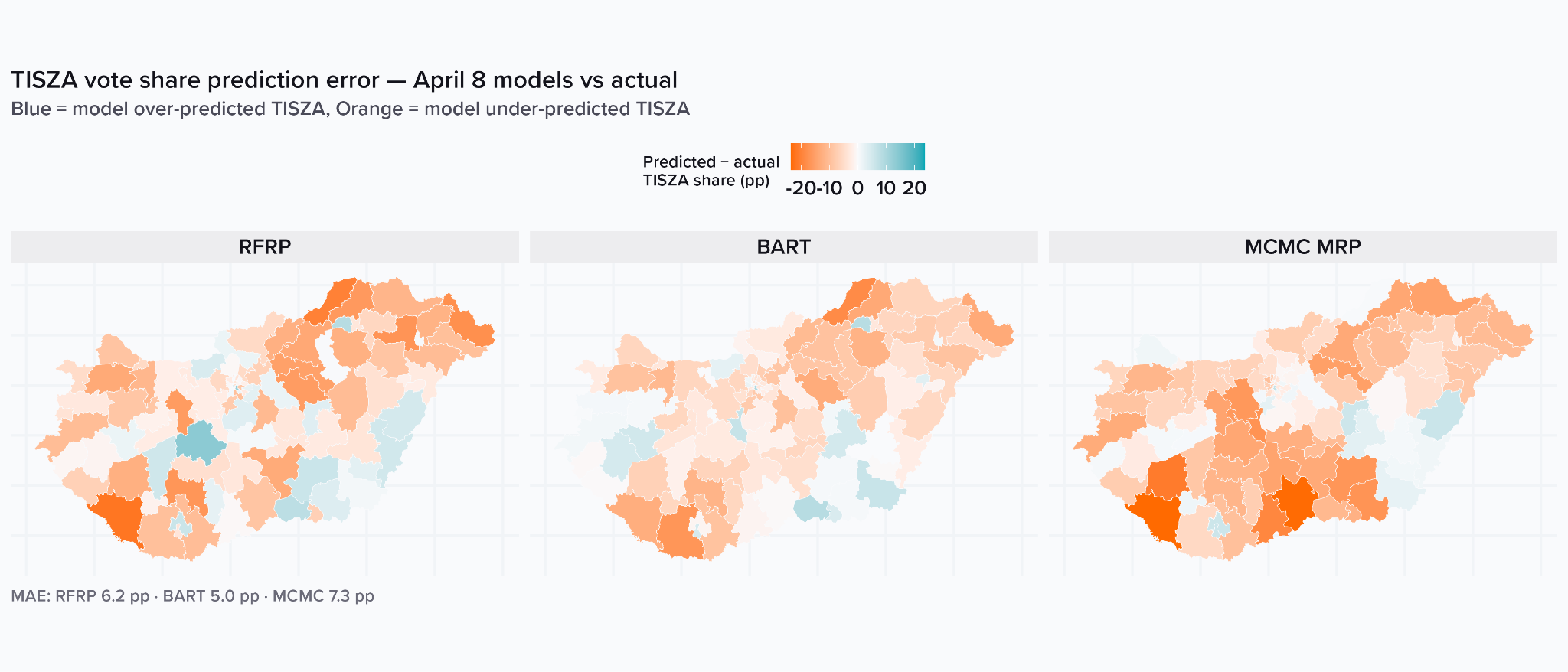
MRP also paid a price for its tightly-specified hierarchical structure in the form of under-dispersed intervals (47% empirical coverage on a 95% nominal), which is the characteristic failure mode of this kind of model in a realigning electorate.
The seats where the models disagreed clustered in precisely the south-western belt where the late TISZA surge was live but unresolved in our point estimates — the constituencies where combining signals across the three models would have pushed our headline seat total closer to the actual result.
What went well
- Direction and shape called correctly. Winner, Fidesz collapse to the rural east, Mi Hazánk across the threshold, DK below it.
- Mi Hazánk threshold bang on. The toughest call in the race, and our 5.8% point estimate was within 0.2 points of the actual.
- BART’s uncertainty was close to calibrated. 85% empirical coverage on a 95% nominal interval is within the error margin you’d expect for 106 seats.
- BART’s error pattern was strictly one-directional. Every seat our headline BART model called for TISZA, TISZA won. RFRP and MCMC MRP were close behind (2 and 3 false-TISZA calls respectively). That’s the kind of error pattern that tells you the models are reading the fundamentals correctly.
- We beat the field. 4 of 5 public projections were further from the actual result than we were on both Fidesz and TISZA seat counts.
- Switching model flagged the right risk. Our 2022-non-voter and Mi Hazánk-defector signals both pointed up on the TISZA side, and both landed.
What went less well
- We under-called TISZA by 18 seats. The magnitude of the landslide sat above our 66% credible interval. We had directional signal on the risk (from the switching model and the turnout asymmetry in the 65+ and low-income groups) but the median forecast didn’t fully translate it into OEVK-level flips.
- All three models missed the same 19-odd seats. These were the south-western Fidesz-leaning OEVKs where the late swing crossed the line. A turnout-conditional projection — “what happens if turnout hits 79% vs 72%?” — would probably have moved us 10-15 seats towards the eventual outcome.
- Constituency priors pulled too hard in western Hungary. In a stable party system, 2022-anchored priors are a feature. In 2026 they were a drag on the signal. In future we’d add a decay function when the polling and priors are materially disagreeing.
In summary
Our primary model (BART) called the election winner, the Mi Hazánk threshold and 82% of single-member constituencies correctly, with every actual winner sitting inside our 95% credible intervals. All three parallel models pointed in the same direction, and across the ensemble the error pattern was overwhelmingly one-directional: under-called TISZA rather than mis-identifying the contest. The headline miss (undercounting TISZA by 18 seats) was directionally explicable and contained within our uncertainty bands. Our projection beat four of the five public seat projections published during our fieldwork window.
Hungary 2026 was a realigning election, not a marginal one. The fact that our ensemble caught the direction, shape and threshold effects -- and beat the field on the seat maths -- is the strongest validation yet of the multi-model MRP approach we’ve been refining across the German and UK elections.
If you’re interested in polling or forecasting from us on any upcoming elections, please get in touch.
This poll was self-funded by Focaldata.
Data tables are linked here