Blog/Analysis
Is AI the next political divide?
This article was originally published as a guest post on the blog Comment is Freed, which is run by Sam and Lawrence Freedman and is the UK’s most popular politics substack.
Focaldata HQ is located in Shoreditch, east London. To access the office from the Shoreditch High Street Overground station, you have to walk under the bridge at Braithwaite Street. We mention this not as a navigational aid, but because the posters above caught our eye over the summer.

Since June, the area has been the centre of a fiercely contested debate around the construction of a data centre on the Truman Brewery estate on Brick Lane, less than 200 metres from our office. It was one of the first ‘US-style’ protest movements around AI data centres the country has seen, and may not be the last. These protests served as the catalyst for our forthcoming report, examining whether AI could become the next political divide on both sides of the Atlantic. We wanted to understand what was driving the emerging politics of AI and whether the dynamics at play in the US offer clues as to how the British debate will evolve.
Over the last month, we polled 3,851 people across the UK and US about their views on AI. Our research found striking similarities between the two countries: for instance, both electorates are evenly split on their views towards AI development, with just over a third in favour (37% in each country), a similar number opposed, and the remainder somewhere in the middle or unsure. Statistically speaking, there is no difference in overall sentiment towards AI between the UK and US.
Under the hood, demographic patterns also look largely the same in the two countries, with millennials, degree holders, full-time workers and those who describe themselves as financially comfortable more pro-AI than the rest of the country.
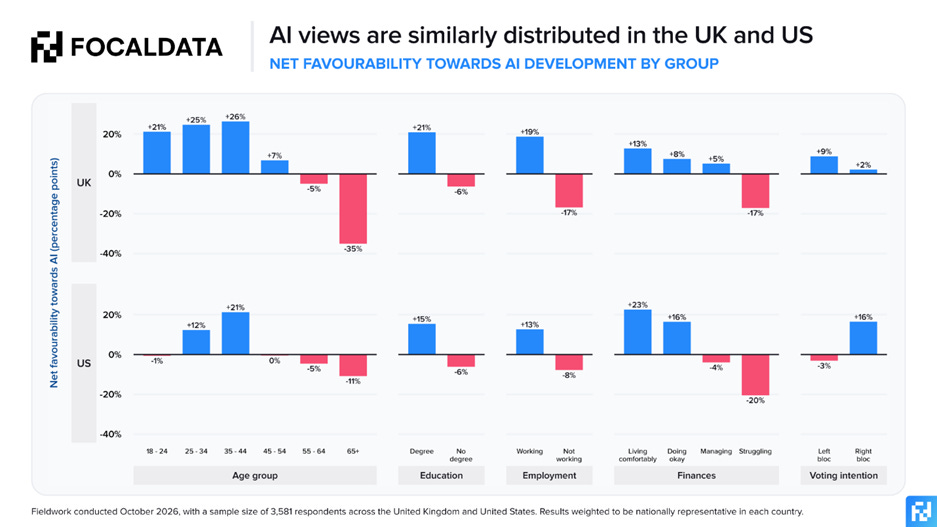
Despite this convergence in overall attitudes, there is a striking divergence in how much of a politicised issue AI has become. In the US, attitudes are increasingly split by political affiliation and the issue has become the latest front in the seemingly interminable culture war, playing a role in the upcoming midterms. This stark political polarisation of AI has not happened in the UK – at least not yet.
In what follows, we test several hypotheses for why the two countries are so far apart on a political basis. Understanding which hypothesis is correct will give us an indication of where the British dynamics go next.
Hypothesis 1: Attitudes towards AI are driven by different forces in the UK and US
One potential explanation for why AI has become politicised in the US but not the UK is that Americans’ attitudes towards AI are underpinned by different values. For instance, if opposition to AI in the US were more intimately connected to concerns that are already politicised – like job losses or economic inequality – that would explain why AI has become a locus of political debate.
However, when we look at which underlying sentiments predict being opposed to AI, the key drivers are the same in both countries. For instance, in both the UK and US, overall opposition to AI is strongly predicted by an expectation that it will lead to a net loss of jobs, lack of trust in the technology, and a worry that it will erode human cognitive ability. These concerns are shared by a large share of both electorates, and they contribute to overall judgements about AI in similar ways.
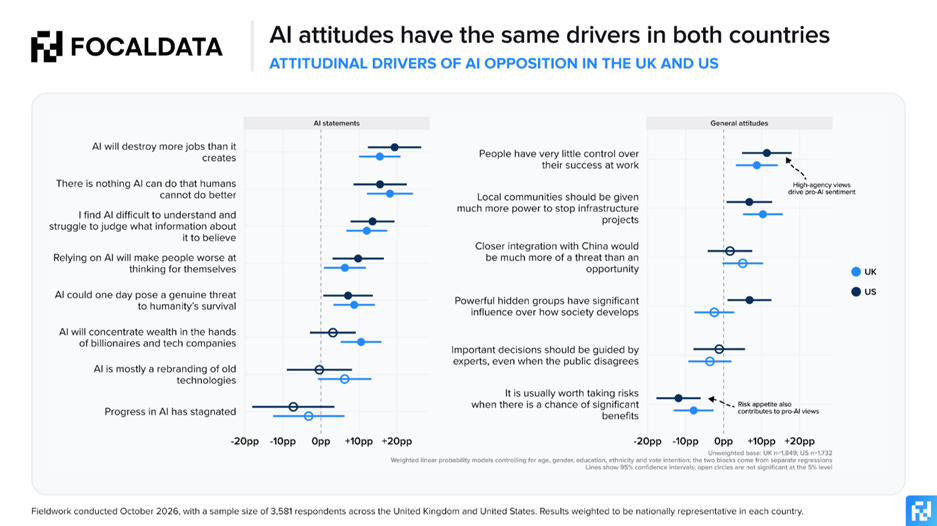
When we look deeper at the fundamental values that drive unfavourability towards AI, once again the most significant associations are common to both countries. Among the most predictive underlying attitudes are a generalised aversion to risk (a reluctance to accept costs even where there is a chance of greater benefits) and a low sense of agency (the belief that people have little control over whether they succeed at work).
This analysis suggests that similar factors are behind opposition to AI on both sides of the Atlantic, including a perceived loss of control over work and fears about diminishing economic security. There are very few AI attitudes which we can say with confidence have a stronger effect in one country than in the other. Whatever explains the divergence in the politicisation of AI, it is not a difference in fundamental attitudes towards the technology.
Hypothesis 2: AI is a less motivating issue for British voters than for Americans
British voters and American voters clearly feel similarly about AI, so perhaps the political difference is that Americans are motivated to act on their feelings at the ballot box in a way that Britons are not. That would explain why the British electorate has not self-sorted into parties that match its views on AI in the same way the American populace has.
To test this hypothesis, we stripped party politics from the equation and assessed voting preferences in the abstract along policy lines using a conjoint experiment. We are not suggesting here that all voters cleanly choose political parties on policy preferences alone, but the experiment can give us an idea of how motivating individual policy areas could be to voters.
In our experiment, we presented respondents with mini manifestos of hypothetical political parties, with five policies each – one on each of the economy, immigration, healthcare, constitutional reform, and AI. Survey-takers were presented with two parties at a time and asked to choose which they would be more likely to vote for. This forced-choice method enables us to understand exactly what matters to voters, uncovering latent preferences in a way we could not if we simply asked them to rank 25 policy options at once.
A head-to-head between two policy platforms might look something like this:
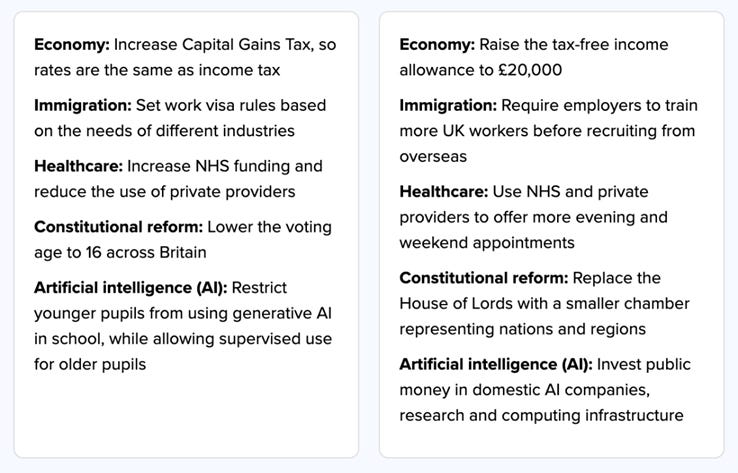
The output of conjoint analysis tells us how likely an average respondent is to choose a package containing a particular policy, all other things being held equal.
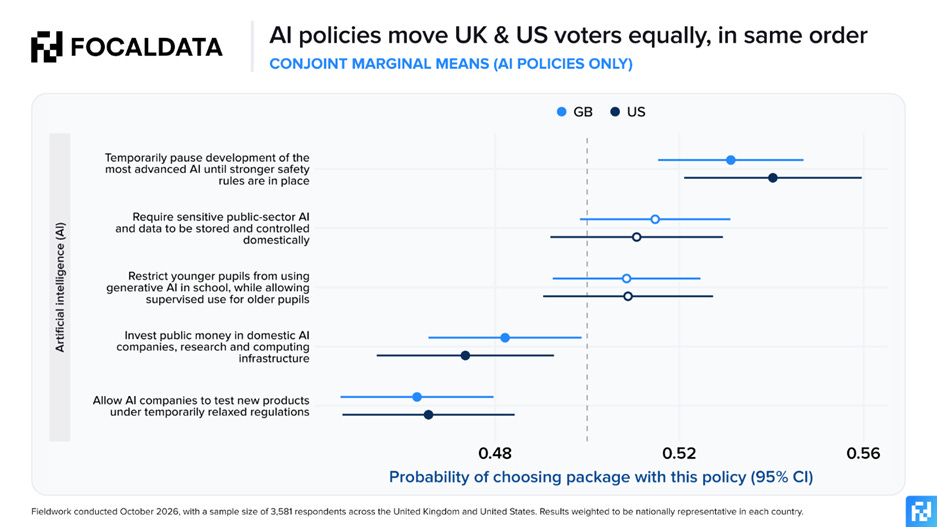
Our analysis showed that AI policy is in fact equally motivating to British and American voters, and both electorates rank the five tested AI policies in the same order of preference. We found no significant differences between the countries in terms of the overall salience of AI policies relative to other issues, or the power of individual policies to motivate vote choice.
In both countries, AI is a more motivating issue for those who are currently voting for parties of the left, with a larger spread between the effect sizes of different policies. Seven of the AI policy-by-country combinations (70%) have statistically significant effects on vote choice among left-of-centre voters, compared to only three for right-of-centre voters.
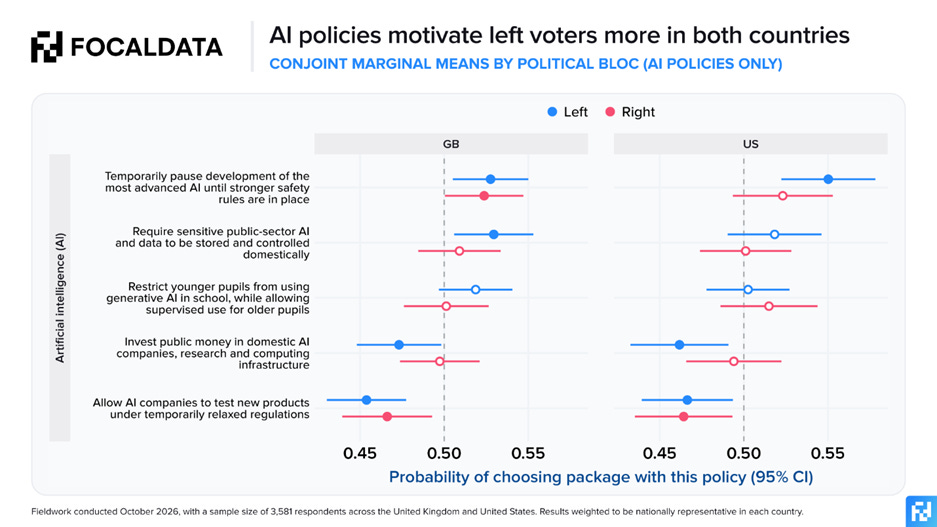
American voters on the left and the right broadly rank AI policies in the same order of preference, at least when detached from political parties. While AI is more motivating for Democratic voters in theory, these policy-only results do not explain the large degree of variation between the two parties in practice, suggesting that top-down signalling from party elites is helping to drive public opinion. This takes us on to our final hypothesis.
Hypothesis 3: British voters lack information about where parties stand on AI
Information plays a critical role in the politicisation of any new social issue, AI included. In particular, signals from political elites can speed up polarisation through two distinct mechanisms.
First, voters sort themselves into parties based on whether leaders’ statements align with their own views. Second, voters take cues from leaders they already support and adjust their own views accordingly. Both self-sorting and cue-taking contribute to polarisation, but the direction of causality is reversed: in the former, voters match their party to their opinion, while in the latter they match their opinion to their party. Crucially, both mechanisms depend on elite signalling. Leaders must make their positions known before the public can respond, whether by changing their vote or their views.
We have seen that the British electorate contains pro- and anti-AI blocs, and that AI policy has the potential to motivate vote choice in the UK, just as it does in the US. Perhaps the difference between the countries lies not in voters’ demand for politics organised around AI, but in politicians’ willingness to supply it.
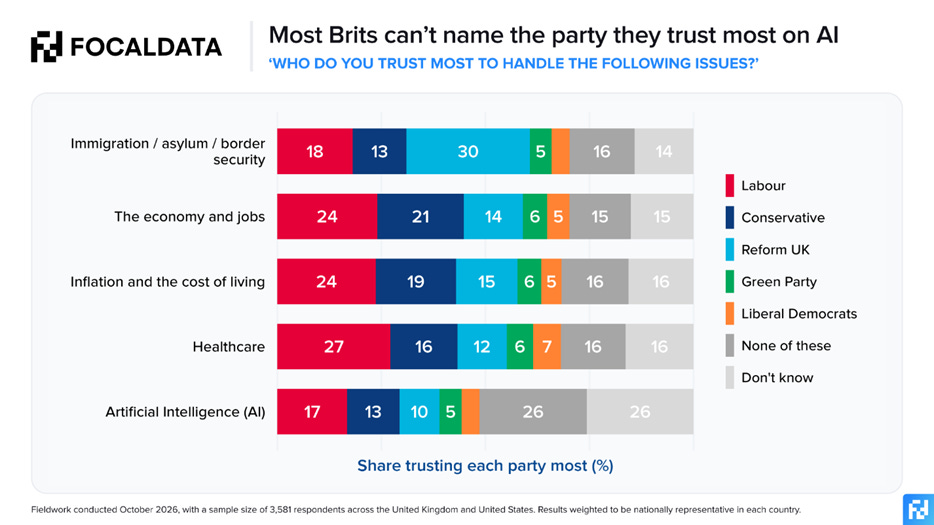
There is strong evidence that British voters have significantly less information than Americans about where each party stands on AI. More than half of British voters express no opinion about which party would best handle AI, far more than for any other political issue we tested. In the US, 61% of voters have a preferred party when it comes to AI. Although American voters are also more likely to be undecided about AI than about other issues, the gap is narrower than in the UK. This means that even if they wanted to, most British voters could not self-sort into parties that align with their views on AI because they do not know which party aligns with their view on AI.
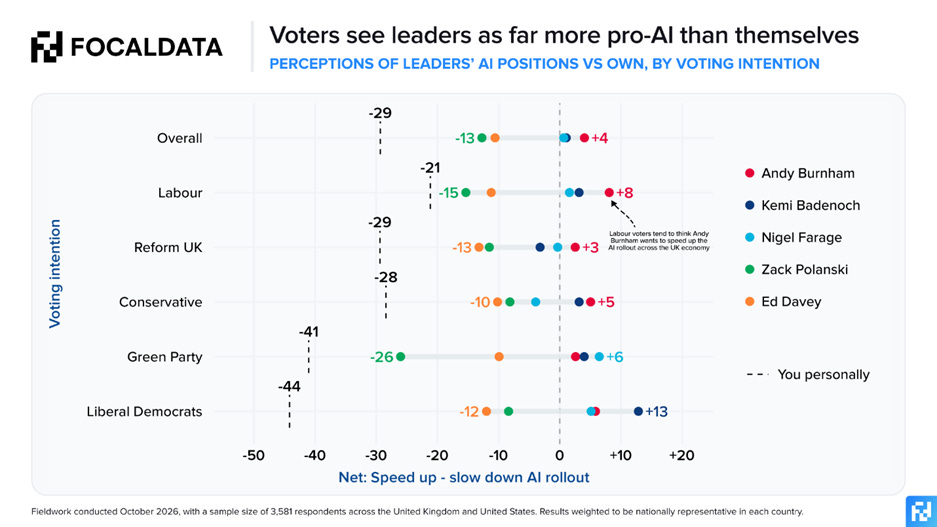
It is no wonder British voters are uncertain about which party to trust on AI, as they have not received clear signals from political elites. When asked whether party leaders favour speeding up or slowing down the rollout of AI into the economy, many voters are unsure. Only 36% of Britons think the Prime Minister wants to speed up (20%) or slow down (16%) the AI rollout; the rest are unsure or think he sits firmly in the middle. Even more are in the dark about Kemi Badenoch and Nigel Farage. And among those who express a view, there is disagreement about what the leaders think, reflecting confusion as well as ignorance. In contrast, British voters tend to know their own minds: only 13% don’t know what their personal view is.
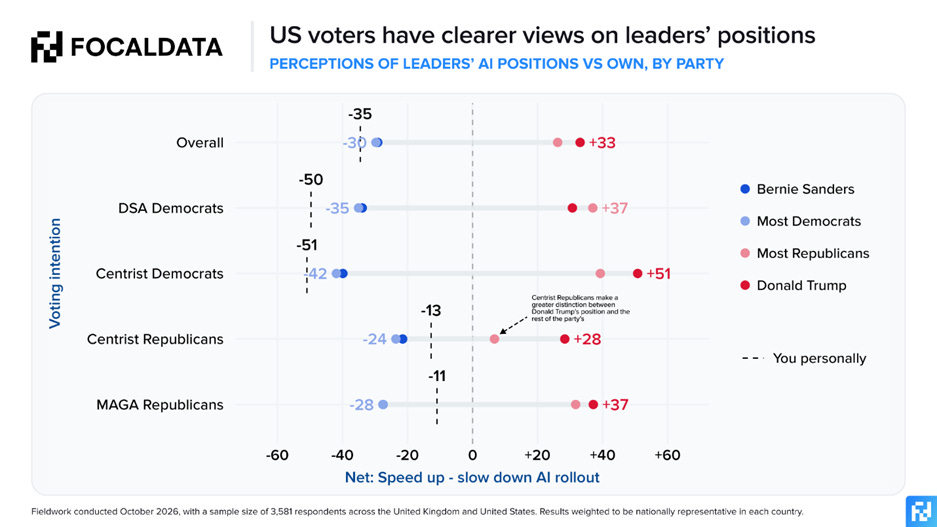
In the US, voters are in no doubt about where the parties stand on AI. Only 14% say they don’t know Donald Trump’s position, and voters across the political spectrum agree that he wants to accelerate AI adoption. Likewise, there is consensus that Democrats would prefer to put the brakes on AI. This degree of common knowledge about parties’ positions allows voters to self-sort or take their cue from political elites, and it’s precisely what’s missing from the British context.
Why is there more elite signalling about AI in the US than in the UK?
Self-sorting and cue-taking are not inevitable. To understand why political elites have sent clearer signals about AI in the US but not the UK, we need to consider the different incentives facing political parties in each country.
In the US, the divides along pro- and anti-AI lines uniquely work in the Democrats’ favour in this current political environment. The anti-AI coalition maps closely on the political compass to the typical Democratic coalition, especially when it comes to economic views. Overall, when the majority of Americans want to slow down the development of AI, this puts Democrats closer to the median voter. The result is that the American left sees both Bernie Sanders and “most Democrats” as closer to their own position than people on the right see Donald Trump and “most Republicans”. Heading into the November midterm elections, Democrats are well positioned to reinforce this stance, whereas any Republican course correction may come into conflict with some of their big-tech backers.
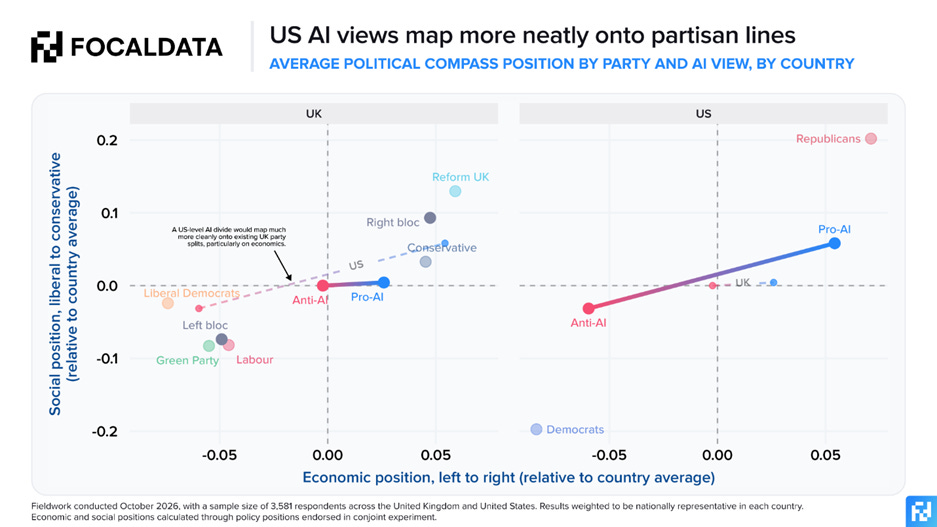
By contrast, AI cuts across political divides in the UK. Parties’ existing identities and electoral coalitions do not map neatly onto the debate. For instance, AI exposes a tension between Labour’s commitment to economic growth through technological progress and its traditional concern for workers’ rights. The Conservatives face a similar dilemma: their pro-innovation instincts favour support for AI, but their voter base contains a high concentration of older voters, who tend to be the most wary about new technology. For parties in the UK, being vocal about AI or having a soundbite-friendly position often risks alienating some section of their existing coalition.
The one exception to this trend is the Green Party. Unlike other leaders in the UK, Zack Polanski has been vocally opposed to the rollout of AI into the economy, and Green voters’ attitudes on issues like data centres have shifted as a result. This is good politics for the Greens, whose commitment to environmentalism, loathing for inequality (only 11% think AI will reduce it), and hostility towards Big Tech make AI scepticism a natural fit. Yet despite Polanski’s public interventions on Palantir, water usage, and data centres, a majority (52%) is unsure what he thinks about AI. This underscores the challenge facing the Greens to put AI policy on the political agenda without a clear opponent.
In the US, there is also another group of elites from whom voters can take their cues: namely, the leaders of the world’s biggest AI firms. We asked Americans and Brits their opinion about various tech leaders that have been at the forefront of the cultural conversation, and found that Americans were far more likely to know who each leader was and have an opinion on them. More than that, Americans on the right were universally more likely to be favourable towards these figures than those on the left. In the UK, the partisan gap is smaller.
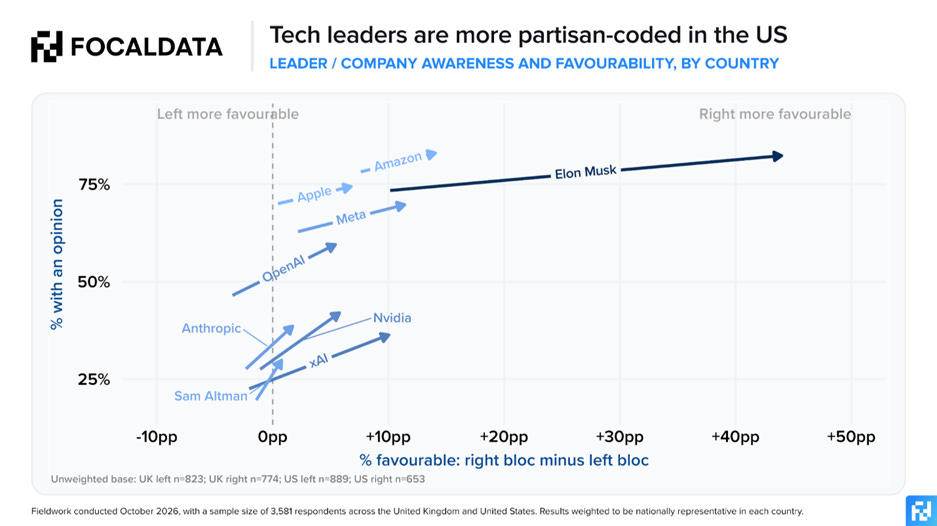
This reflects the fact that tech leaders play an outsize role in US politics. In Forbes’ “AI 50 list”, 9 out of the top 10 AI companies were based in America (the exception being Mistral AI, located in Paris, France). These tech firms have a GDP output of roughly $1.2 trillion per year in the Bay Area alone. The most visible player, Elon Musk, has increasingly been spending millions of dollars for Republicans in electoral races, and led Trump’s Department of Government Efficiency (DOGE), though Musk is far from the only tech leader contributing to Republican politics. This puts Americans in a position where they are responding to signals not only from politicians themselves but also from high-profile and partisan tech leaders.
The final reason why elite signalling is more prevalent in the US is that the explosion in data centre construction has forced AI onto the political agenda. Voters in the US are even more polarised when it comes to data centre construction than to the development of AI itself.
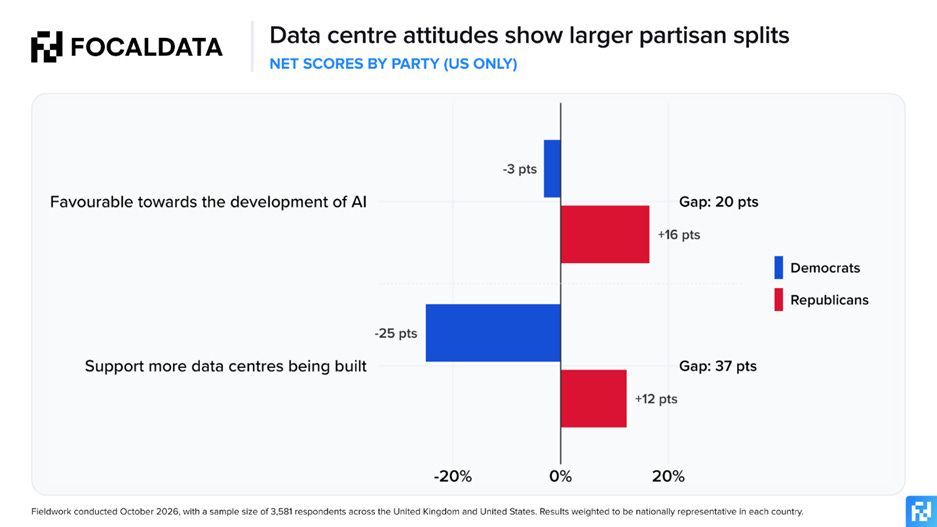
Similar left-right splits among the electorate exist in the UK, with those on the left showing soft opposition to data centres, and those on the right showing soft support. However, the difference in polarisation is stark: only a 5-point gap exists in the net scores between the UK left and right blocs compared to the 37 points observed in the US.
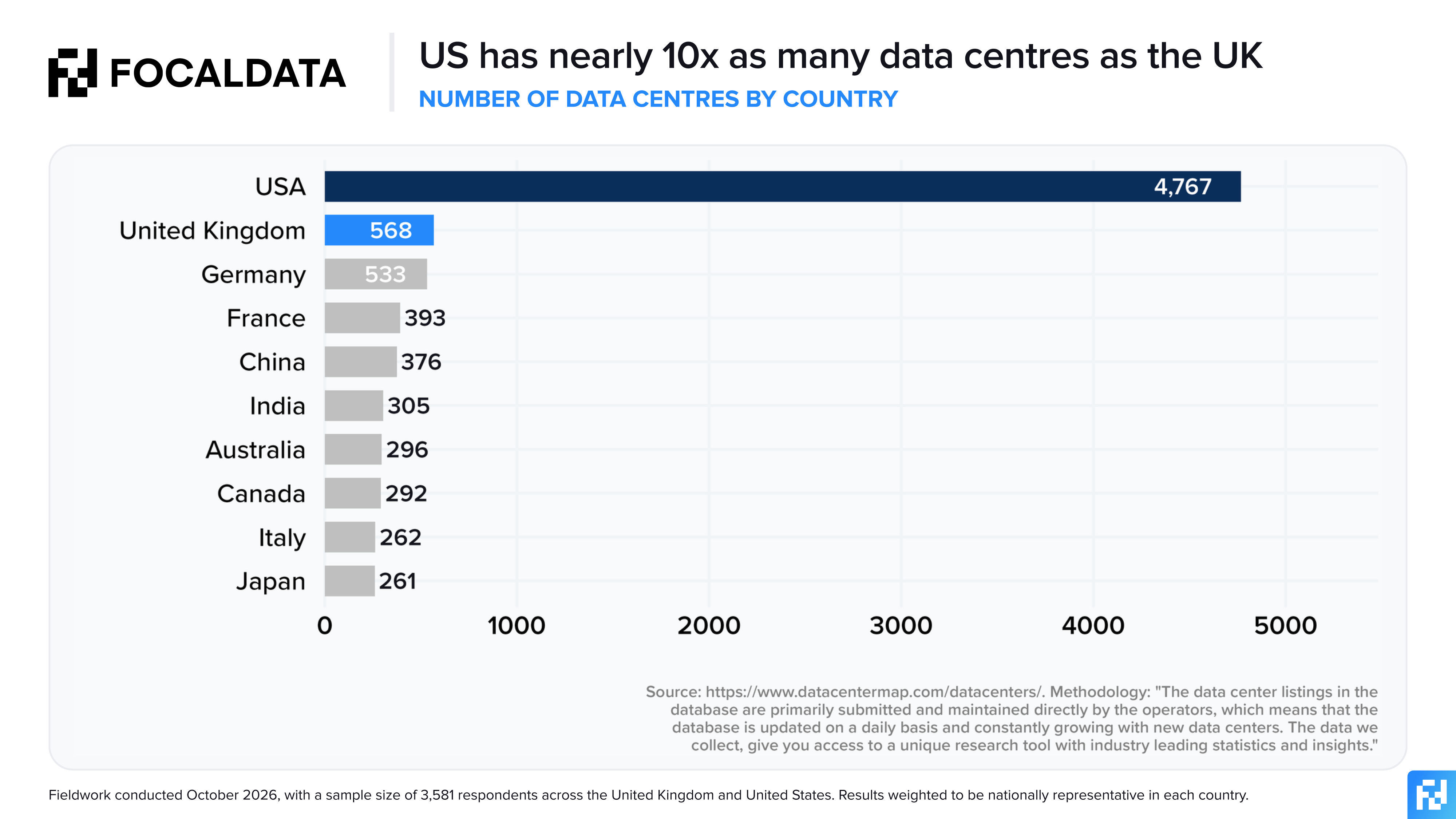
As with AI overall, there is good reason to believe that elites in the US are under more pressure to pick a side. Just as most of the tech firms at the forefront of AI development are located in the United States, the US is also home to the largest number of data centres in the world by a factor of almost ten (4,767 in the US; 568 in the UK).
AI as a political opportunity?
It is tempting to assume that American politics is a leading indicator for what will happen in the UK. Based on that assumption, it would only be a matter of months before British politics becomes engulfed in fiery debate about AI policy. The reality is likely to be less dramatic and we should not be too ‘America-brained’ when thinking about this issue. Although there is latent demand among the British electorate for politicians to respond seriously to their concerns about AI, there are fundamental differences between the UK and US which mean it may not be met, at least in the same way.
The distinct structure of the British party system means that most UK political leaders have not had an incentive to send strong signals to voters on AI. UK parties’ electoral coalitions generally hold a wider set of views on AI, and AI positions map less tightly onto existing political divides on this side of the Atlantic. What’s more, America’s relationship to big tech is fundamentally different. The UK has far fewer tech leaders and is far less politically polarised when it comes to views on some of the biggest companies and leaders.
The exception to the above is the Green Party, who may spy a political opportunity to reverse their declining fortunes by pushing a US-style debate about AI and data centres onto the political agenda. This could be particularly advantageous for the party if it plays up traditional green-left concerns around environmental protections and job concerns. This could put pressure on Labour from its left flank, especially if fears around AI grow, but is unlikely to shift positions across the full political spectrum as in the US. The full importation of a US-style political divide is far from inevitable, and our politics might be all the better for it.
You can sign up to receive the full report when it’s released here.