Blog/Polling
Labelmaxxing: inside Gen Z's terminally online vocabulary
“Rizz”, “Looksmaxxing”, and “Mogging”. Terms you’ve likely never heard of if you are over the age of 35, although you might have stumbled across the “manosphere”. For the Rest is Entertainment’s latest episode of the Vibe Check we asked over 1,000 Brits whether they’d come across a slew of slang terms associated with Gen Z and the internet. What we found was a world most over-35s were oblivious to, particularly the emergence of the fraught world of "looksmaxxing,” which is becoming increasingly popular among young men.
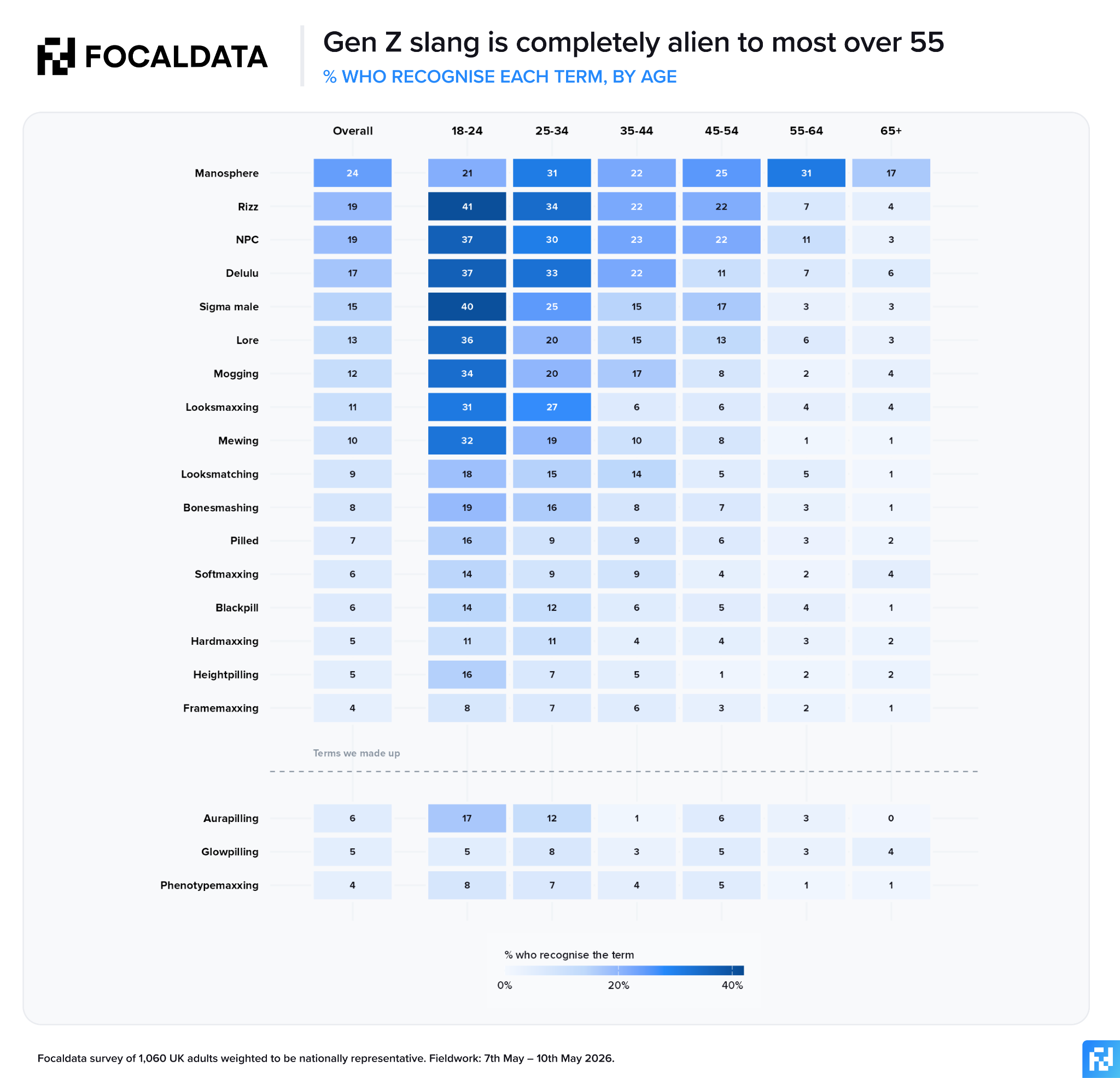
There was a steep downward age gradient for most of our terms; 84% of 18–34 year olds said they had heard of at least one of the slang terms we listed (excluding "manosphere"), compared to only 40% of those aged over 35. But the “manosphere” was an unusual exception. It had unusually high recognition among all age groups and therefore a much more regular age profile. 24% said they had heard of the term and recognition was actually lower among 18-24 year olds than those aged 25-34. It was by far the most recognised term among over 55s at 23% recognition, against just 6% for the next most familiar term (NPC). This suggests that the manosphere is less of a terminally online Gen Z slang and more of a millennial-coded term which is now becoming mainstream.
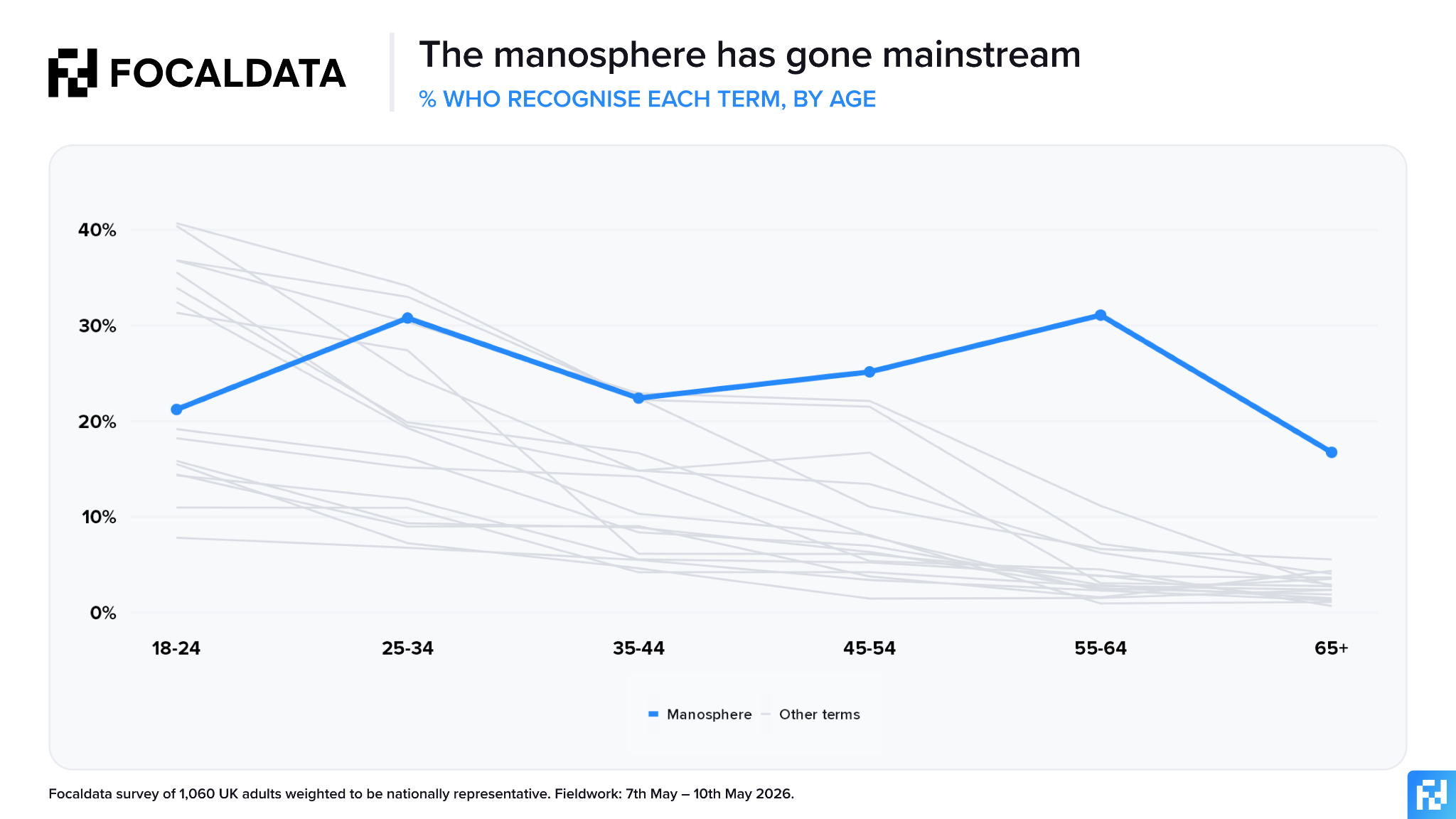
For our other terms, over 40% of 18-24 year olds say they have heard of Rizz, a shortening of charisma which is often used as a verb (to “rizz” someone up usually means to try and chat someone up), which was the second highest recognition for a term behind “manosphere”. NPC, an acronym of the technical video game term “non-playable character”, Delulu, a play on the word “Delusional”, and Sigma Male, a part of the alpha/beta terminology used to categorise wolves, also have very high recognition rates among young people. Each has their own in-group meanings, NPC is usually used derogatorily to describe someone who mindlessly follows the herd, while Sigma Male is almost a direct contrast and is typically used to describe a lone wolf type personality who effortlessly gets female attention.
We also included a few terms that we completely fabricated: Aurapilling, Glowpilling, and Phenotypemaxxing aren’t actually real slang (yet). In spite of this, a few participants claimed to be familiar with them. 17% of 18-24 year olds said they had heard of “Aurapilling”, with many likely thinking that the term was connected to “aura,” another term that has been incorporated into Gen Z/Internet slang and can be roughly translated as either “magnetism” or “vibe”.
When you plot men aged 18-34 against women of the same age group, it becomes clear that there are some terms which are gender-coded, 38% of women aged 18-34 recognise “Delulu” compared with only 29% of men in the same age group. Yet while “delulu” is our only clearly female-coded term, there are plenty that are male-coded: looksmaxxing (40% male, 20% female), bonesmashing (27% male, 10% female) and NPC (38% male, 29% female) are all terms that young men recognise at a much higher rate than young women.
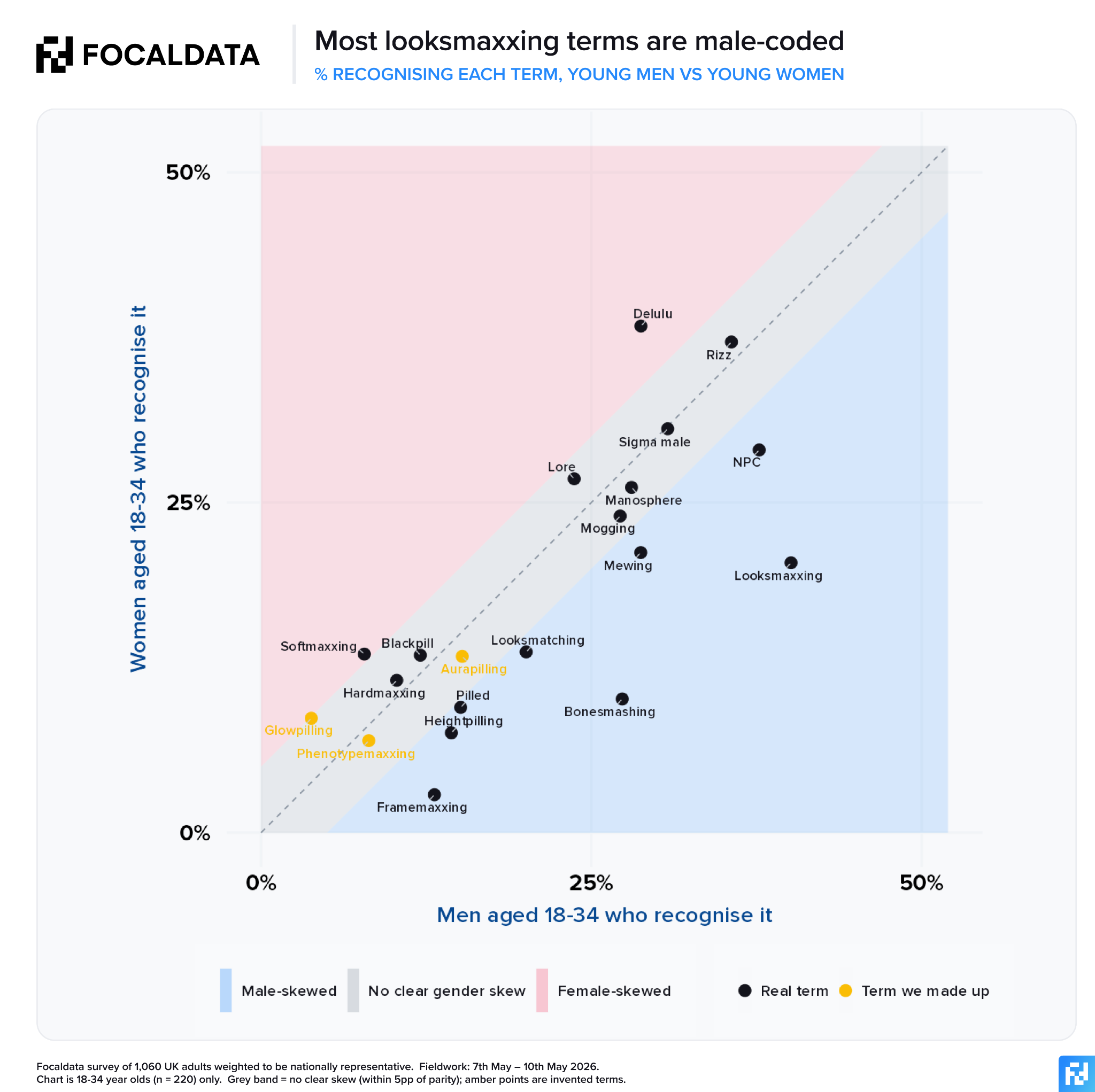
Looksmaxxing, and associated terms such as bonesmashing, heightpilling, mewing, and framemaxxing, all skew young and male. Put simply, looksmaxxing is just “attempting to maximise the attractiveness of one’s physical appearance”, although the lengths taken to achieve this can vary from just simple grooming and skincare to extensive cosmetic surgery. Looksmaxxing also has one of the steepest recognition drop-offs after the age of 35, 40% of men aged 18-34 know what looksmaxxing is compared to only 6% of men aged over 35.
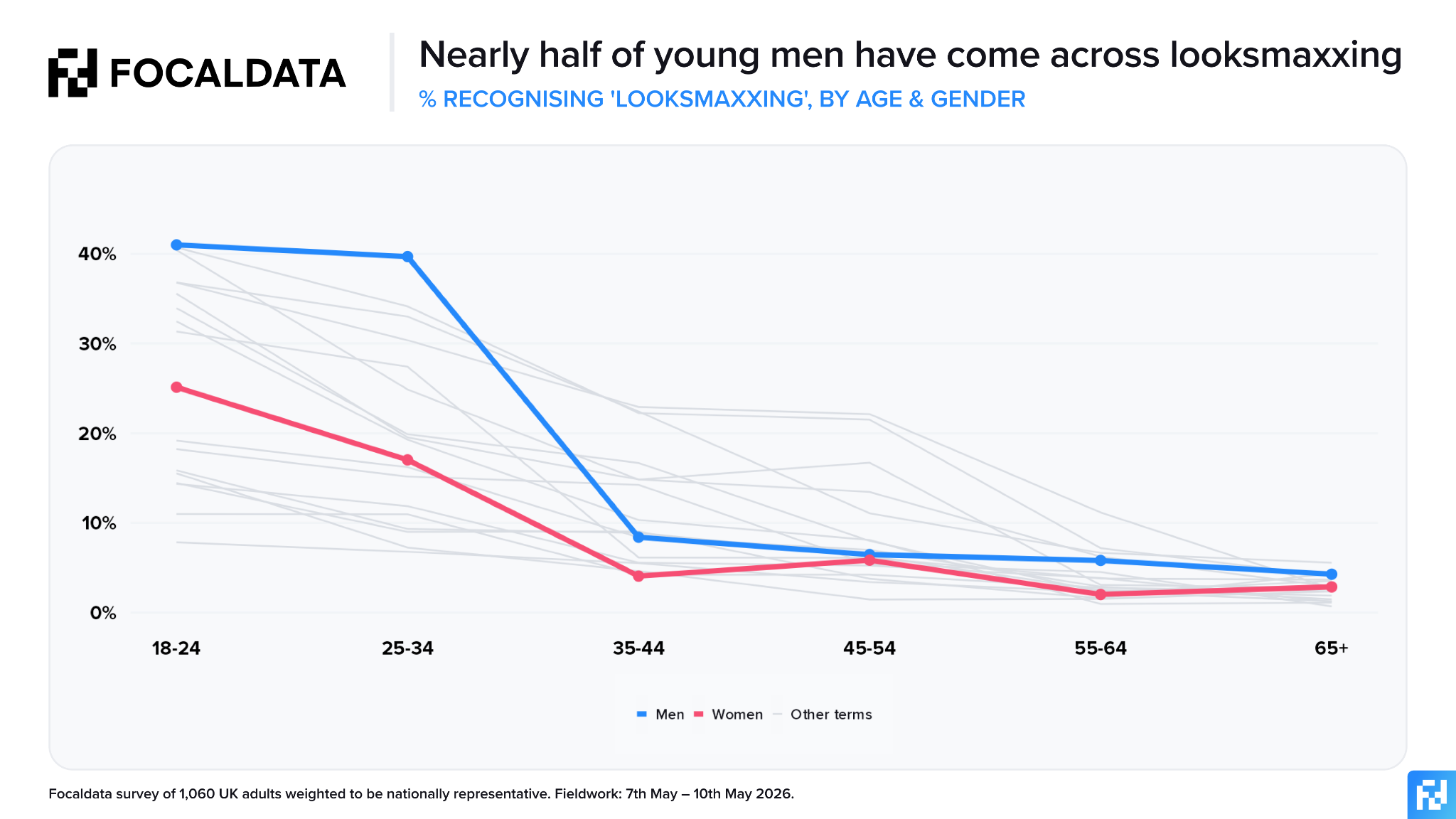
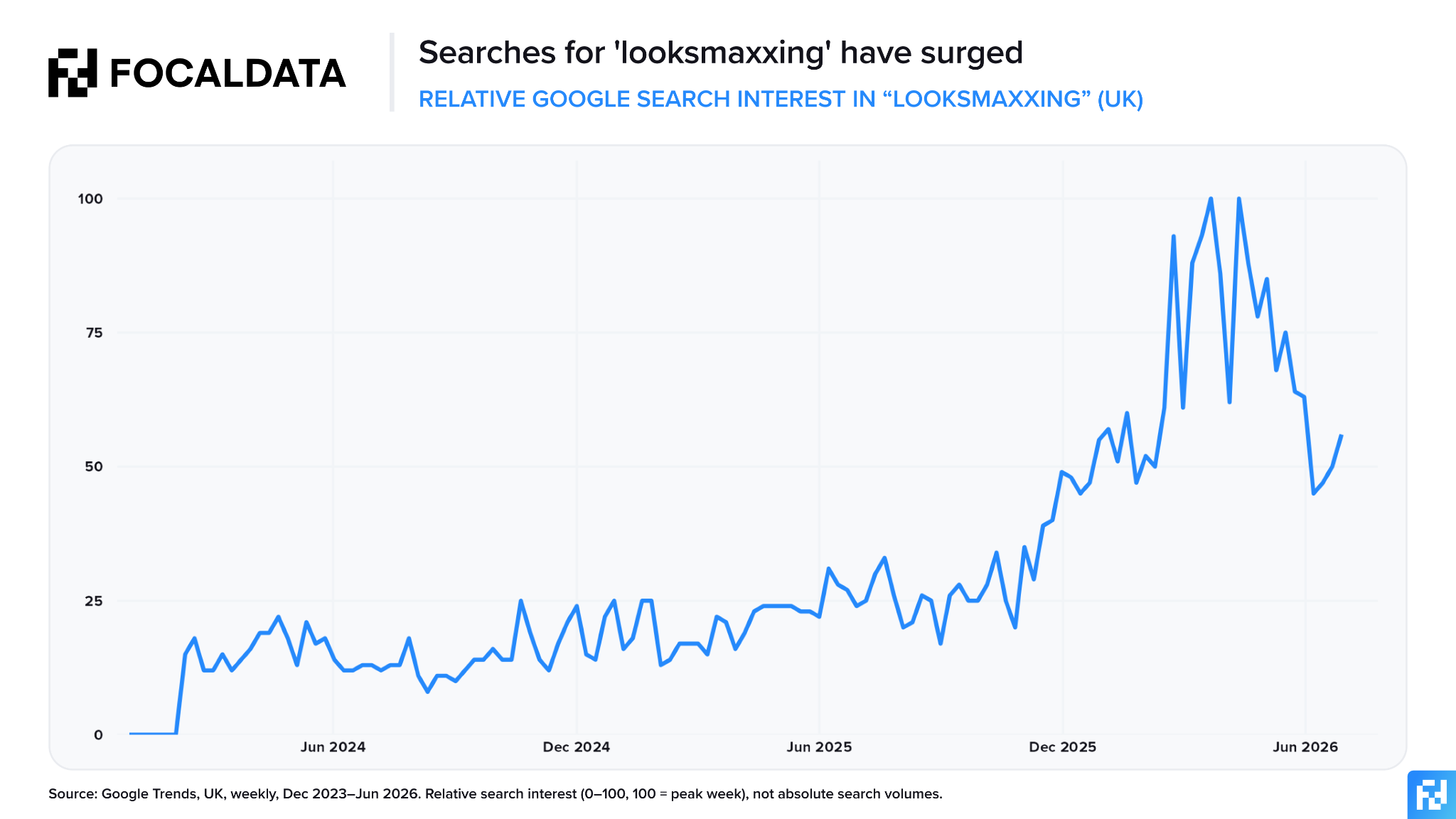
The term has skyrocketed in recent months, going from almost complete obscurity to a place where almost half of young men have heard of the term. This is in large part due to the surge in popularity of 20-year-old online streamer Braden Peters, better known by his internet username Clavicular, who has acted as a sort of figurehead and advocate for looksmaxxing. At its core, Clavicular's philosophy holds that attractiveness is the main, if not the sole, determinant of your place in society, which makes looks the one thing in life that truly matters.
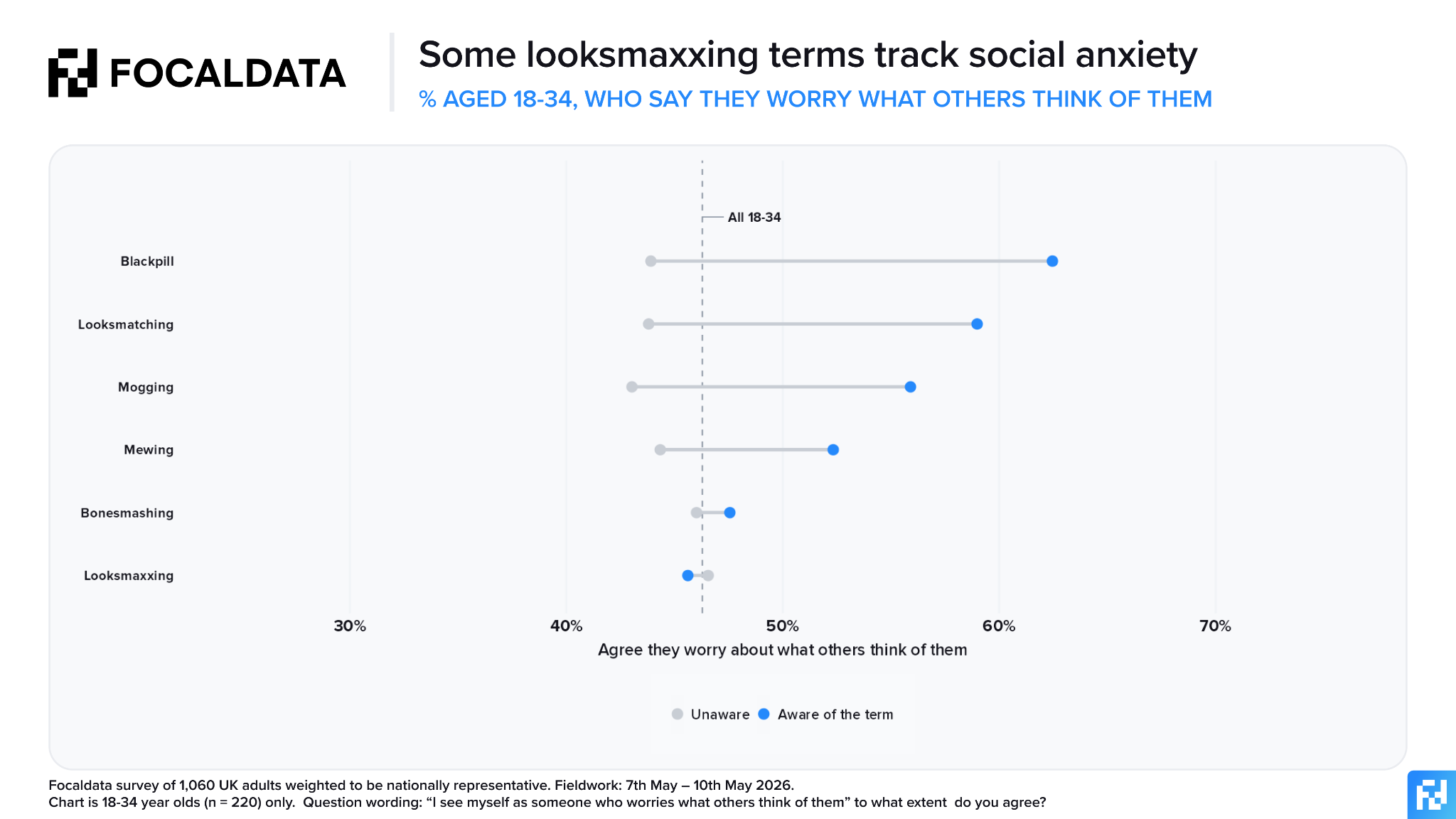
Based on this a reasonable hypothesis might be that those familiar with the term “looksmaxxing” would be more likely to worry about what others think of them, but our research suggests that this isn’t true, perhaps due to the fact that the term has become more mainstream among 18-34 year olds. However, more obscure terms within the same space (such as blackpill or looksmatching) seem to track this self-consciousness closely.
In a sense, it’s intuitive that terms like the blackpill and looksmatching are the terms that most reinforce anxiety and a deterministic worldview. The blackpill (poorly defined online, but roughly translating to a nihilistic worldview in which women choose male partners based solely on immutable physical traits) and looksmatching (the idea that partners in a relationship are judged to be of equal attractiveness) both feed into this same fatalism. Among 18–34s, 62% of those who recognise "blackpill" agree they worry about what others think of them, compared with 44% of those who do not, and recognisers of "looksmatching" show a similar gap (59% versus 44%).
The world of Gen Z and Internet slang may seem completely alien to those over the age of 35, but chances are that many of these terms could soon follow in the footsteps of “the manosphere” and make their way into the mainstream over the next couple of years.
Data tables for this survey can be downloaded here.