Blog/Research
The Housing Belief Map: Why Britain Wants More Homes but Won’t Build Them
Building public permission for new development
The government wants to build more homes. So does the sector. The argument for doing so, that Britain does not have enough housing and that building more will make it more affordable, is widely accepted among policymakers and economists, yet the public does not accept it.
That is the central finding of our new research. Three things follow from it, each of which complicates the politics of new development.
Affordability comes first
Cost-of-living pressure is the backdrop to every policy debate in Britain right now, and housing is no exception. When people think about housing costs, they are thinking about their rent next month, not about 10-year supply curves.
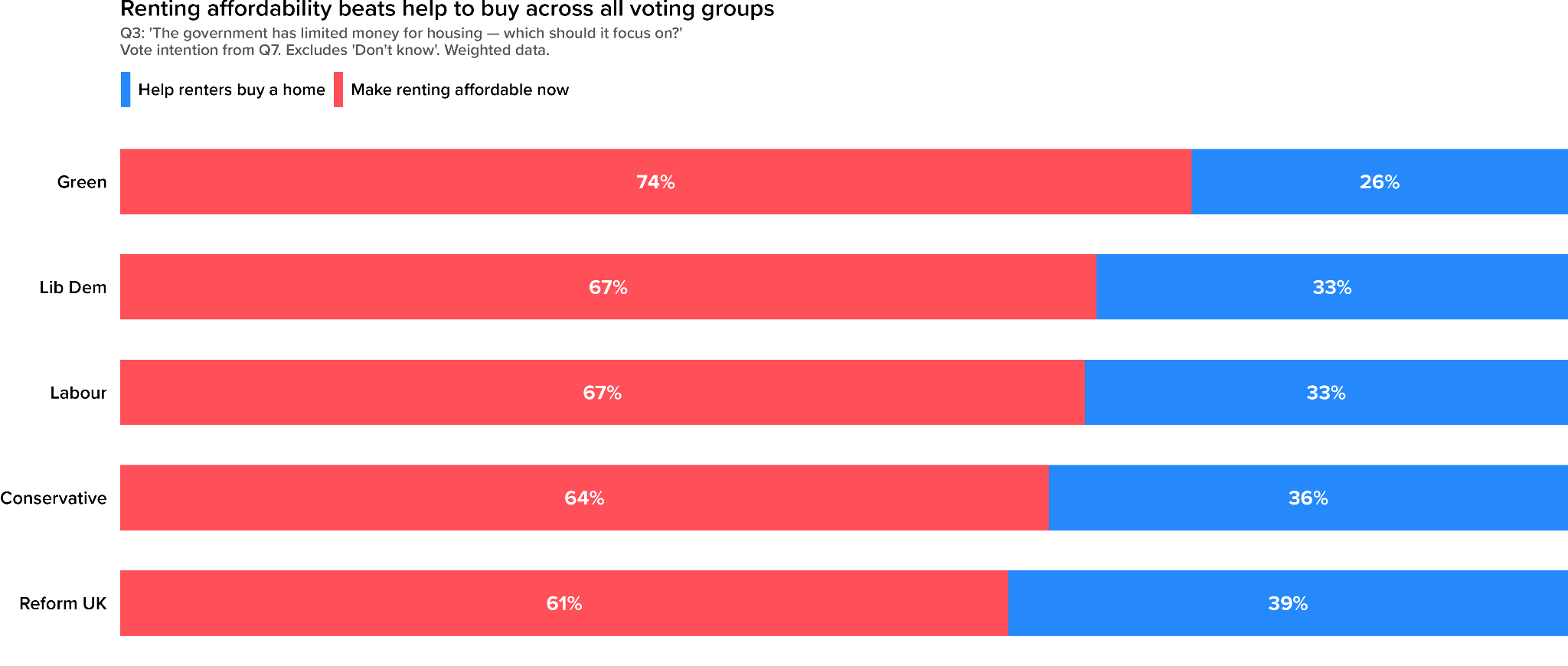
That immediacy has rewritten the politics of housing in ways the sector has not fully caught up with. When we asked renters what the government should focus on with limited resources, 61% chose making renting more affordable and secure now; 31% chose helping renters buy a home in the future. The same answer comes back regardless of political affiliation, including amongst Conservative and Reform UK voters. A politics organised around home ownership has given way, in the space of a few years, to one focused on simply making housing more affordable.
That shift explains why rent caps now hold majority support across almost every cross-cut of the electorate. 66% percent of the public back a cap on rents in the UK. Three-quarters of private renters do, but so do 69% of home owners. It crosses party lines too: a clear majority among Conservative and Reform UK voters as well as Labour, Lib Dem and Green ones. A policy often seen as left-wing interventionism has come close to reaching a cross-partisan settlement because the strain of the cost-of-living and rising rents is now impossible to ignore.
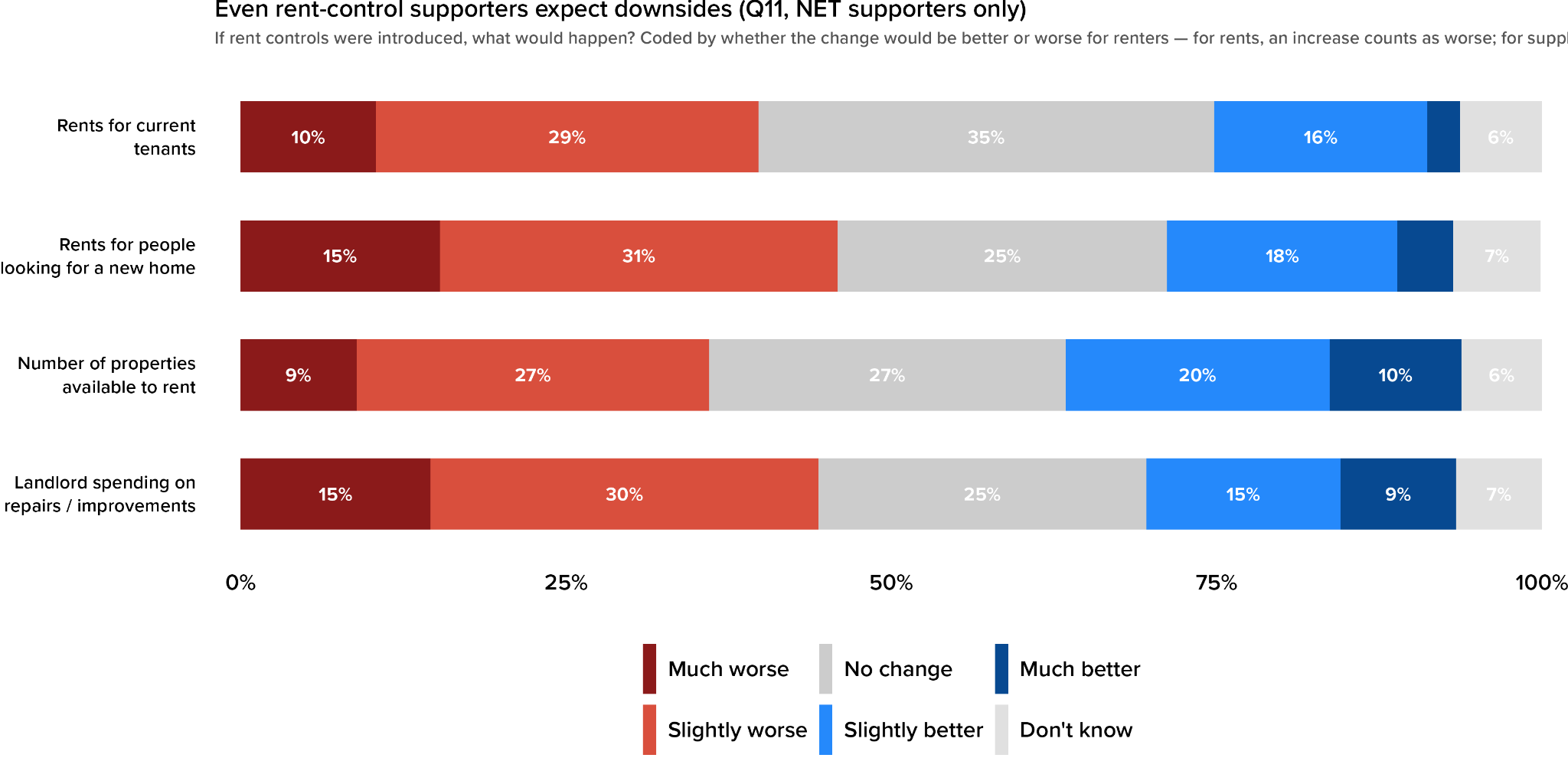
However, this support is not naive. Asked what they expect to happen if rent controls were introduced, rent-cap supporters themselves expect downsides. 40% think rents for existing tenants would rise anyway. 45% think landlords would spend less on repairs. 36% percent think rental supply would fall. This suggests the public are not backing rent caps because they think the policy is costless. They are backing it because the alternative, continued exposure to a market that feels out of control, is worse.
Rent caps poll this well because the policy is intuitive, immediate, and easy to picture. Building more homes is none of those things, and so struggles to compete.
The public does not buy the supply argument
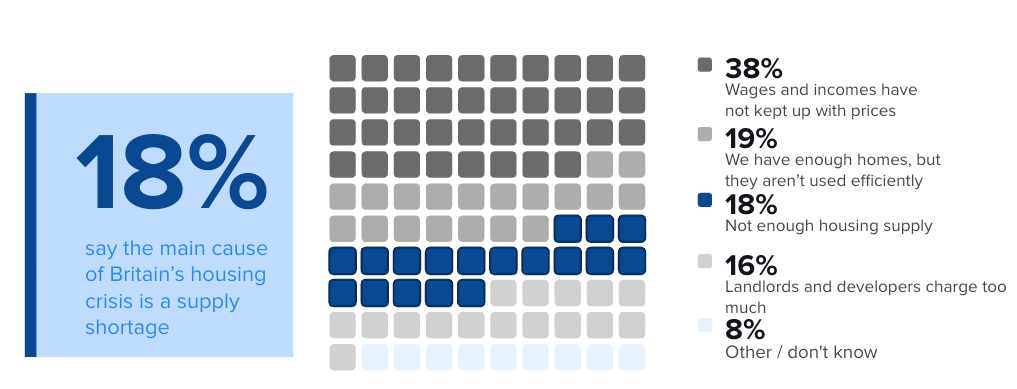
The case for building more homes rests on a particular diagnosis: that there are not enough of them. The public mostly does not share that diagnosis. Only 18% point to a shortage of housing as the main cause of Britain's housing crisis. Larger numbers blame stagnant wages (38%), inefficient use of the existing stock (19%) or landlord and developer behaviour (16%).
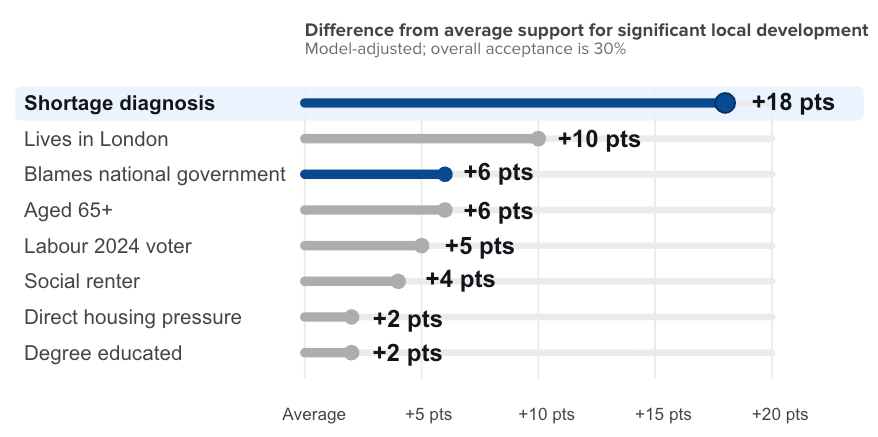
This is not just a quibble over causes. What people believe about the cause of the problem determines what they will accept as the solution. Among those who do identify shortage as the main cause, 52% accept significant local development while among those who give any other answer, acceptance falls to between 16% and 30%. Our regression analysis confirms that this single belief, that Britain has too few homes, is the strongest predictor of support for local development, sitting 18 points above the 30% average and outweighing every demographic and political factor we tested.
This means the supply argument is the most powerful single lever the sector has. But it also means the sector is making its case to a minority that already agrees with it. The wider public, the four in five who locate the problem elsewhere, are not being argued with at all. As long as that continues, support for new building will stay narrow, and direct interventions like rent caps will keep feeling like the more obvious answer.
Building communities, not houses
If supply belief is so effective at driving support for new homes, the obvious response is to explain the supply argument more clearly. We tested whether this works.
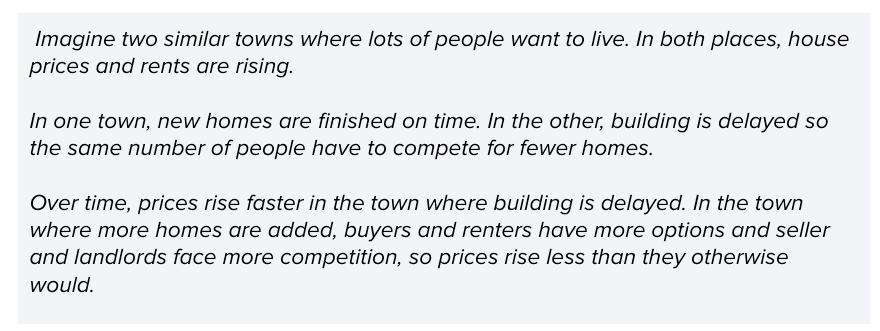
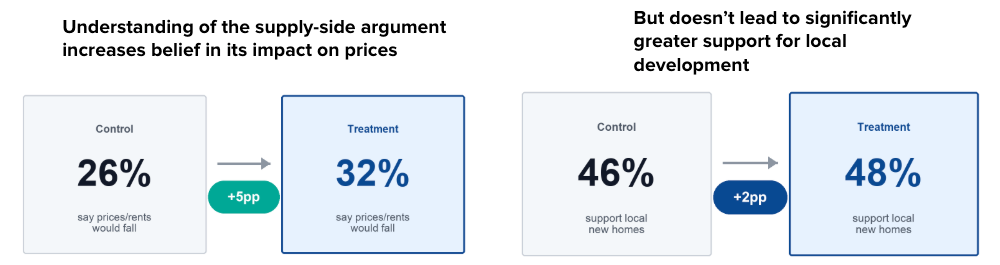
Half of our respondents were shown a brief illustration of how supply affects prices: two similar towns where lots of people want to live, one where new homes are built on time and one where they are delayed, and what happens to prices in each. It worked, up to a point. Belief that more homes would reduce rents and prices rose by around 5 points among those who saw it. But support for new homes in the respondent's own area did not move.
That gap is the most useful single finding in the study. It tells us that believing the supply argument and winning support for local developments are two different problems: you can shift someone's view of housing economics without shifting their willingness to accept building near them. The economic case opens the door to support, but it does not walk through it.
So, we asked people who did not yet accept significant local development what would change their view. Infrastructure alongside new homes came first, named by 28%: roads, schools, GP surgeries, green space. Genuinely affordable homes came second (16%), and evidence that more homes lower prices came third (13%). The pattern holds across most age groups.
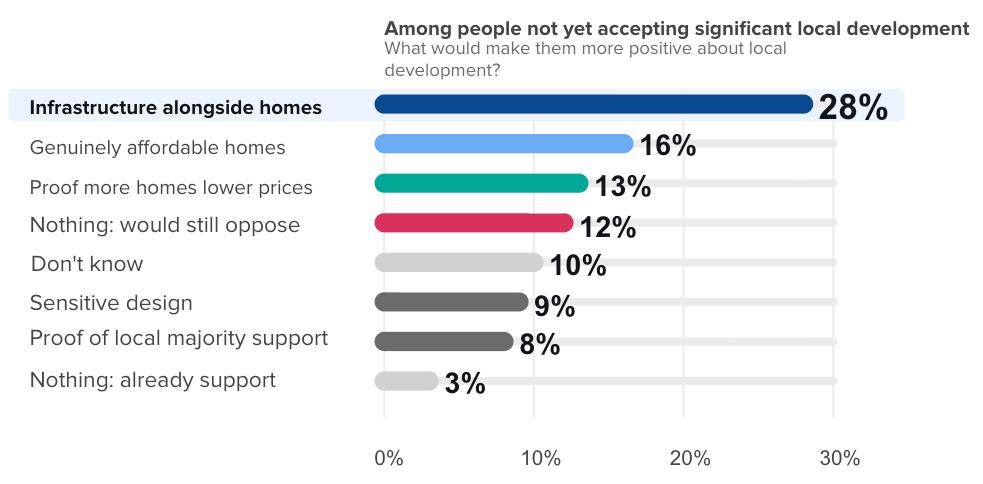
The exception is 18-24 year-olds, who are far more likely to be priced out of housing themselves: for them, evidence that more homes reduce prices is the top answer at 22%. This means that younger adults will accept the supply case if you can make it land; older voters want to see what they get in return for accepting a local development.
Both groups are telling the sector something useful. The winning frame for new development is not “build more homes”. It is “build communities people can see themselves benefiting from”, with the economic argument running underneath rather than out in front.
Where this leaves the politics of new development
Take these findings together and a fairly clear picture emerges. The sector is fighting on terrain that does not suit it. It is making an economic argument to a public that does not buy economic arguments about housing. It is asking communities to host new development without offering a credible account of what they get back. And it is doing this against a political backdrop in which immediate affordability has become the dominant frame, and rent caps are the clear and understandable solution.
None of this means the supply argument should be abandoned. The data is unambiguous that supply belief is the most powerful single thing that moves opinion. But it does mean two things have to happen in parallel that the sector currently treats as the same task.
The first is the economic argument: making the case that Britain has too few homes, and that this is what drives prices. That argument is largely absent from public discourse on housing today, and reviving it is the precondition for almost everything else. The second is the community argument: pairing every specific development with a credible offer of what arrives alongside it. Infrastructure, affordable homes, design that fits the area. Without that, even people who accept the supply case in the abstract will resist its application to their street.