Blog/
The UK’s Shrinking Donor Base
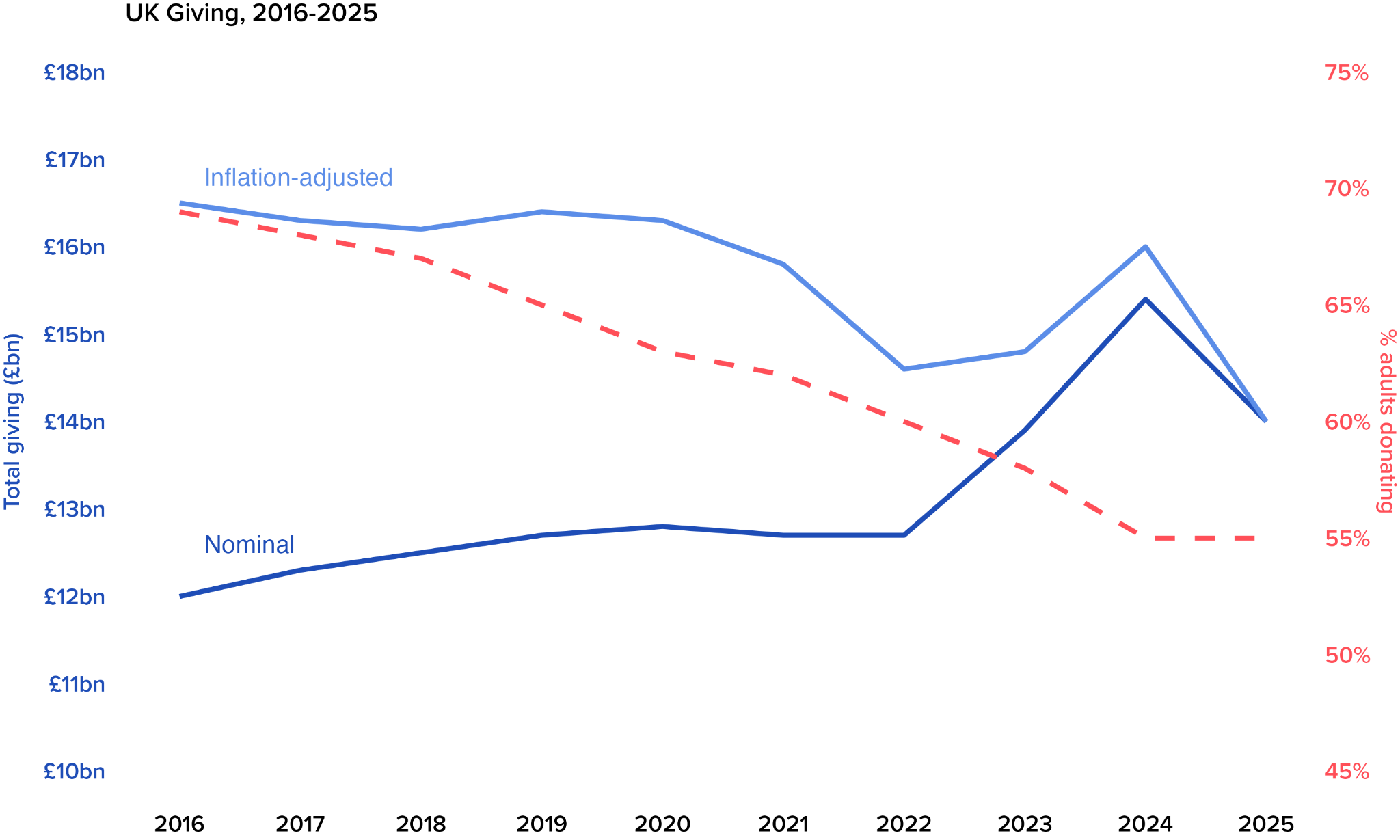
Data from CAF’s annual World Giving Reports shows a consistent decline in the proportion of UK adults who donate money to charitable causes since the first report was published in 2016. Despite a shrinking donor base, the estimated total amount given across the UK had remained broadly stable up until 2022 in nominal terms – albeit not increasing in line with inflation.
In 2023 and 2024 the estimated total amount donated increased sharply, with 2024 indicating a real-terms recovery to the relatively stable level of donations prior to 2022. At the same time, the donor base continued to shrink, and at a faster rate than any years prior.
The most recent report estimates a 10% decline in total donations year-on-year, from £15.4 billion in 2024 to £14 billion in 2025. This is the first significant drop in donations in nominal terms, and the lowest total in real terms, since CAF began tracking in 2016. The timing points to the cost of living crisis as a likely factor. To explore this further, we ran a poll of 2,111 British adults to dig deeper into the characteristics of the sector’s donor base and the drivers of giving.
Charitable Giving is Concentrated
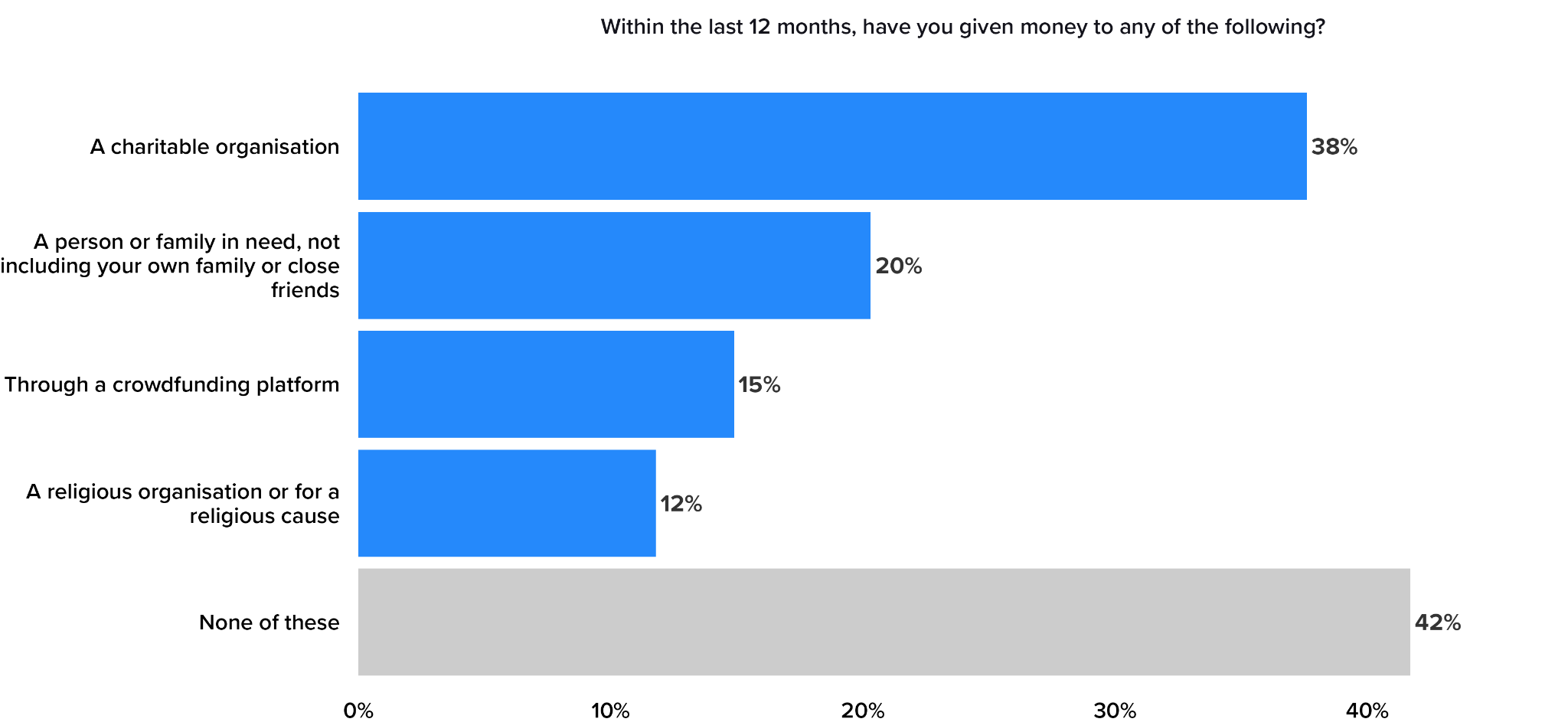
Charitable giving is common – a majority (58%) say they have donated money to a charitable cause in the last year. Charities are the most common recipients of donations: almost two in five (38%) have donated to a charity within the last 12 months.
Within this broad – though shrinking – donor base, impact is concentrated among a small proportion of donors. Those who gave over £500 to charitable causes over the past year make up less than one-fifth of those who donated to charity, but contributed an estimated two-thirds of all donations. Conversely, the 50% of donors who donated less than £100 over the year altogether contributed ten times less than the group of top givers – less than 7% of total donations.
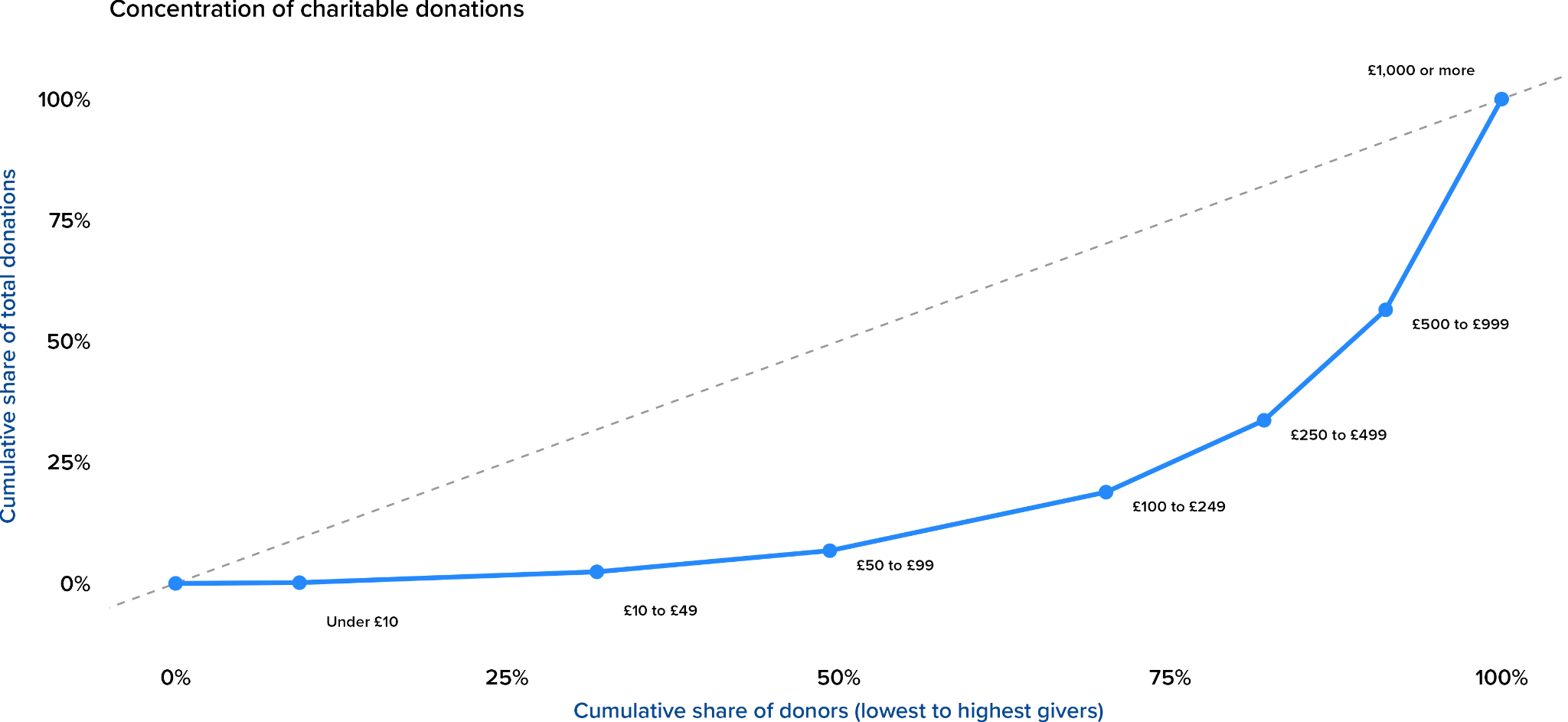
An average donor in the top one-fifth of givers donates 27 times the amount of an average donor in the bottom 50%. This asymmetry means that the behaviours of high-givers – whether their numbers increase or decrease, or whether individuals give more or less – matters far more for total donations than changes among the broader donor base. It also explains why total donations can remain stable, or even grow, despite a declining number of donors overall: losses among lower givers can be offset by relatively modest increases in giving among this small group.
While this concentration has insulated total donations from the declining donor base of the past decade, it has also obscured a growing fragility in the sector's financial foundations. As fewer people give at all, the sector becomes increasingly reliant on a small group of high-givers. If charitable giving is, at least in part, a habit that develops over time – with today's lower-givers becoming tomorrow's higher-givers as their incomes and circumstances change – then a shrinking donor base does not just represent lost contributions today, but a narrowing pipeline of future high-givers. The decline in giving in 2025 suggests this dynamic is already beginning to materialise.
What Drives Donations
We ran a regression analysis to understand what distinguishes those who donate from those who do not.
Predictably, having a high income and being financially secure are both positive predictors of the likelihood of donating. These are distinct predictors: higher income increases the likelihood of giving, but so does feeling financially secure, independent of income level. Both also predict how much donors give. The cost of living crisis has impacted both of these, with squeezes in real-terms income and price inflation increasing financial pressure on households. Affordability pressures have likely already contributed to the reduction in the donor base in recent years – and with financial security mattering independently of income, a recovery in wages alone may not be enough to reverse this trend.
Education is also an independent predictor: degree-holders are more likely to donate, over and above the effect of income or financial security.
Employment status is another distinguishing factor. Those working part-time are more likely to donate than their full-time counterparts. On the surface, this may seem counterintuitive given that part-time work is often associated with lower earnings – but when we account for income and financial security, part-time workers are still more likely to give, suggesting the relationship is driven by something beyond finances alone. Part-time workers may, for instance, have more flexibility and time to engage with causes through volunteering or community involvement.
Older individuals are more likely to donate, independently of their financial situation. This could be a lifecycle effect, whereby younger generations will donate more as they age. However, the shrinking donor base means fewer young people are giving today who could, over time, become regular or higher-value donors. Alternatively, it could be a cohort effect, reflecting habits distinct to today's older generations that will not be replicated by future generations. Either way, the outlook is concerning. Notably, age does not predict how much donors give, only whether they give at all, meaning the risk is to the breadth of the donor base.
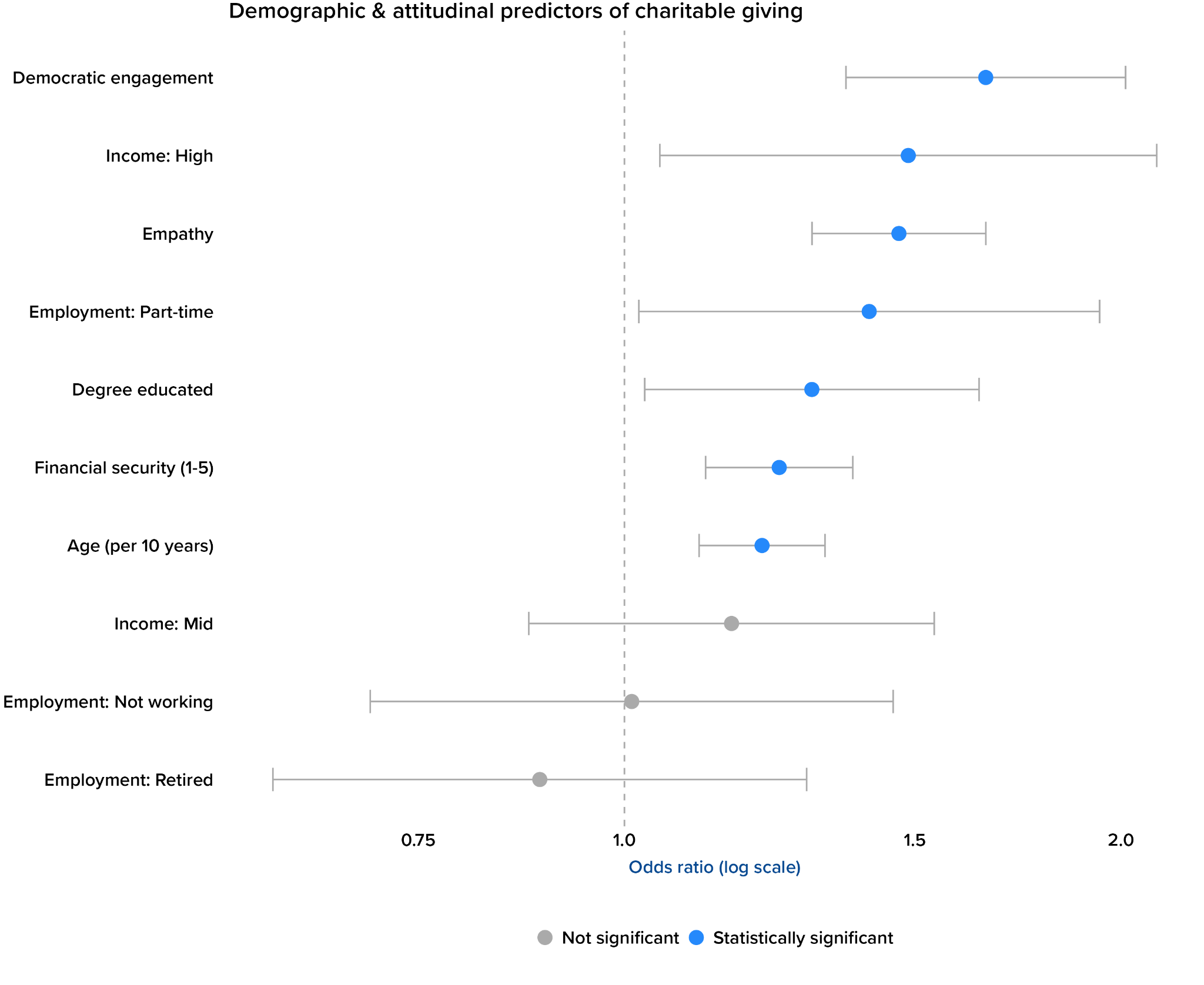
In addition to these demographic factors, the model shows attitudes independently shape propensity to give: those who are more democratically engaged and those who are more empathetic are both more likely to donate – and to give more. These are not merely proxies for wealth: two people with identical financial circumstances will differ in their likelihood of giving based on their values and emotional orientation alone. This points to something the sector can potentially influence: unlike income or age, emotional engagement with causes is amenable to how charities communicate and connect with donors – and its effects extend to both broadening the donor base and deepening the contributions of those already in it.
Our analysis finds that, when controlling for demographic and attitudinal factors, vote intention does not predict whether someone donates to charity. In other words, charitable giving is not a politically polarised behaviour – people across the political spectrum give at similar rates once other factors are accounted for. The conditions that drive or inhibit giving cut across political lines, meaning the opportunity to broaden the donor base is not limited to any particular segment of the electorate.
Attitudes towards charity
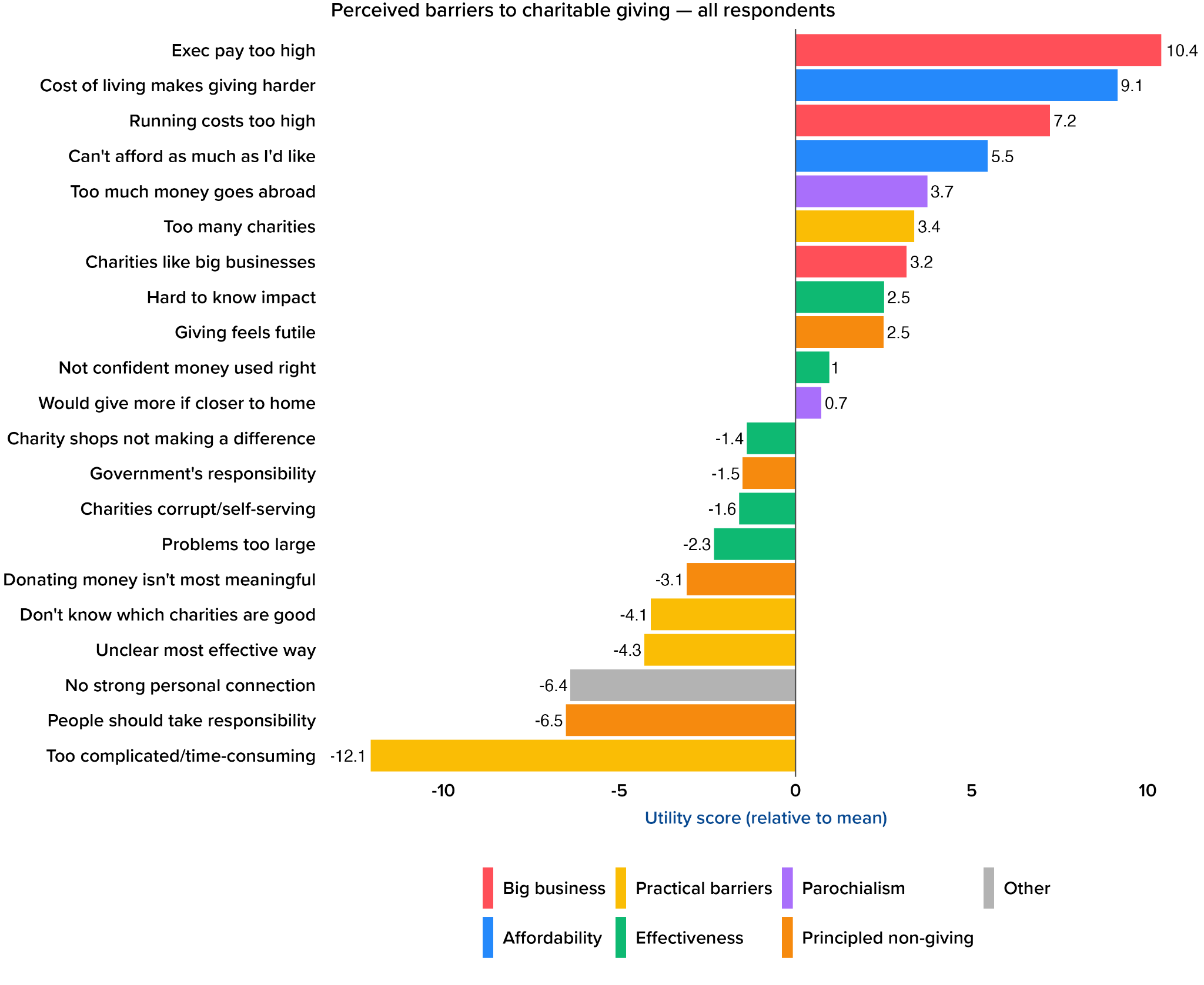
We also ran a MaxDiff to understand the risk factors for the sector when it comes to perceptions of the sector as a whole, and attitudes to donating. The chart below shows which statements were agreed with most, and those which were most disagreed with.
The results reveal two key themes in attitudes towards charity donations: first, concerns about charities as ‘big businesses’ dominate, with two of the most frequently selected statements being “Senior charity executives are paid too much – large salaries undermine the point of giving” and “Too much of a charity's income goes on running costs rather than reaching people in need”.
Affordability is also prominent – the cost of living and personal affordability both feature among the top statements, with respondents selecting ”the increase in the cost of living makes it harder to donate” and “I cannot afford to give to charity as much as I would like to” as among the most resonant.
On the other hand, practical barriers – such as complexity or lack of information about how to give – are far less common.
The chart below shows how those who gave to a charity in the last year differ from those who didn’t donate, across these statements. Scores are relative to the other statements tested, so the gaps reflect differences in the salience of each concern between the two groups rather than absolute levels of agreement.
This reveals that affordability is an issue for givers as much as it is for non-givers – concerns about affordability are curtailing donations among those who already give, and preventing non-donors from donating.
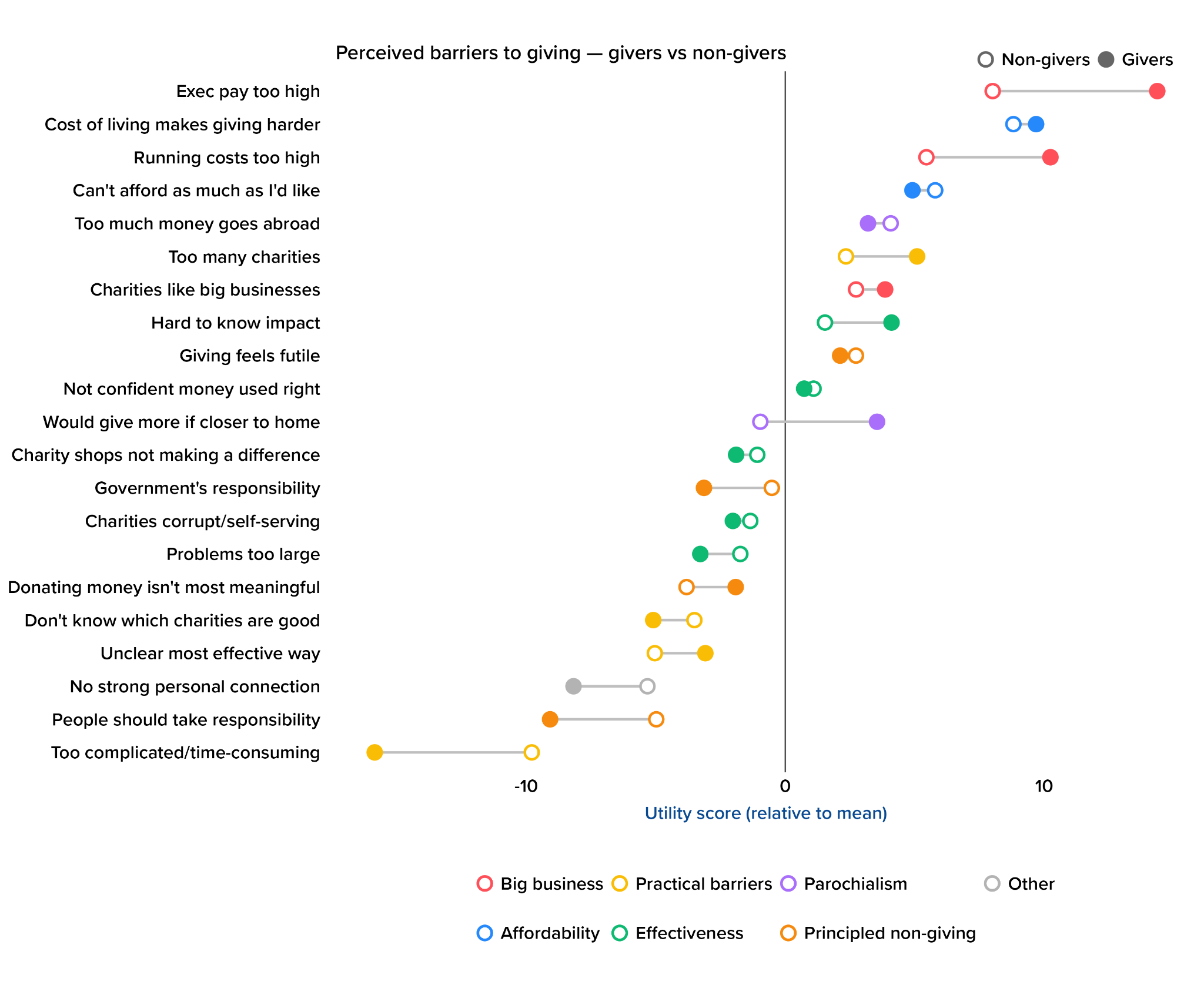
Concerns about big business – executive pay and running costs – are more salient among those who have donated than those who haven’t. On one hand, this shows that an oft-cited criticism of the sector is not sufficient to prevent people from donating. However, these negative attitudes about the sector among donors may prove to be a latent risk if affordability pressures deepen and give donors a more pressing reason to scrutinise where their money goes. A person who already questions whether charities use their income efficiently – and who is simultaneously feeling the squeeze of higher costs – has a ready-made justification for giving less.
Perceptions of effectiveness are broadly similar among the two groups, suggesting that doubts about whether donations make a difference are not the cause of reduced donations.
What this means for the sector
The charity sector is facing an increasingly fragile donor base – total donations have been propped up by a small share of large donors, obscuring and delaying the impact of a declining donor base. Affordability pressures and generational change risk a further decline, narrowing the pipeline for current donors to become large donors in the future.
The sector must therefore focus on retention, and ideally expansion, of two groups: the crucial high-givers, and the broader base of habitual donors who may become high-givers as their circumstances change. Where it has the most agency is in emotional engagement – empathy and civic engagement independently predict both whether people give and how much, and both are amenable to how charities communicate. Because giving is not politically polarised, these efforts can reach broadly without the need to tailor appeals by political identity. Getting ahead of public concern about executive pay and running costs through proactive transparency reduces the risk that these latent attitudes harden into a justification for giving less when donors are already under financial pressure. Longer-term, engaging younger people as the next generation of donors is a priority: the habits formed early determine who enters the pipeline of future high-givers.
This research was commissioned and funded by Focaldata. Data tables for this survey can be downloaded here.