Blog/Polling
What Democrats Want
After losing the presidency, Senate, and House to Republicans in 2024, Democrats are navigating a more favourable political environment heading into November’s midterms, but face a deeper question about what it means to be a Democrat in 2026 and what the party wants to become in the run up to 2028.
To find out, Focaldata surveyed 1,331 Democrats in the United States between 25 and 31 March 2026.
The findings reveal that:
- The Democratic base is lurching to the left, and the party faithful now views socialism more favourably than capitalism. Given the trends identified by Gallup, we expect that this is the first time our question wording would have found this dynamic. Democratic voters generally oppose supply-side economics, with only 37% preferring a growth-led vision of the economy, in contrast to a majority (55%) who believe the best way to help ordinary people is through ‘regulating and constraining market forces’.
- While many Democrats are positioning the party away from ‘culture war’ issues, two-thirds of Democrats agree that civil rights and fighting discrimination are inextricably linked to economic policy.
- There are five main segments of the Democratic base when it comes to their political attitudes and what they want from the party and its leaders. These segments are Loyal Progressives, the Populist Left, Frustrated Capitalists, Disillusioned Skeptics, and Concerned Civics. Each has different needs and beliefs, and creating majority support in the party requires uniting at least two of these segments.
- Loyal Progressives (98% net favourable towards the party) want bolder progressive convictions, delivered with principled conduct and institutional integrity. The Populist Left (net zero on party favourability) want the same destination but from a posture of anti-establishment scepticism, with sharper economic edges and less patience for party machinery. Frustrated Capitalists want boldness of a different kind entirely: economic credibility and direct address of their material circumstances, without the ideological framing that defines either progressive lane. Disillusioned Skeptics want someone who fights hard for them, but have largely disengaged from the political process.
- Looking ahead to 2028, Democratic voters want a young, progressive presidential candidate focused on kitchen-table issues like the cost of living. Despite more radical shifts in tone from some Democrats in the Trump 2.0 era, ‘combative and confrontational’ politics performs worst of any political style, a potential early indicator of a ceiling on the emergent ‘Newsomism’.
- The party has not internalised the 2024 election loss. Kamala Harris is still seen as the party’s most effective messenger, and leads the early 2028 primary polls with over 40% of the vote. A majority of Democrats say they would rather lose with integrity than win with Republican-style tactics.
The Five Segments of the Democratic Base
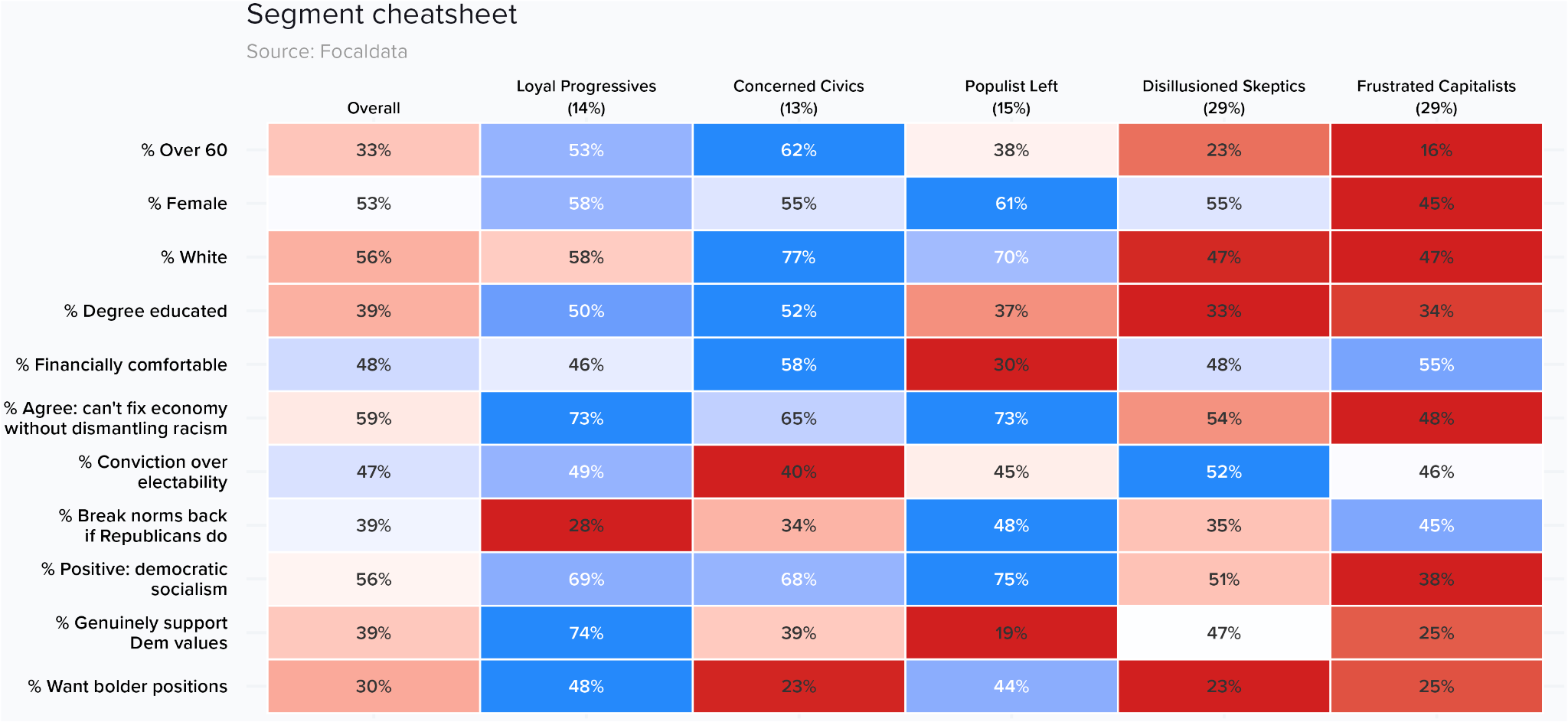
Loyal Progressives (14% of the sample)
The engaged, loyal heart of the Democratic party, Loyal Progressives are highly educated, mostly in their 60s, and turned out strongly in 2024 (89% voted for Harris). They carry the highest levels of political interest, vote likelihood, and party favourability of any segment, with near-universal levels of positivity (98%). They feel proud, energised, and hopeful, and score lowest on frustration, anger, and embarrassment.
They believe in playing by the rules, and want bolder progressivism from the party, willing the party elites to share their unapologetic pride in Democratic values. Around half (48%) want the party to adopt bolder positions, and 83% say being principled is a political asset, scoring the highest of any segment on both counts.
While they want the party to go further in its progressivism, that does not extend to going further on breaking norms. They mostly support prosecuting Trump (86%) and procedural obstruction (77%), but draw a line at zero-sum tactics: only 27% endorse tit-for-tat norm-breaking.
In terms of figureheads, this is the Harris/AOC swing group. Their 92% messenger effectiveness rating for Harris is the single highest score in the dataset for any politician in any segment. Though with Harris’ high name recognition, this is perhaps more of an act of political solidarity with a candidate they see as blameless in the party’s 2024 loss. .
Concerned Civics (13% of the sample)
The ‘democracy-first’ segment, Concerned Civics are the oldest group (62% are aged 60 or over), the whitest demographic, and most likely to be highly educated. They typically want a candidate who can be trusted with the rule of law, speaks in substance rather than slogans, and treats democratic integrity as a non-negotiable part of their political identity.
They are the only segment to respond negatively to social justice as a policy framing, and the only segment that is actively repelled by combative, confrontational messaging. 34% find aggressive executive orders acceptable, the lowest of any segment, and only 13% endorse zero-sum politics. They don’t necessarily back down from a fight; 75% support prosecuting Trump and 75% also support using procedural rules to block Republican legislation, but they want their toughness to come from a place of principle and fall firmly within political norms.
Frustrated Capitalists (29% of the sample)
Disproportionately young (a majority are under 40), male, and from a minority background (47% are White, 26% are Black, and 20% are Hispanic), Frustrated Capitalists are the segment most tangentially attached to the Democratic Party. Just half (50%) view themselves as ‘strong’ Democrats, and a third only ‘lean’ towards the party. Many of the demographics which swung towards Trump in 2024 overlap strongly with this segment.
They are one of the most pro-market segments on almost every economic measure, and are the only segment where less than half of its members believe in regulating and constraining market forces as an economic strategy.
This group is very much economy-first, and is not really interested by the vociferously anti-Trump tactics of some of the party faithful. 30% say Democrats don’t spend enough time ‘building, investing, and creating new economic opportunities’, twice as high as the overall party average, and only 51% say investigating and pursuing criminal charges against Trump officials would be an acceptable political move.
Populist Left (15% of the sample)
This segment is the core Sanders wing of the party, and the most left-wing group overall. The Populist Left is predominantly white (70%), has the highest share of women of any segment (61%), and is financially the worst-off group. They are the most anti-establishment segment by a wide margin, defined by their overwhelming agreement that ‘the system needs a complete overhaul’, ‘politicians serve the wealthy’ and that the system is unfair. This group is looking for, in Bernie Sanders’ words, a ‘political revolution’.
Almost two-thirds say the party devotes ‘far too little’ attention to cost of living, the most emphatic response of any group. They are also the most admiring of confrontational politics (84%) while stopping short of pure win-at-all-costs: only 39% endorse zero-sum tactics, and 63% would still hold Democrats to a higher standard.
The tension in this segment is a mobilisation problem. In 2024, 19% did not vote, the highest non-participation rate of any segment. Their strong political ideologies in combination with low turnout show that they are not a ‘Vote Blue No Matter Who’ group. If the Democrats don’t show strong left-of-centre credentials, a sizable share will just sit an election out..
Disillusioned Skeptics (29% of the sample)
Defined by indifference, Disillusioned Skeptics are one of the two largest segments, at 29% of the sample. They are one of the most racially diverse groups (47% White, 24% Black, 16% Hispanic), skew younger, and are concentrated in the South. In 2024, 18% sat the election out entirely.
They care about housing and wages but are not heavily motivated to show up at the polls. Their issue priorities are practical and local — crime, affordable housing, immigration reform — registering neighbourhood-level concerns that the party does not seem to be adequately addressing for them. They are low-interest, low-trust, and low-turnout.
They are not neatly grouped into a particular ideological bucket. The progressive lane doesn't give them a sufficient reason to show up in the polls, but incremental reform and pragmatic positioning actively depresses their vote share in our conjoint experiment. What moves them is someone who fights hard and means it, within recognisable political structures, on the economic issues they actually face. That candidate does not yet exist in the current 2028 field.
Attitudes Towards the Democratic Party
Across segments, the core Democratic base remains favourable towards the party, but is demanding more from those who represent them. When it comes to the feelings people have about the party, 59% of Democrats say they are ‘hopeful’ about the party’s future, but ‘pride’ and ‘frustration’ come next in equal measure, at 35% each.
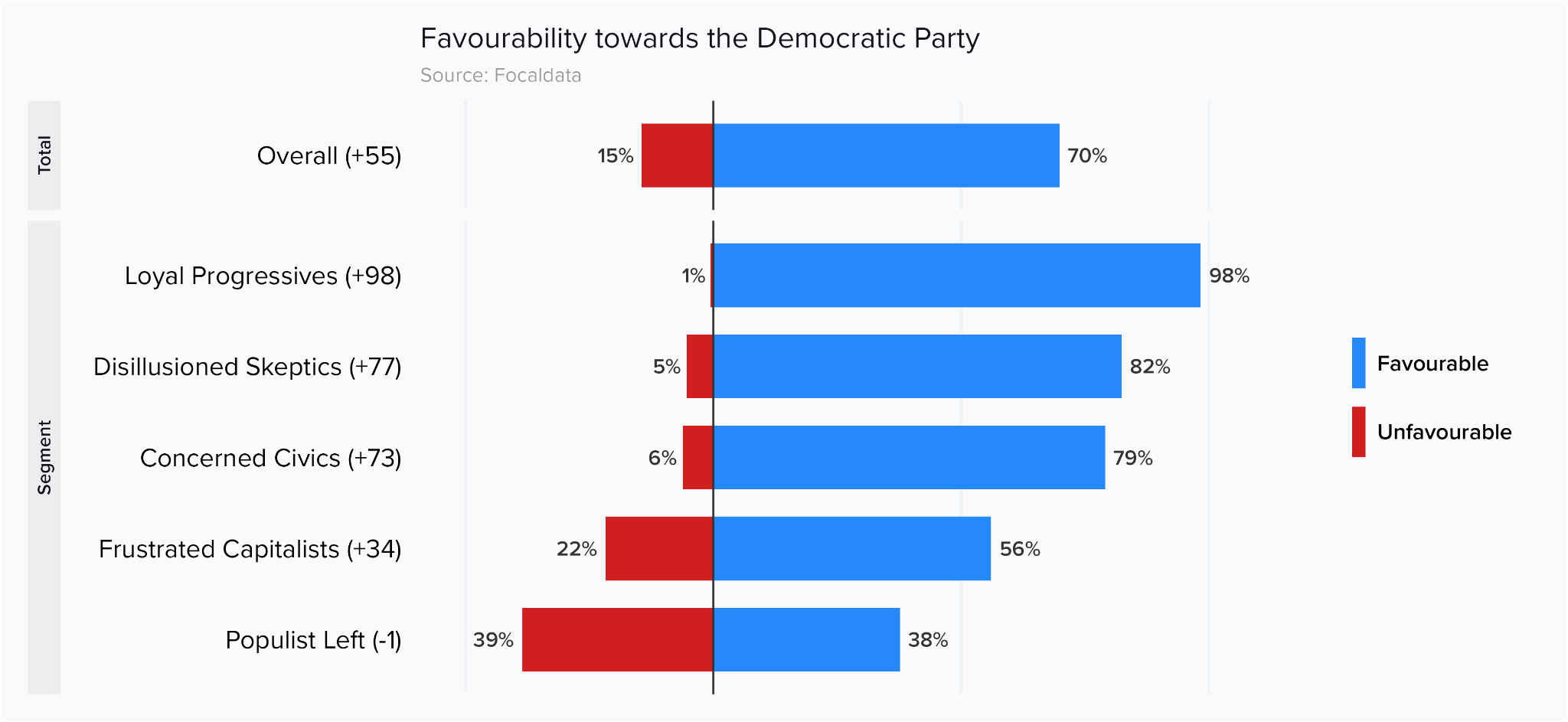
Just 16% of Democrats want the party to moderate its positions, about half as many as the number who want the party to take a bolder direction. This is not a sign of a party in which primary voters, at least, will respond well to a ‘pivot to centre’ in the coming years.
Candidate Lanes and the 2028 Primary
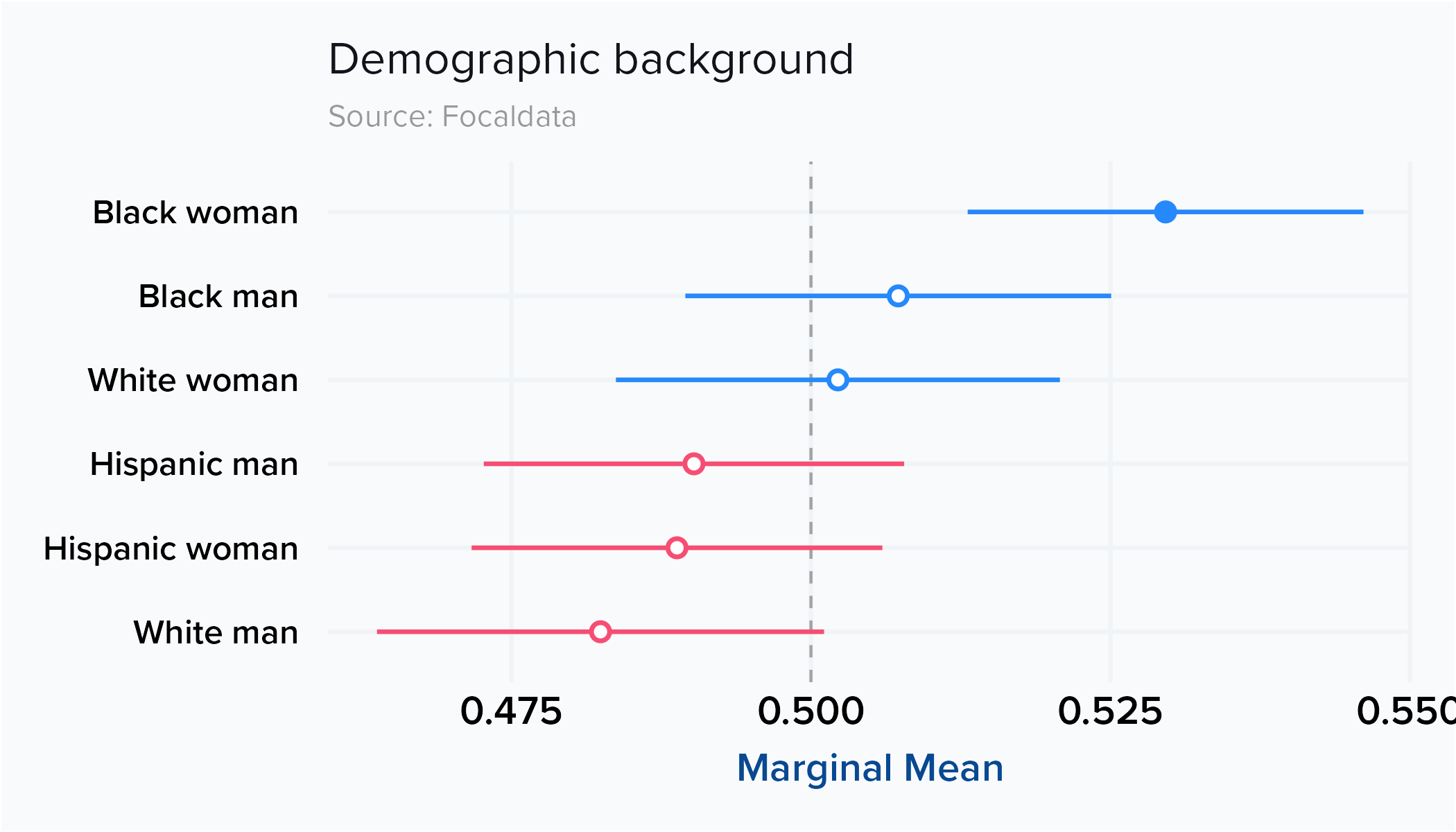


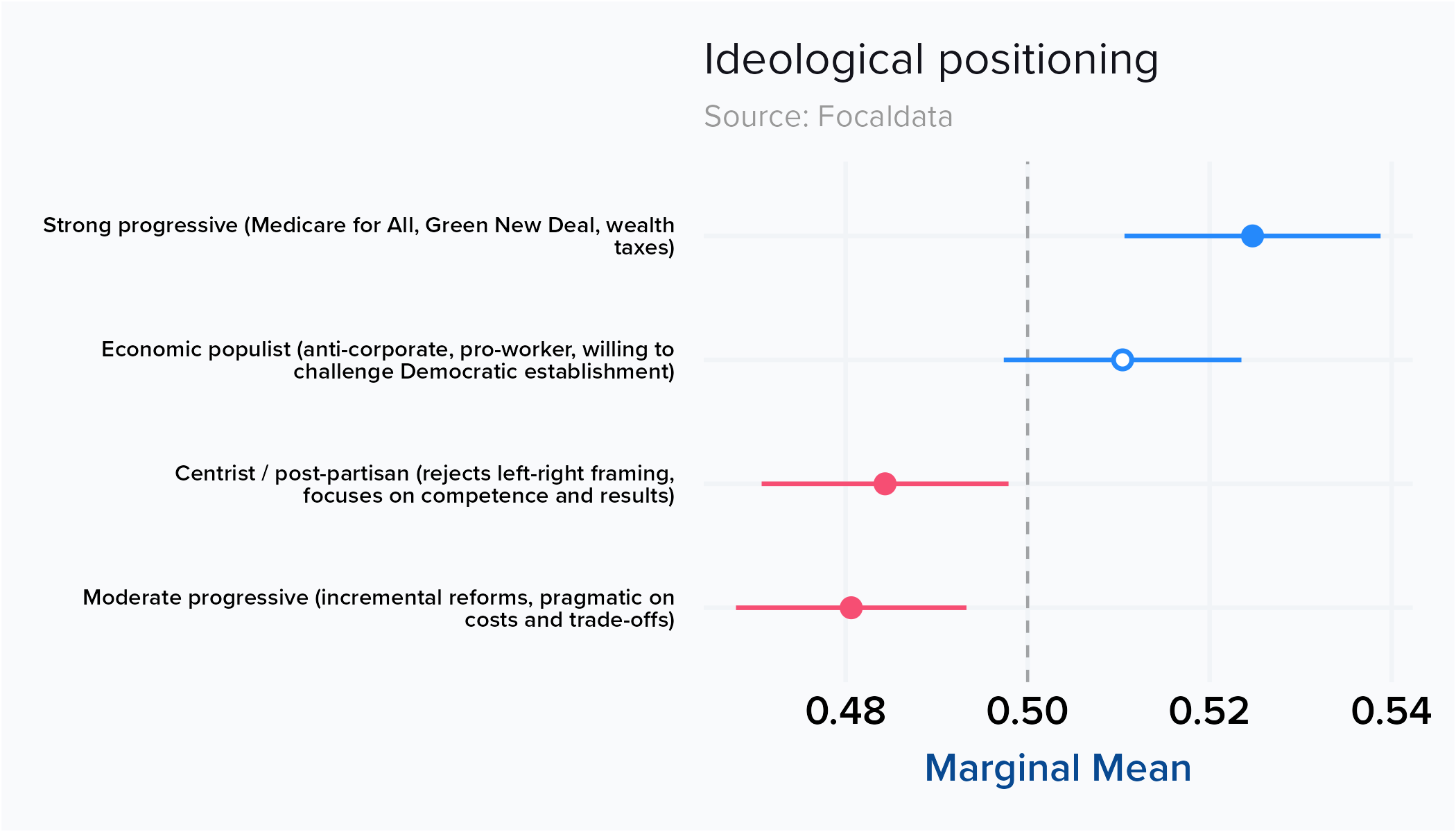

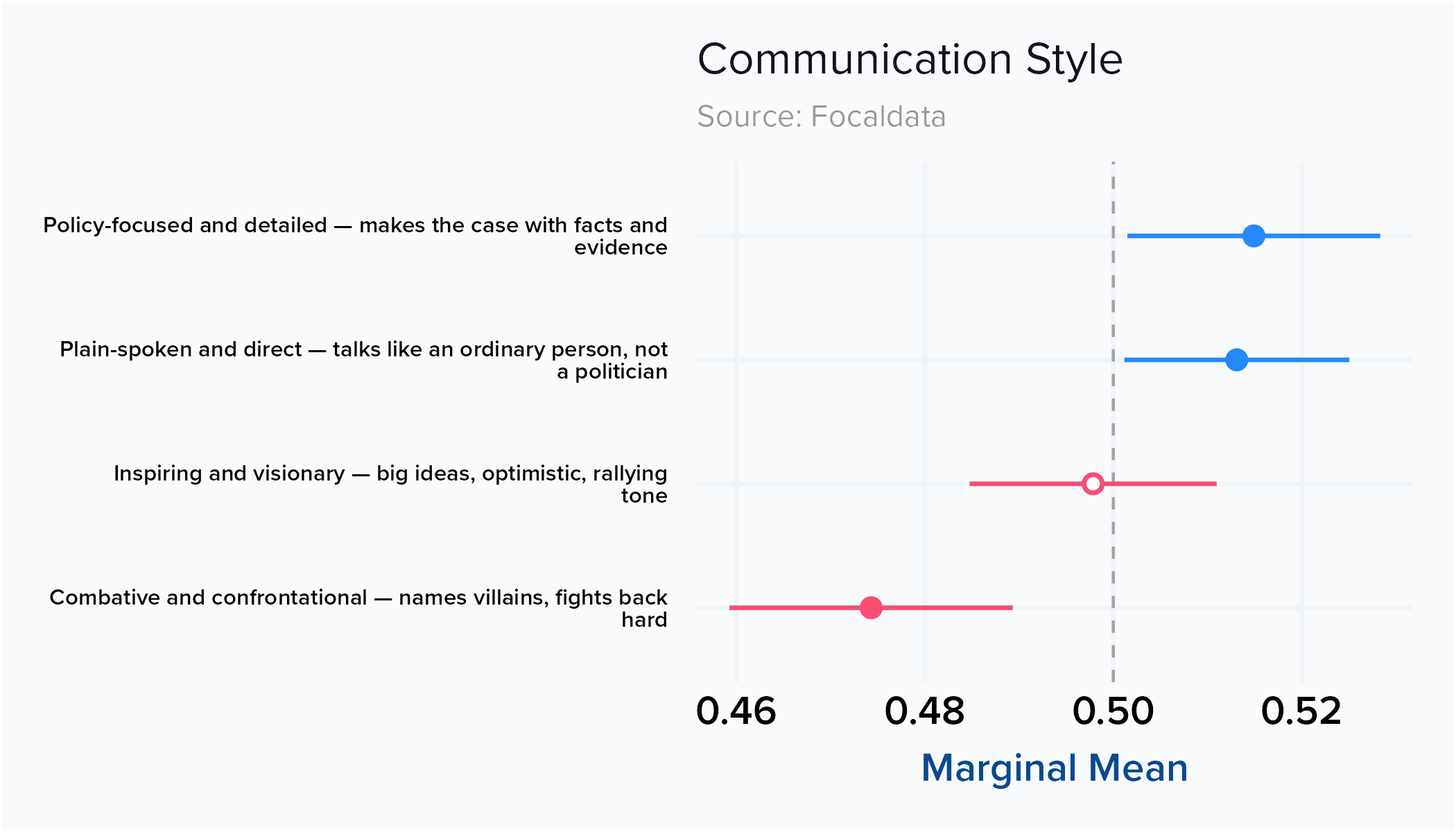
We conducted a conjoint experiment, which reveals structural constraints on the 2028 primary field that the current candidate discussion does not adequately reflect. We asked respondents to choose between sets of randomly-generated hypothetical presidential candidates with a variety of demographic, political, policy and stylistic attributes. Our results show the impact of those attributes on voting behaviour, where a marginal mean of 55% for an attribute means an average respondent would choose an average candidate with that attribute in a head-to-head 55% of the time.
Three key findings hold across all five segments. First, providing further evidence of the rejection of moderation, the centrist and post-partisan attribute (i.e. the candidate who rejects left-right framing and focuses on competence and results) produces a neutral or negative signal across the party. Second, the business executive with no prior elected experience is the single most universally rejected attribute in the conjoint, a clear rebuttal to the idea of a Democratic counterpoint to Trump. Third, the party urgently wants a fresh face, with all segments largely rejecting candidates over the age of 65. Identity remains an important characteristic for the party, in some cases as important as experience and positioning.
What they do want is a candidate who centres the economy and the cost of living, with some prior governing experience, without being seen as an old establishment figure. When asked about real potential 2028 candidates, the results showed a similar outcome.
Harris and Sanders, the faces of the party establishment and party left respectively, are penalised by the base. The second-in-line for each of these two lanes (Newsom and AOC), over-perform relative to their name recognition, where Harris and Sanders do not. Despite most people ranking Harris as their first choice for the 2028 nominee, looking beyond name-recognition shows where there is potential for new leaders to break through. We will be looking at the potential 2028 outsiders in more detail over the coming months.
However, in order to win in 2028, candidates will have to consolidate support across segments. There are three distinct coalitions that a national candidate can mobilise to win:
The Economic Pragmatist Lane
Disillusioned Skeptics (29%) and Frustrated Capitalists (29%) together constitute 58% of the Democratic electorate — the largest available coalition by a significant margin, and both filter almost entirely on competence and economic delivery. Economy, jobs, and cost of living is the only policy focus that significantly moves both segments in a positive direction.
The candidates most aligned with this lane (e.g. Shapiro, Kelly, and Beshear) currently suffer from name recognition deficits. The results show an absence of strong enthusiasm rather than active resistance: Shapiro's 9% first-choice share among Disillusioned Skeptics is the best of any non-Harris candidate in that segment, but it reflects unfamiliarity as much as fit. The challenge is not just credibility but mobilisation as both segments recorded relatively low Democratic voting rates in 2024.
The Progressive Lane
The Populist Left (15%) and Loyal Progressives (14%) form a mostly coherent but mathematically constrained coalition at 29% of the electorate. They share a strong preference for a progressive policy agenda, economic populist messaging, and outsider credentials, but consolidating this base is insufficient to win a primary on its own unless other segments participate at much lower rates.
Trying to crossover to the Frustrated Capitalists and Disillusioned Skeptics poses two structurally different challenges. Frustrated Capitalists actively resist progressive framing. Disillusioned Skeptics won’t be compelled to vote for progressive candidates.
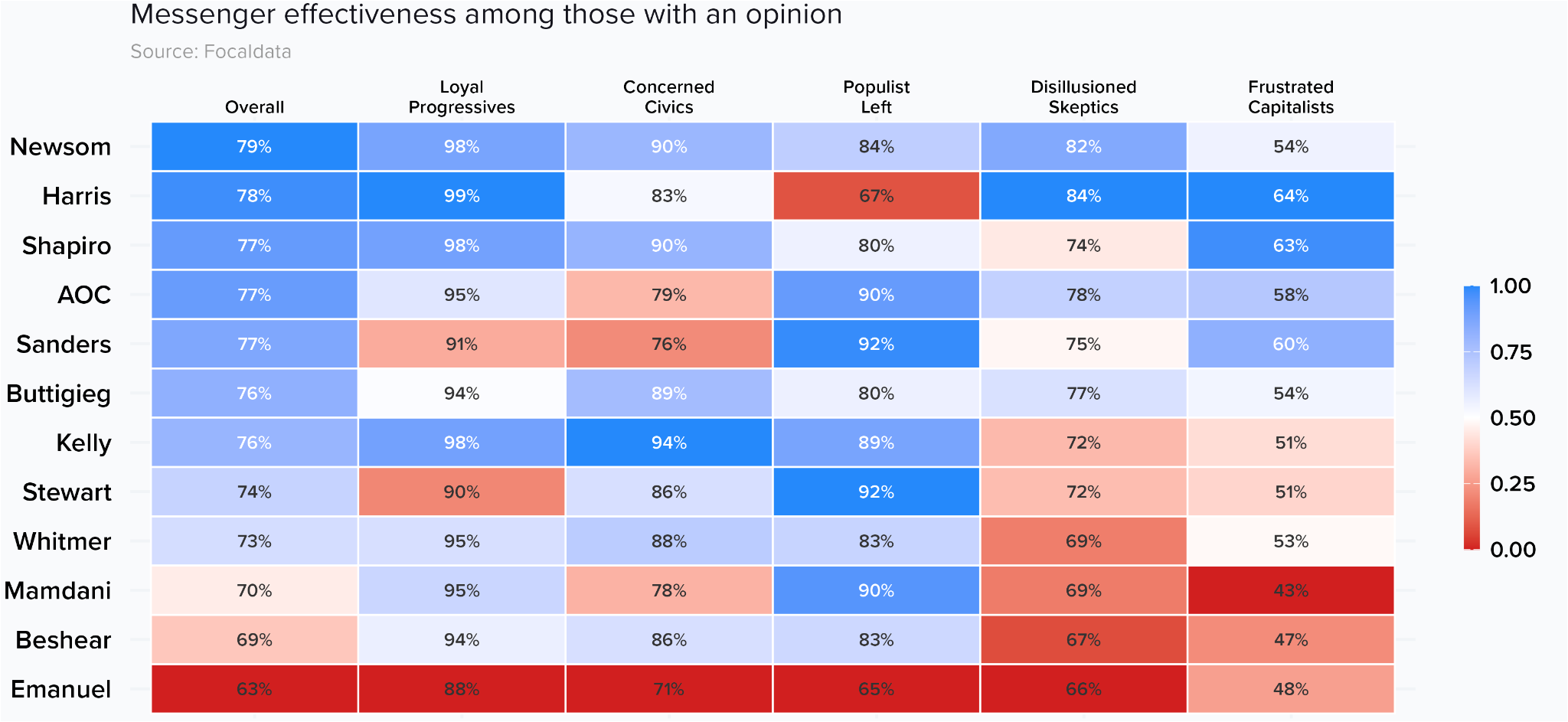
Among those with an opinion, Harris is the second least effective messenger for the Populist Left, but the most effective for the Loyal Progressives. This reveals a tension in this group, the Loyal Progressives want to stick with the known faces of the party, whereas the Populist Left want someone completely new. The messengers who unite both groups are outsiders with progressive credibility but low partisan baggage: Kelly (94% across the combined wing), Mamdani (93%), AOC (92%), and Sanders (92%) all outperform more establishment figures. Buttigieg (87%) and Shapiro (89%) lag behind. While the Loyal Progressives are likely to support the figurehead of the party no matter what, a rising candidate will need to have a compelling outsider identity to keep the Populist Left in the tent.
The ‘Establishment Plus’ Lane
Concerned Civics (13%) represent the floor of the establishment moderate lane. Their politics are organised around democratic institutions and civic obligation rather than ideology. They are the only segment to respond negatively to social justice as a policy framing and the only one actively put off by combative, confrontational messaging.
A 13% primary floor requires significant reach into other segments to be viable. The segment most commonly invoked to justify a centrist pivot is also the one that actively rejects many of centrism's defining features — and whose most effective messengers are Newsom (net +70), Buttigieg (net +66), and Kelly (net +67), with Harris falling into fourth place.
Issue Priorities
Similar to the strong performance of hypothetical cost-of-living-focused candidates, our issue priority data reveals a Democratic electorate whose concerns are economically grounded. Cost of living registers as receiving "too little" attention from the party across all five segments — strongest among the Populist Left (94% , with 64% saying "far too little"), and 61% among Concerned Civics. Even Loyal Progressives, the party's most institutionally committed segment, come in at 47%. Economic discontent is the strongest consensus in the data, and Democrats think their leaders aren’t speaking enough about it.
The issues most associated with Democratic overreach — LGBTQ+ rights and racial justice — score low as priorities for more attention, even among the most progressive segments: 5% of Loyal Progressives on LGBTQ+, and 15% on racial justice. But this should not be understood as a rejection of those causes. 65% of Democrats say that civil rights is economic policy, and 61% agree you cannot build a fairer economy without dismantling structural racism and sexism, taking an intersectional approach to politics. Democrats hold these commitments, they just don't want them treated as separate from, or more urgent than, their material concerns. The frustration is with framing rather than values.
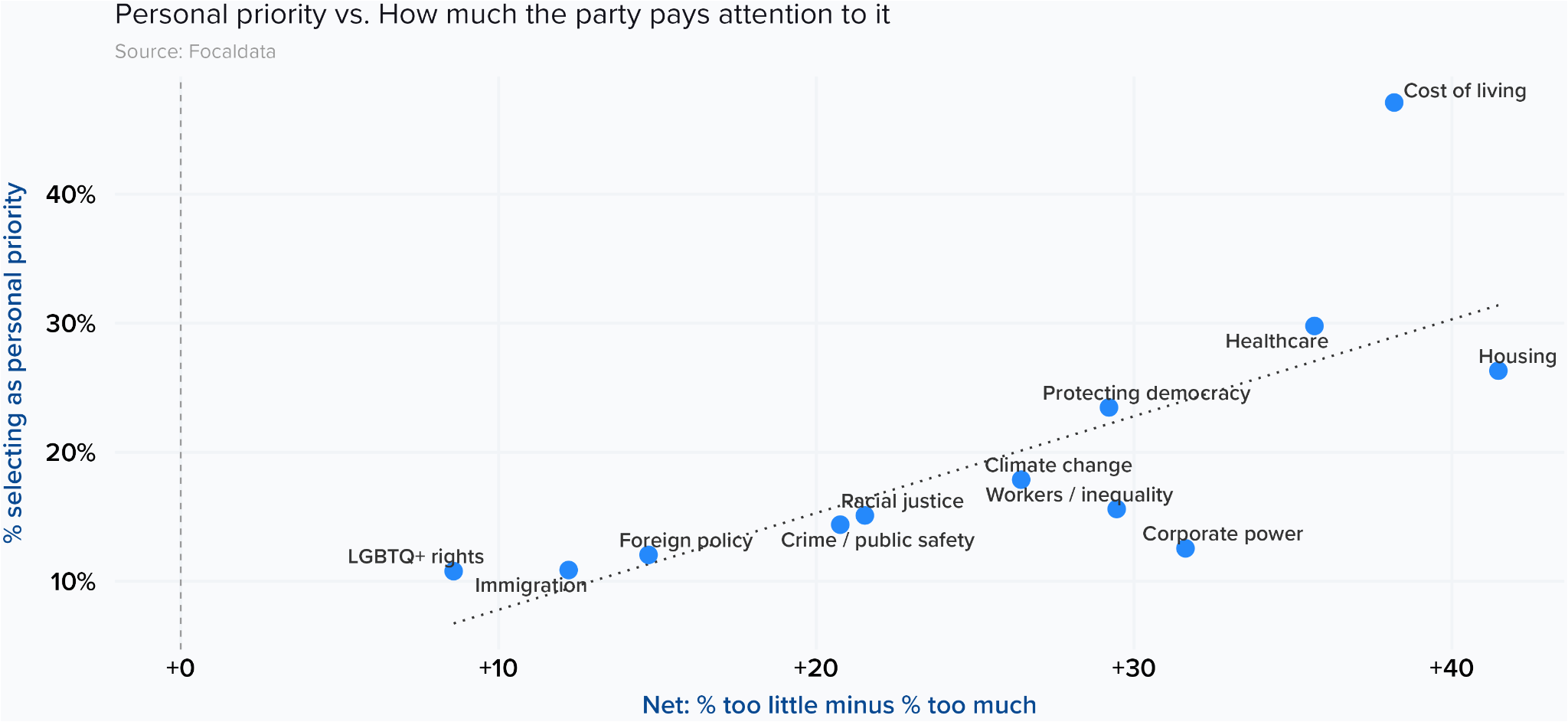
What separates many of the segments is not the diagnosis but the prescription. The Populist Left wants structural transformation, corporate accountability, redistribution, and a party that names villains. Frustrated Capitalists want economic credibility and practical delivery without the ideological framing. Disillusioned Skeptics want neighbourhood-level concerns addressed: housing, crime, wages, but an economic focus is where these three all agree.
Loss Comfort and Democratic Tactics
Democrats want to fight but disagree on what fighting ought to look like. The most broadly supported tactic across the party’s coalition is investigating and pursuing criminal charges against Trump administration officials: 83% find this acceptable overall, rising to 88% among the Populist Left and 86% among Loyal Progressives. The lowest acceptance is among Frustrated Capitalists at 51%.

Beyond prosecution, institutional hardball commands solid majorities. Using procedural rules aggressively to block Republican legislation is acceptable to 62% overall, with Concerned Civics (75%) and Loyal Progressives (77%) among the most supportive — a finding that reinforces their preference for principled toughness within the rules rather than norm-breaking outside them.
Despite respondents saying they most strongly admire Democrats who are willing to be tough, confrontational, and aggressive in standing up to Republicans, the conjoint experiment shows that when paired up against other communication styles a ceiling on this rhetoric emerges. Voters are more likely to turn away from a candidate like this compared to a policy-focused or plain-speaking one.
Where Democrats draw back is at the edges. Targeted protests outside officials' homes are acceptable to only 41%, and rejected by a plurality of Disillusioned Skeptics (44% unacceptable) and Frustrated Capitalists (39%). Refusing all compromise — treating politics as a zero-sum contest — finds only 38% support overall and just 13% among Concerned Civics. 67% of Democrats overall say being principled and fair-minded is a political asset, and 60% would hold the party to a higher standard than Republicans even at electoral cost. A minority (42%) believe Democrats should mirror Republican norm-breaking if Republicans break norms first.
When asked how Democrats want to oppose Trump, a wide plurality of respondents say "focus on winning the next election”. However, when this is posed as a choice between low-ball tactics and losing, fewer than half of Democrats feel this is an acceptable compromise.
The picture that emerges is not a party afraid to fight. It is a party that broadly wants hard, aggressive, institutional combat while retaining the belief that moral credibility is itself a strategic resource. Even the most combative segment stops well short of endorsing a politics defined entirely by winning.
Economic Positioning
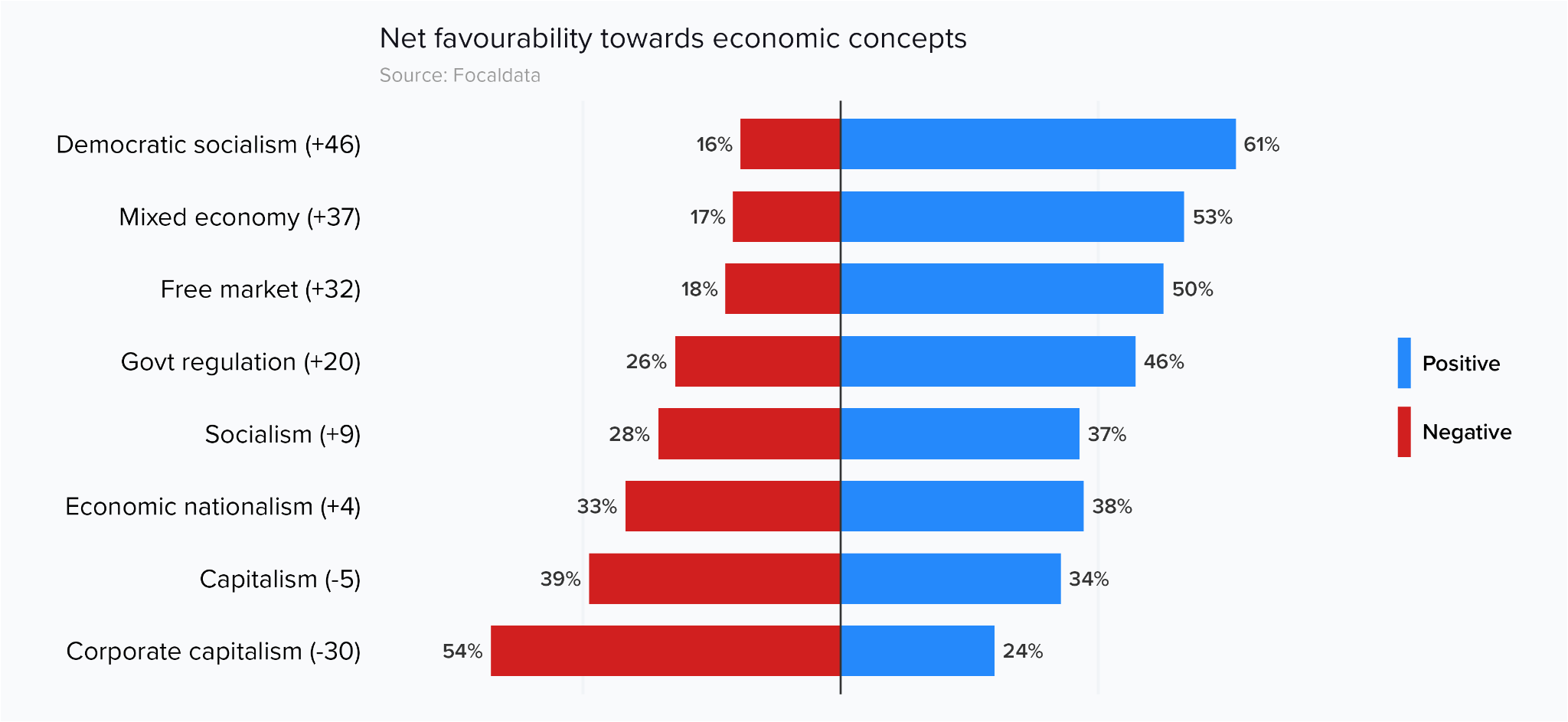
The economic identity of the Democratic base has undergone a significant shift in recent years. Socialism (net +9% favourability) has overtaken capitalism (net -5% favourability) as the preferred economic system among Democratic voters, though the picture varies sharply by segment. "Democratic socialism" is the most positively viewed ideology across the base at 57% net positive overall. Bernie Sanders' two runs for president have seemingly reshaped the party's economic profile in his image. A more left-wing economic platform, rather than a shift to the right on social issues, seems the most palatable ideological move to Democrats which has not yet been tested in a national political environment.
Conclusion: Where the Party Is Going
The Democratic Party is not solving for victory right now, it is solving for identity. The base would rather adopt bolder positions than moderate, would rather communicate better than change direction, and would rather hold to what it sees as moral and political principle than compromise for electability. The lessons of 2024 have not been broadly internalised — Harris still leads 2028 first-choice polling at 44%, and for large parts of the coalition the verdict on that campaign is that she was failed, not failing.
The structural constraints on 2028 are well-defined. The economic pragmatist lane — Disillusioned Skeptics and Frustrated Capitalists at 58% of the electorate combined — is the largest available coalition by a significant margin, and the most electorally volatile. Neither is asking for moderation, but neither is the progressive lane speaking to them either. The progressive lane has the clearest messengers and the most coherent ideological offer, but a base of 29% that is mathematically insufficient on its own.
The direction of travel is clear enough from our data to make a prognostication about the Democrats’ future. The base is moving economically left and adopting a more populist tone. Yet it’s not solving for electoral victory at the expense of what it understands as its moral purpose. Loss comfort is high. The 2028 primary will test whether that comfort has a price, and whether any candidate currently in the field is capable of making the coalition that wins it.
This poll was self-funded by Focaldata. Tables are available here.