Blog/Polling
Democrats increase lead and Rubio stock surges amid Iran war
At the start of the year, we launched our midterms tracking poll and found that the cost of living was the dominant force in American politics, propelling the Democrats towards a House majority in November. Economic concern has not gone away, but a new factor has entered the fray this month.
The confrontation between the US and Iran has sent war and international conflict surging up our most important issues index. For now, the crisis is reinforcing rather than transforming national trends, but it has begun to reshape the 2028 Republican presidential primary in significant ways.
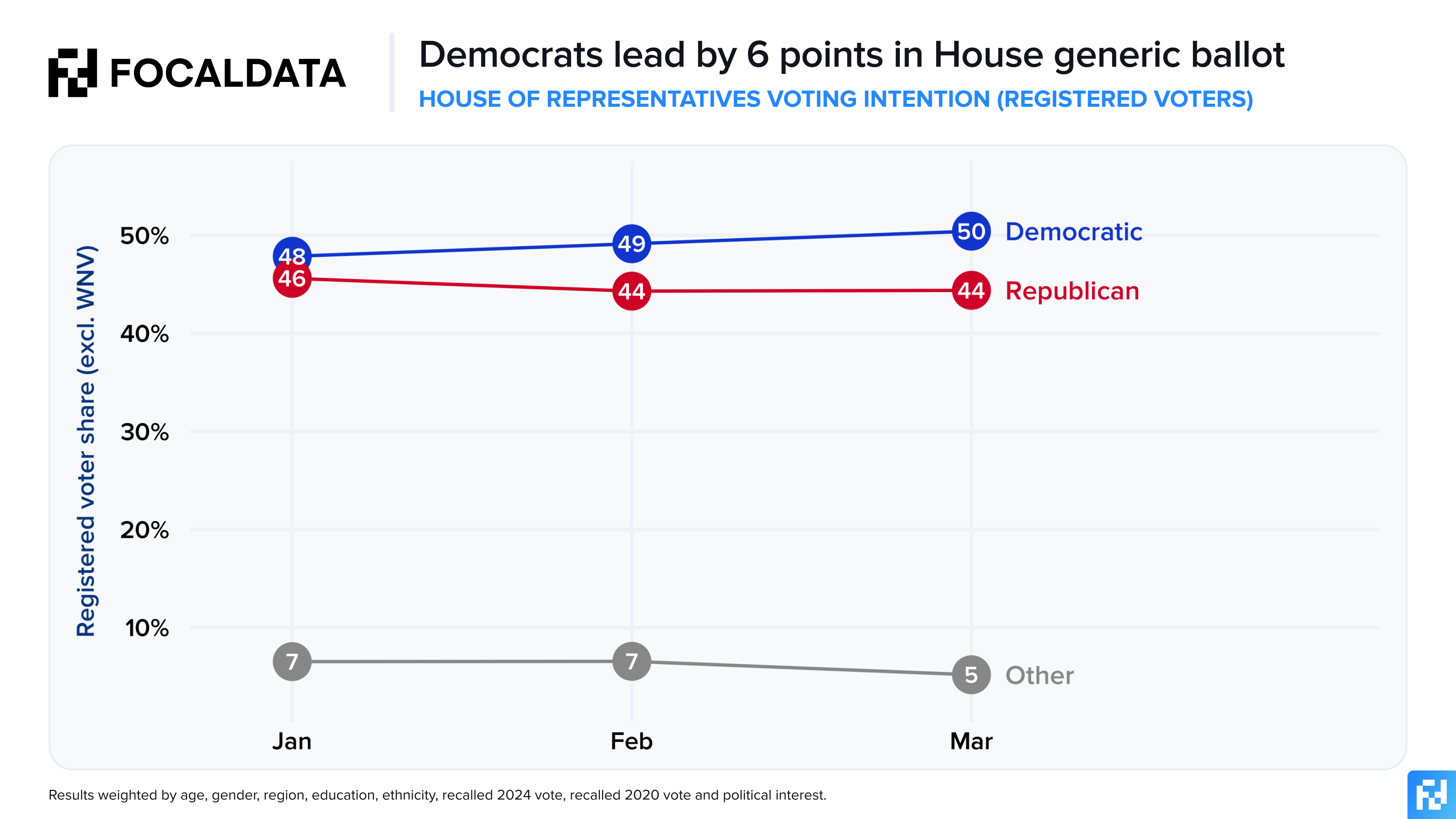
Our third wave of polling, conducted 6–10 March, gives the Democrats a 6-point lead in the generic House ballot among registered voters (50% to 44%), widening to an 8-point lead (54-46%) in the two-party squeeze. Both of these leads are the highest we have registered for the Democrats so far this year, and the Republican vote share has declined in each consecutive wave we have conducted.
War concern surges
When we asked Americans to name the most important issues facing the country in January, just 8% mentioned war or international conflict, even after the US intervention in Venezuela. Within the last month, though, concern about international conflict has risen by 22 percentage points, and is now in Americans’ top three most important issues, supplanting immigration and border security for the first time.
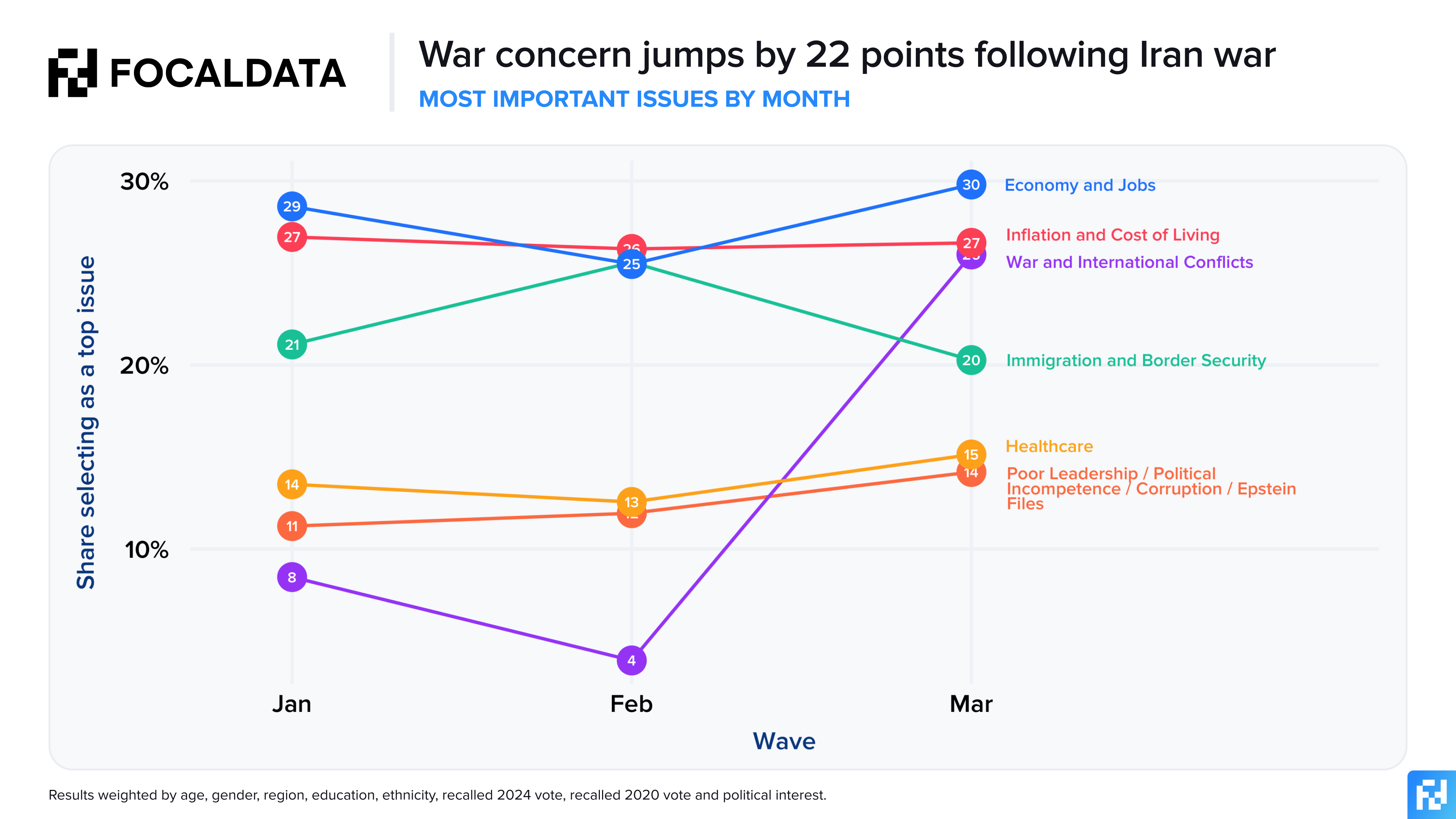
Voters who currently select war as a top issue facing the country backed Trump by 5 points in the 2024 election, making them marginally more Republican than the rest of the electorate. They now lean towards the Democrats in the House elections. For the time being, however, concern cuts across party lines and is not a driver of vote switching. Those who told us war and international conflict was a top issue are just as likely to be swinging to the Democrats as anyone else.
Trump's inflation problem worsens
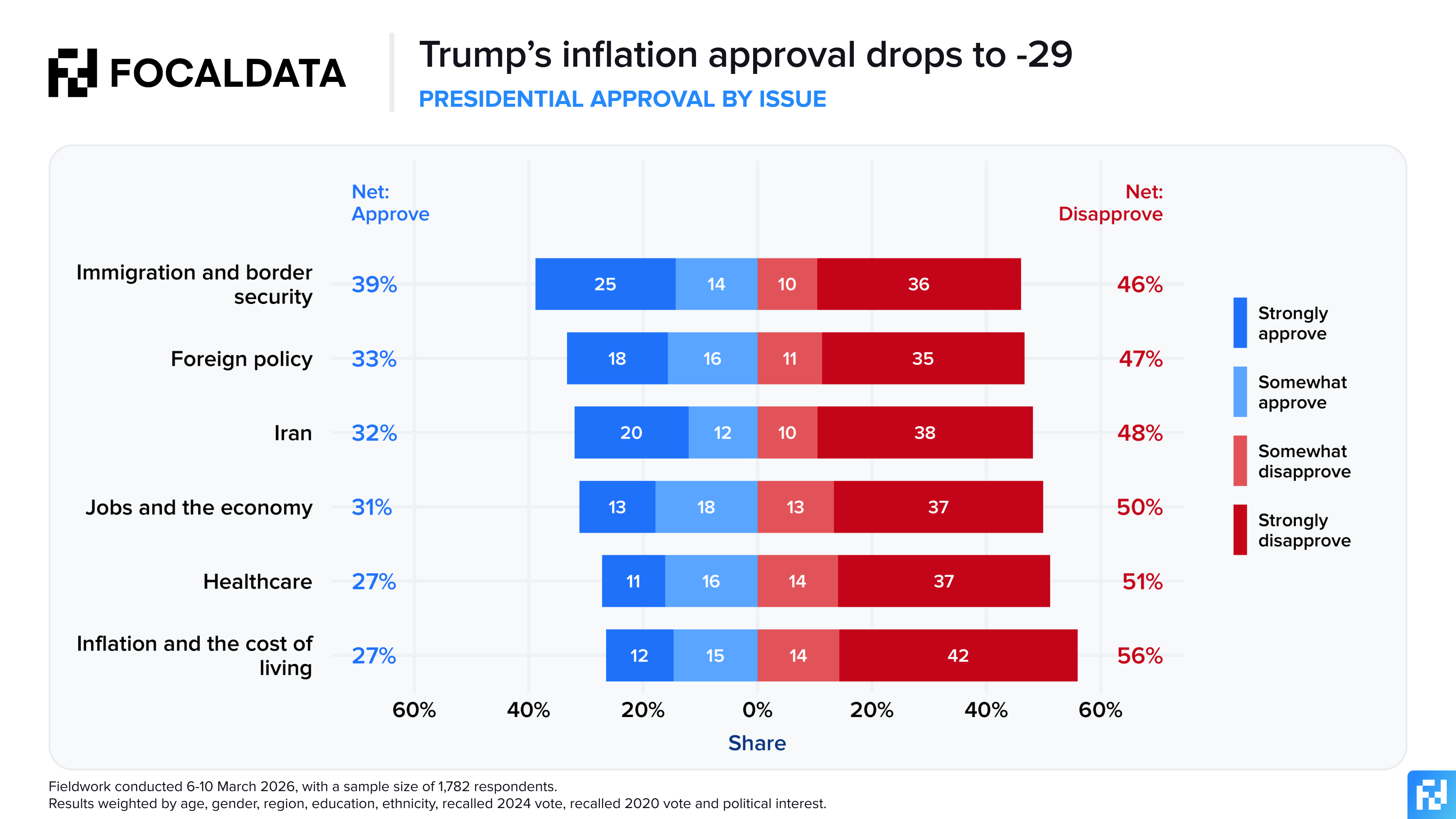
We demonstrated last month that concern over inflation and the cost of living is driving about 2.5 million voters towards the Democrats. The president’s overall approval rating remains underwater, and his weak spot on prices continues to get worse. Amid surging gas prices at the pump, the president’s net approval on the cost of living has dropped from -24 points in January to -29 in March, remaining his worst issue overall and helping to extend the Democrats’ lead on the national stage.
Who is driving the Democrats' lead?
Last month we looked at the issue-based drivers of the Democratic lead in the generic ballot, but which demographics of voters are shifting towards the Democrats? When we compare Republican retention of Trump’s 2024 voters, we see two key demographics are shifting away: voters under 50 and ethnic minorities.
Younger Trump supporters, many of whom swung right for the first time in 2024, appear to be the most loosely attached to the Republican Party. The Republican voter base in November’s midterms is likely to skew older than Trump’s, with more than 1-in-10 of his voters under the age of 40 now intending to vote blue in November.
Likewise, Trump increased his vote share with Hispanic and Black Americans in 2024, but this coalition is unravelling. The Republicans are holding onto 91% of white voters who voted Trump in 2024, but retention rates fall to 83% for Hispanic voters and 69% for Black voters.
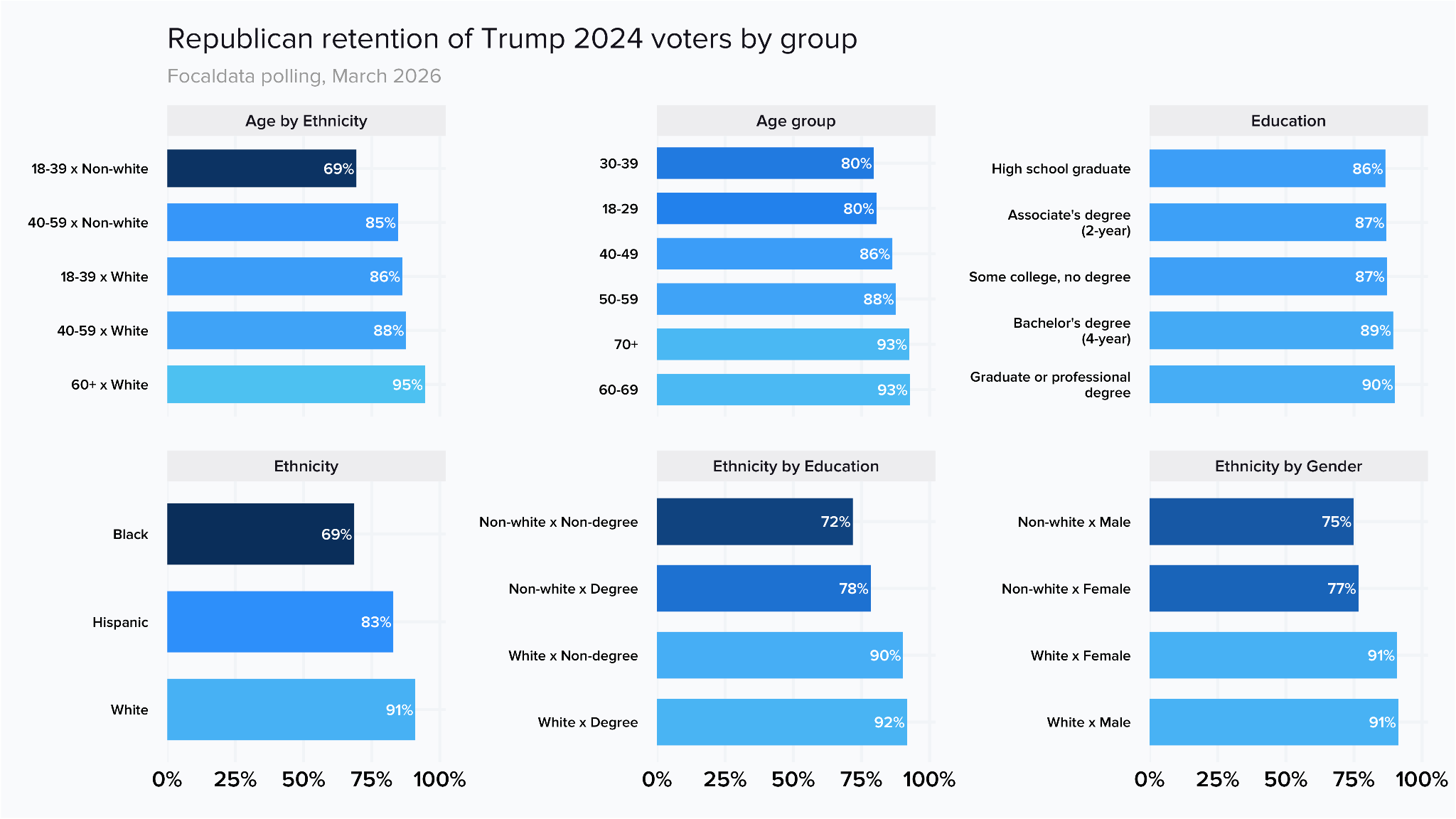
Across the board, 7% of Trump’s 2024 voters are now intending to vote for the Democrats in November.
Iran reshapes the 2028 Republican primary
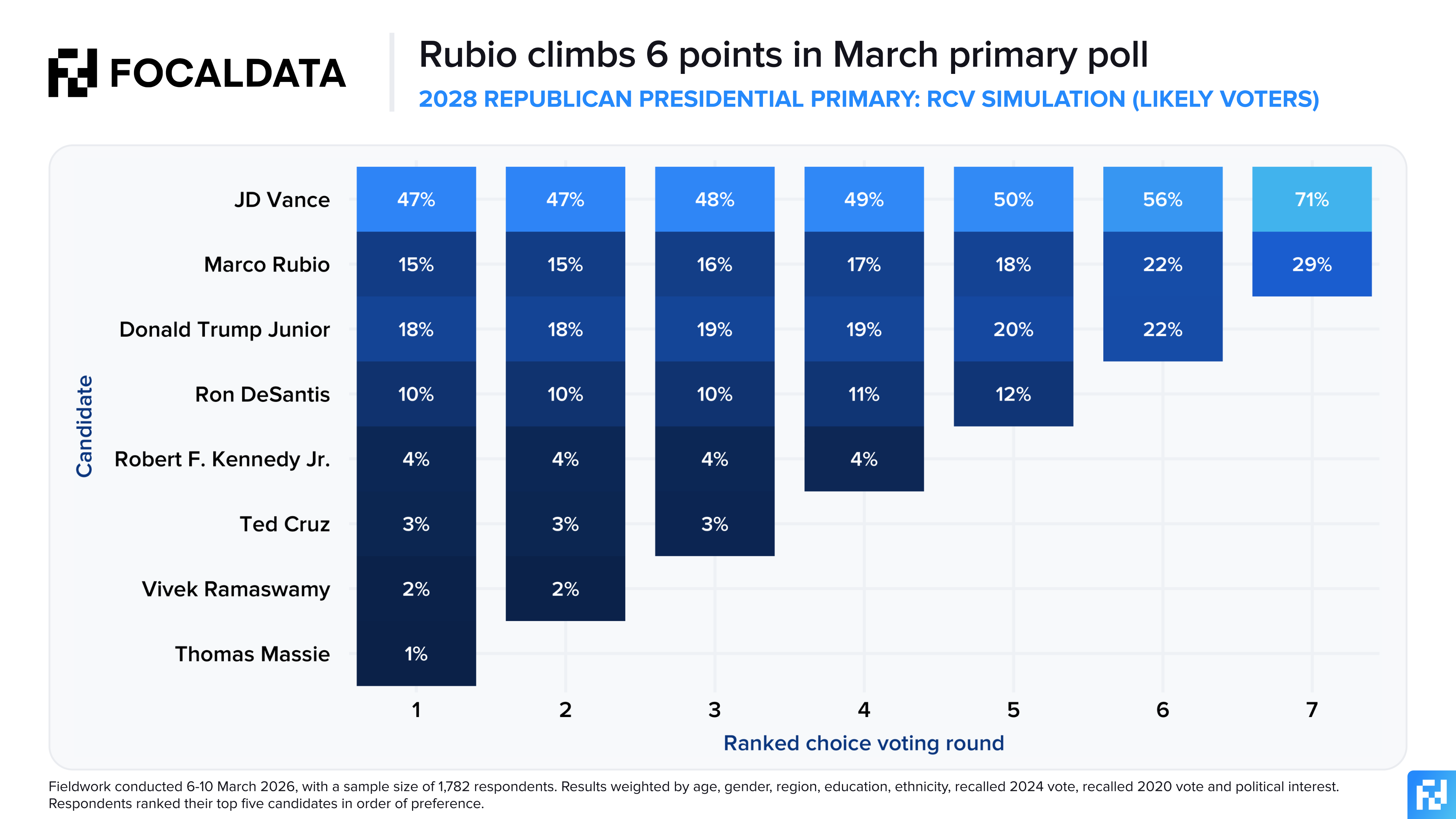
The Iran crisis has had an immediate impact on the 2028 Republican presidential primary. JD Vance, who led our January poll with a majority of likely primary voters (52%), has fallen by 5 points to 47% this month. Secretary of State Marco Rubio, the administration’s most visible face on Iran, has climbed from 9% to 15%, and now finishes second in our ranked choice simulation.
Digging into the profiles of Vance and Rubio supporters reveals some large differences. Among Republicans who name war and international conflict as a top issue, Rubio climbs five points versus those who do not, while Vance’s support drops from 48% to 43%. Rubio backers are also more likely to hold a college degree (65% of his supporters, versus 52% for Vance) and are slightly less loyal to the president (95% of Vance supporters approve of Trump, versus 91% of Rubio supporters).
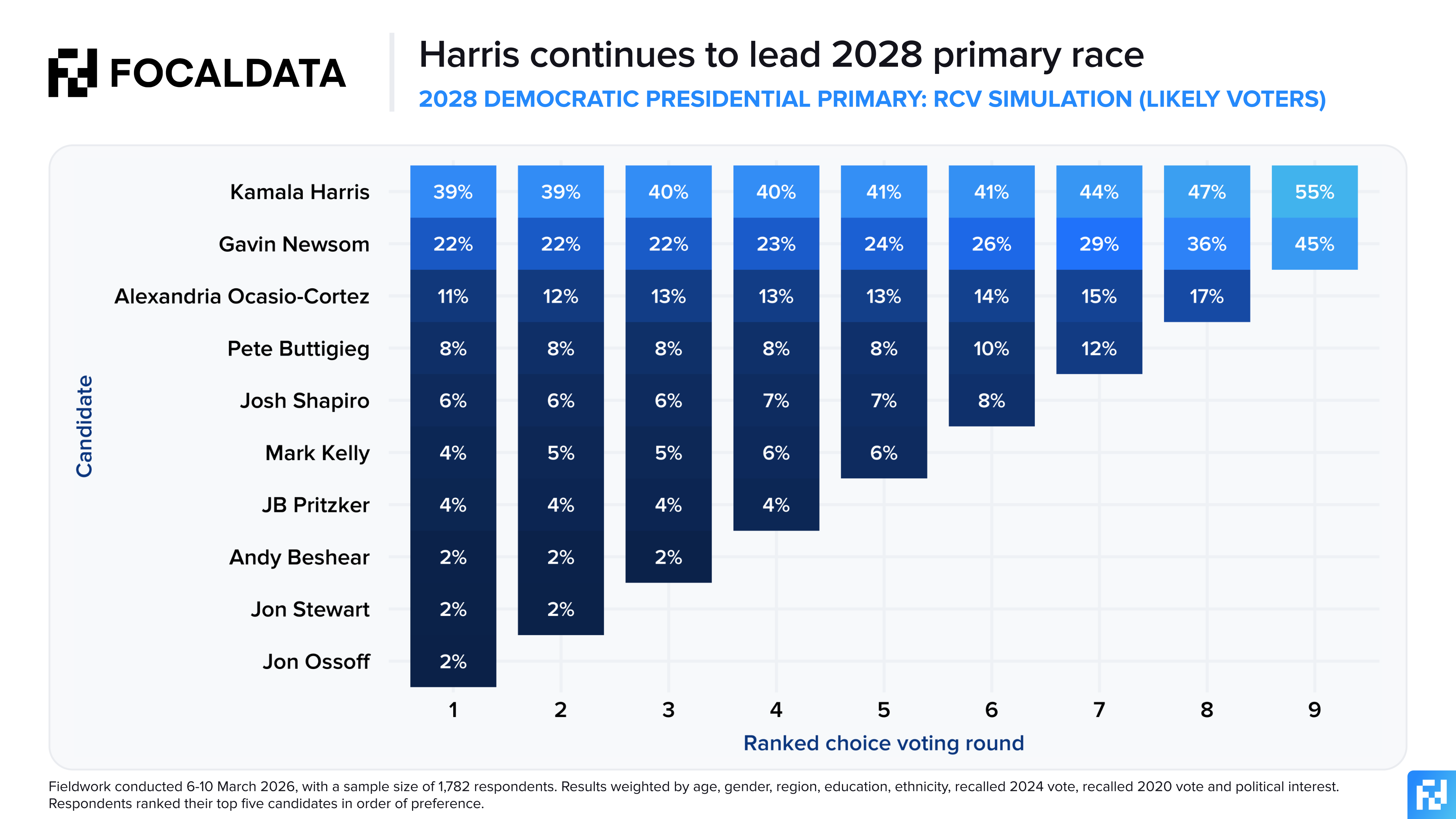
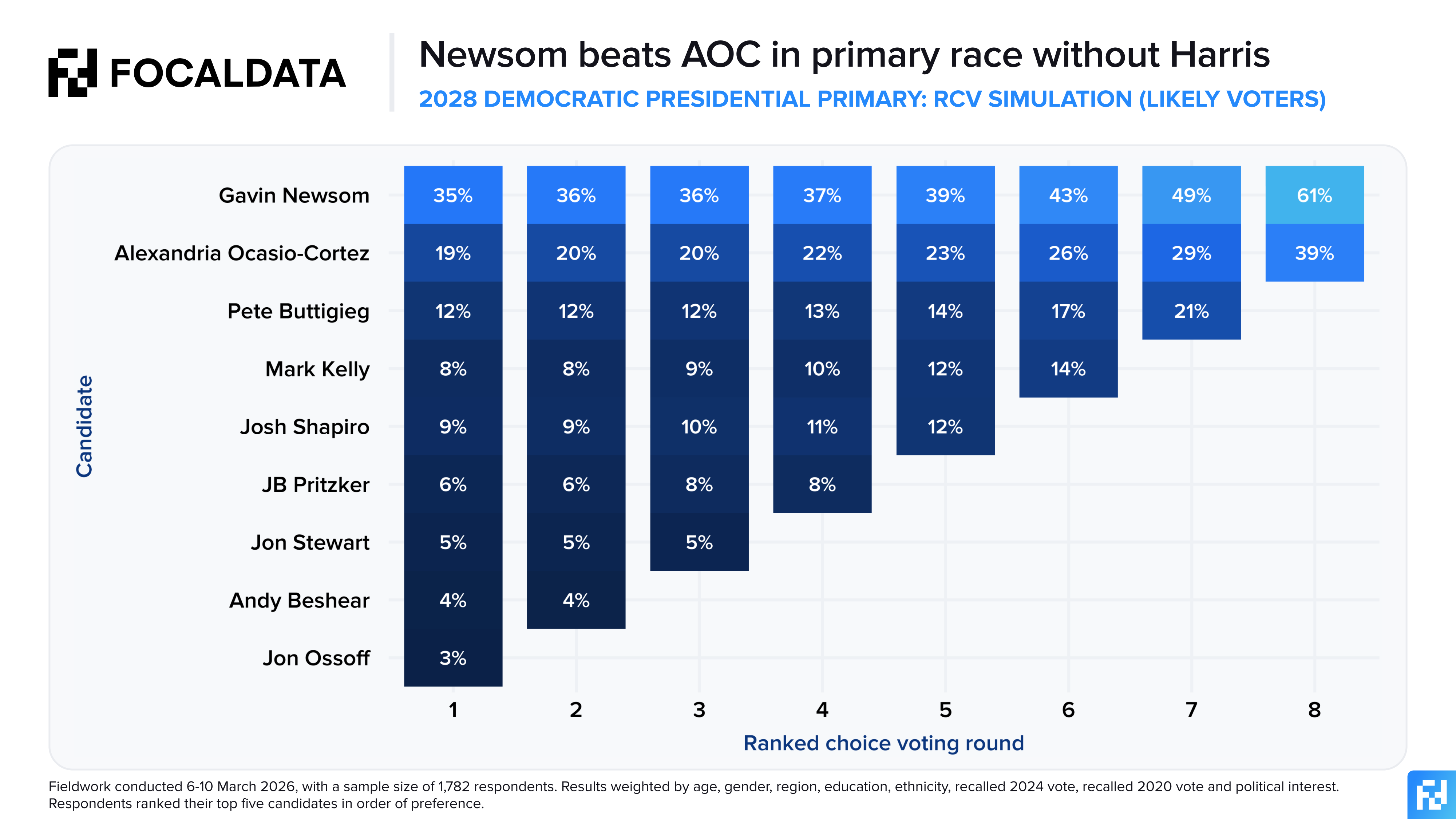
On the Democratic side, little has changed since last month. Kamala Harris continues to lead the early field, holding steady at 39% of the vote despite her loss in 2024. In our ranked-choice simulation, Alexandria Ocasio-Cortez now beats Pete Buttigieg into third place, but Gavin Newsom (22% of first preferences) is still the strongest alternative to Harris.
In a hypothetical 2028 matchup between Harris and Vance, the former vice president beats the current VP 44% to 39%, though of course this is being asked in the context of a D+6 midterms environment. In the last 10 midterms cycles, the president’s party has recovered by an average of 2.7 points by the time of the next presidential election, so we would probably be looking at a central estimate of Harris +2 at this stage.
What to watch
With eight months until election day, the midterms picture is becoming clearer. The Democrats' House lead has grown in every wave of our polling, driven primarily by economic discontent.
Next Wednesday, we will be hosting a webinar to reveal our first seat-by-seat House projections, using MRP modelling to estimate the race in every congressional district. Sign up here.
Data tables for this survey are available here.
“Marco Rubio” by Gage Skidmore, CC BY-SA 4.0