Blog/
'Ossoffism' and the GOP's Elite Problem
In politics, public perceptions of what you can get done and how well you can implement it are no less important than in whose interests you are perceived to be doing it.
Last month, we looked at issue handling and voter perceptions of economic competence in the United States. This month's poll looks at what is sometimes referred to as the 'social imagery' of the parties (perhaps just a fancy political science phrase for 'vibes'). Social imagery touches more on the abstract, and on the politics of representation, in contrast to the politics of competence we measured last month. What kinds of people does the American public think the two parties actually represent?
Democratic senator Jon Ossoff has made a name for himself in recent months with his barbs against the so-called "Epstein class", what he calls a ruling oligarchy "by, and for, the ultra rich". Though originally coined by the California congressman Ro Khanna, the phrase has been turbocharged by the Georgia senator.
Given our current populist era in which both sides of the aisle seem to be engaged in a war of words about which of them represents 'the people' and which only serves to represent out-of-touch elites (whether they be the cultural – 'coastal elites' – or economic – 'the 1%'), our survey sought to find out which party's brand was more elite-coded, and whether the nascent 'Ossoffism' has a future in US politics over the next few years.
Before getting into the party brand results, here are the headlines from this month's survey, conducted in partnership with the Financial Times:
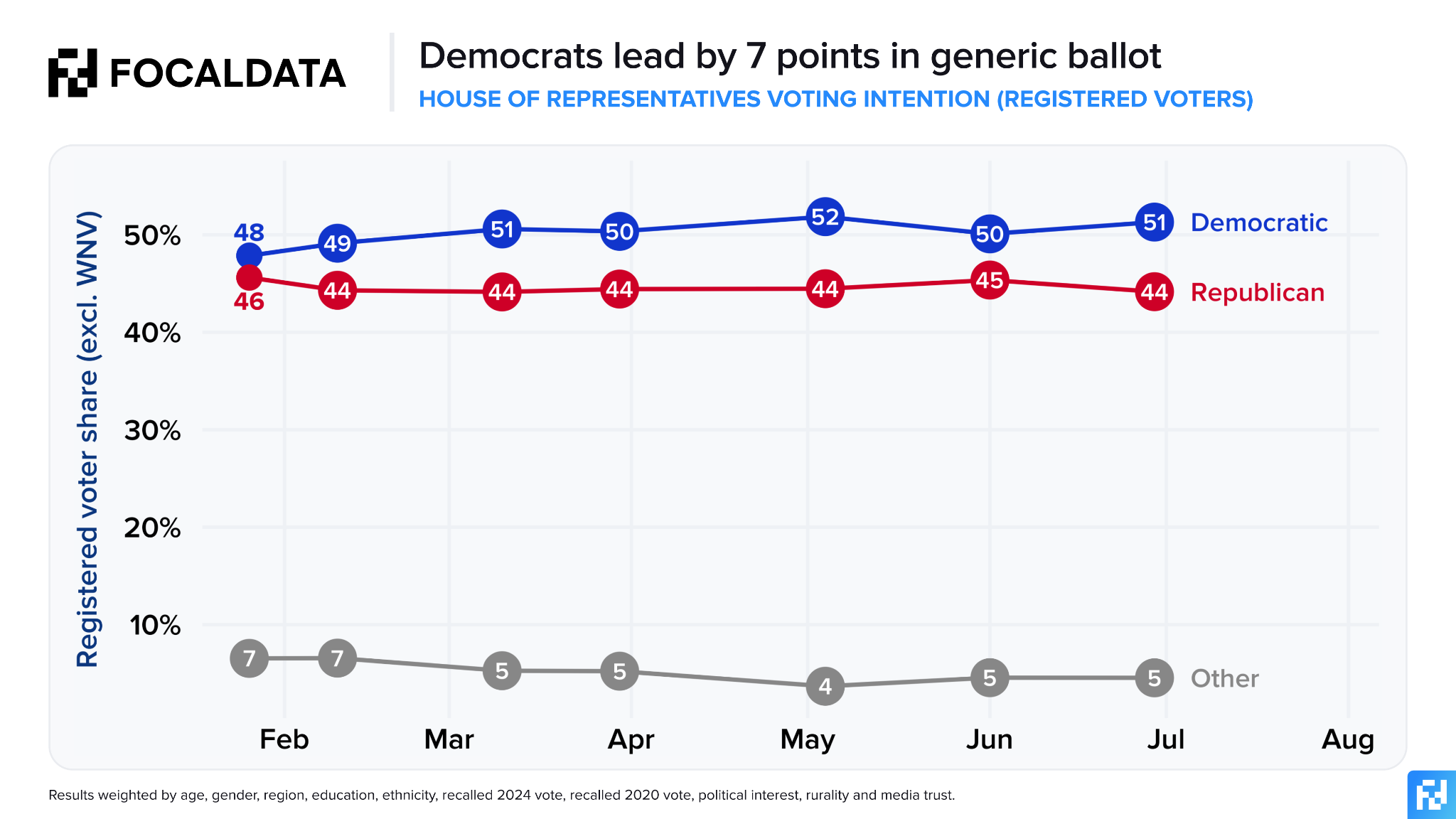
- The Democrats lead by 7 points in the generic House ballot, up two points since last month, and more aligned with their previous leads we recorded between March and May.
- President Trump's net approval rating has reached an all-time low of -23, with the share of Americans disapproving of his performance rising for the fourth consecutive month to 57%.
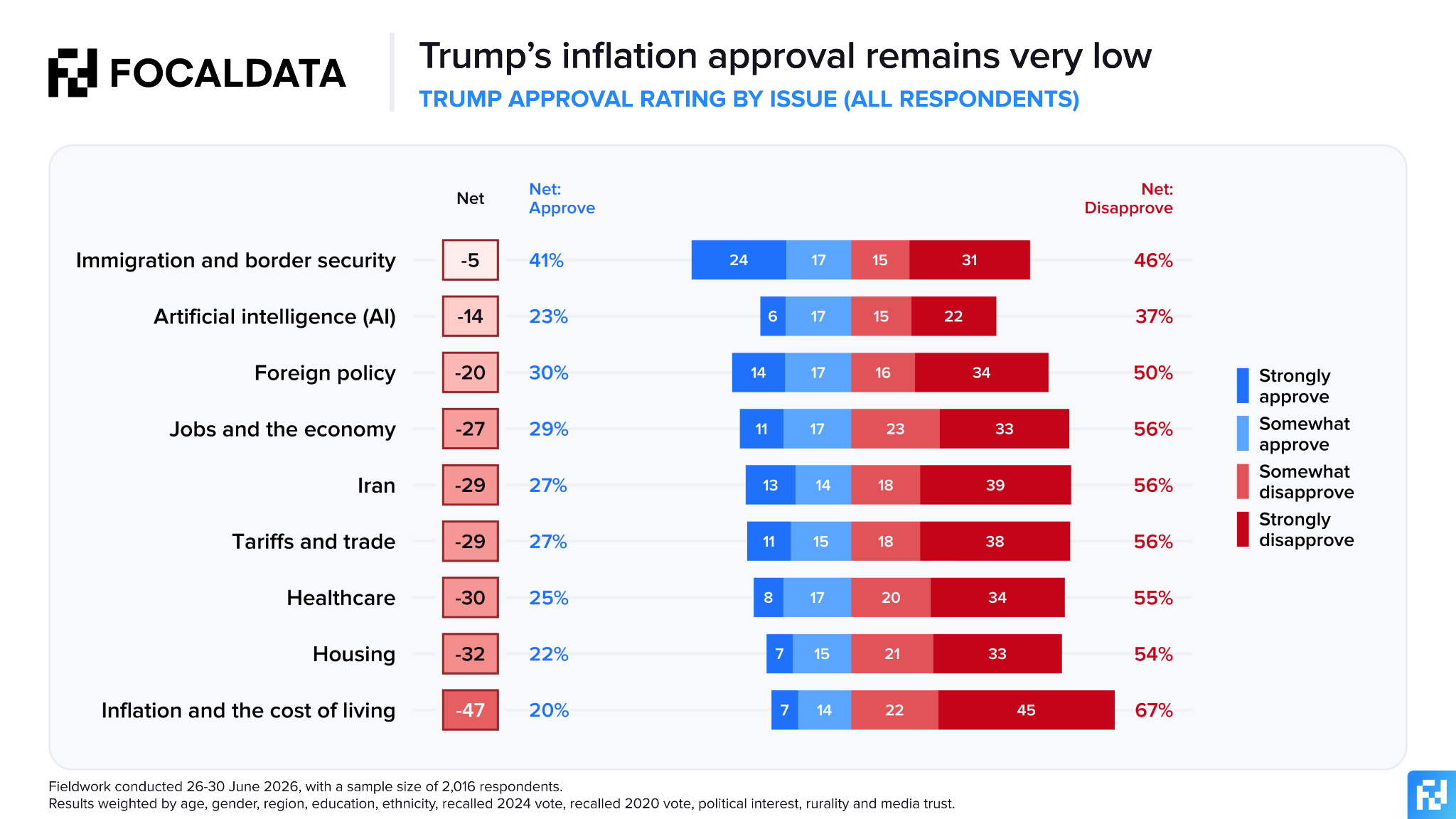
- Issue-by-issue, Trump's handling of inflation and the cost of living remains extremely low at -46, a very slight ease compared to last month's nadir of -51.
Just under a third (30%) of respondents say they have recently heard a politician using the phrase 'Epstein class'. When given a description of the term (some politicians have described the 'Epstein class' as a ruling class "for the ultra rich [...] They are the elites they pretend to hate" who "play by a different set of rules"), about half of voters call the term a fair description of a 'real group of elites'. This includes a majority of independent voters, who record the highest net approval of the terms usage (+40) of any party ID grouping. Nationally, 28% thought the phrase was an unfair description of wealthy people (and potentially offensive to Jeffrey Epstein's victims) with the remaining 23% unsure.
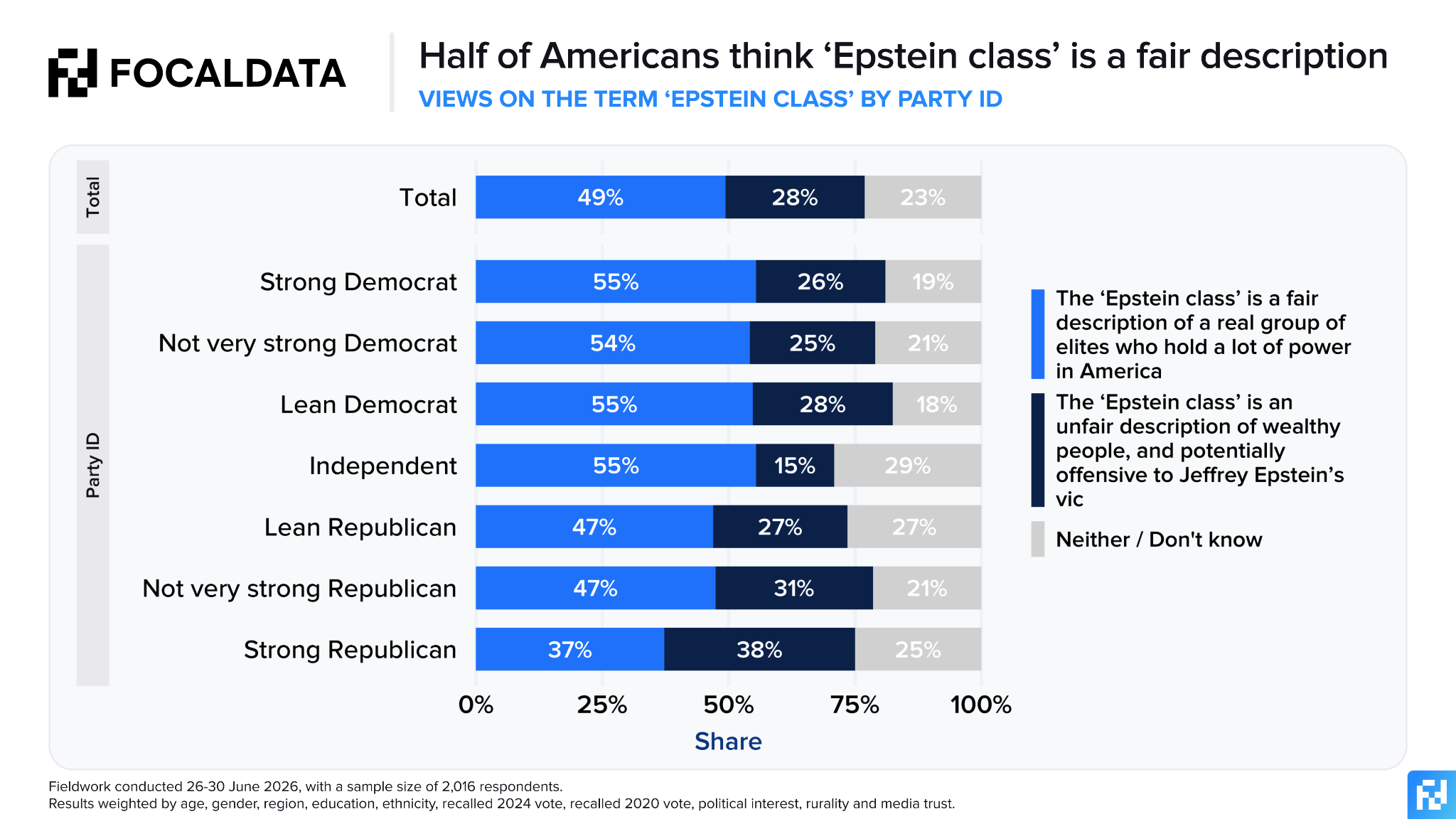
The high approval scores with independents and leaners play into the somewhat non-partisan approach Ossoff has taken to his anti-corruption rhetoric. He argued at a rally in April that the issue "runs a lot deeper than Donald Trump", referencing money flowing into "both sides".
We tend to imagine so-called moderates as political pluralists who would be happy with either party in power. In reality, independents and leaner groups contain a large number of voters who do not trust either party.
It is rare that mainstream politicians accept criticisms of excessive financial influence in their own party in a highly-polarised environment, but the data outline the potential Ossoff's framing has among independents, non-partisans, and particularly low-trust, low-interest voters. Net support for the 'Epstein class' description was highest with voters who trust the media the least.
Many tout the senator as a potential 2028 presidential candidate, though as our recent What Democrats Want report detailed, language critical of the Democratic Party may find an unreceptive audience with Democratic partisans and primary voters, who still view the party largely favourably.
To understand voter perceptions on the partisan coding of elite groups more widely, we ran a MaxDiff experiment featuring 40 archetypes of Americans, including everything from 'billionaire', 'investment banker', and 'Hollywood actor', to 'unionised blue-collar worker', 'dog owner', and 'suburban wine mom'.
Respondents were presented with five archetypes and asked to choose which one they thought would be most likely to vote for the Democrats and which would opt for the GOP.
The results draw a clear line between the party brands. With the public at large, the most Democratic archetypes are journalists (35% of respondents assigned them to the Democrats in an average match-up, versus just 9% to the Republicans), Hollywood actors (37% to 12%), academics/professors (33% to 10%), Uber drivers (28% to 9%), and nurses (28% to 10%). The Republicans were seen to represent billionaires (48% to 11%), CEOs (41% to 12%), country club members (37% to 10%), investment bankers (38% to 13%), and recreational golfers (31% to 8%). Republicans are broadly viewed as the party of economic elites, with the Democrats representing the cultural elite.
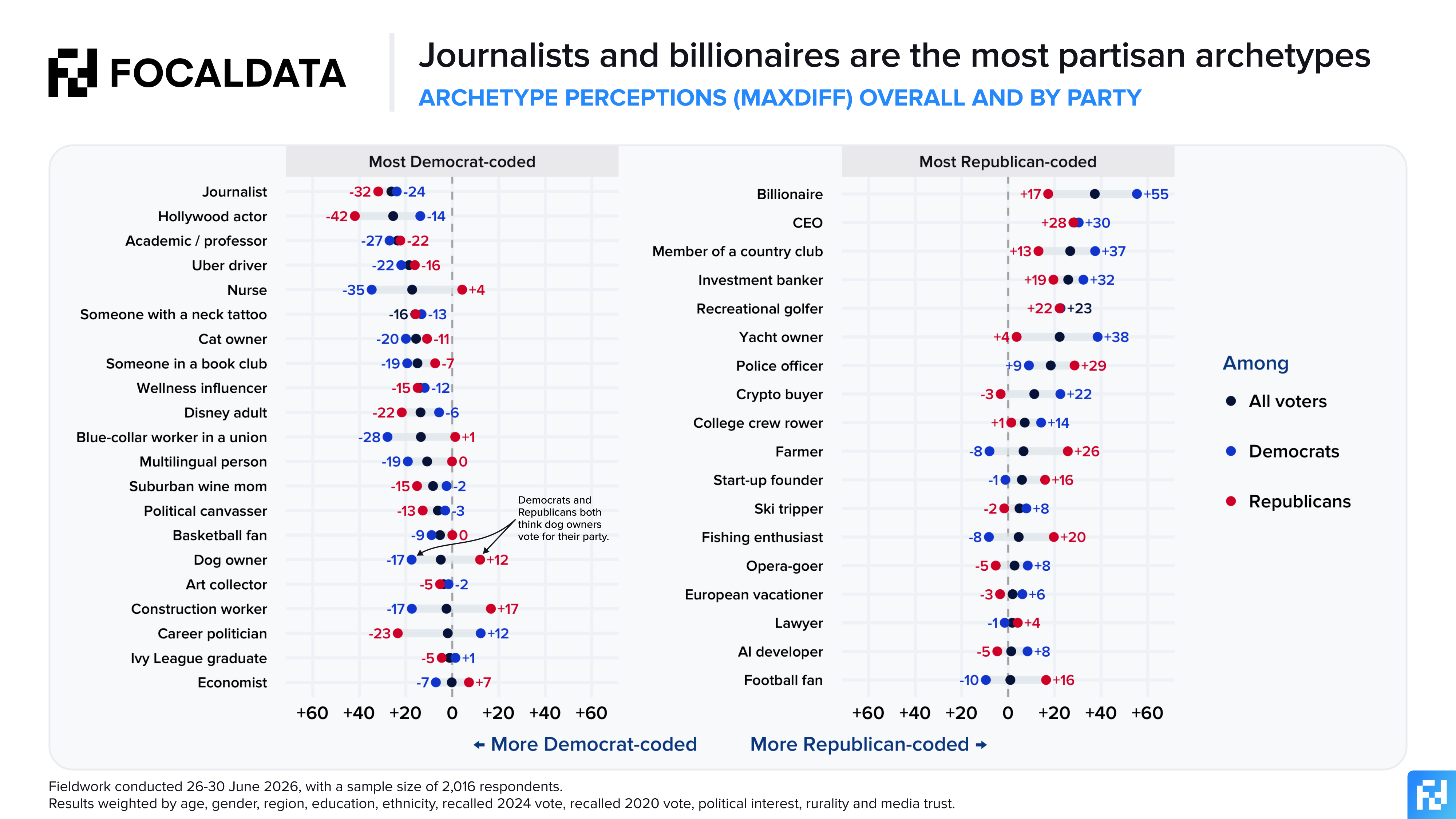
A sharper contrast appears when comparing how voters perceive themselves (their own party) with how they code their opponents. In the former, a political divide between nurses and police officers emerges; in the latter, Hollywood versus billionaires.
Democrats see their party as governing on behalf of nurses, unionised blue-collar workers, academics, journalists, and Uber drivers. The party faithful does not entirely reject the cultural-elite label, but pairs it with a belief that they are on the side of precarious workers, creating an imagined coalition of voters with low economic capital and high cultural capital.
Republicans, on the other hand, position themselves on the side of police officers, CEOs, farmers, recreational golfers, and fishing enthusiasts. GOP voters picture themselves with a more rural, masculine edge.
When it comes to their opponents, Democrats view Republicans as yacht-owning billionaires, country club members, investment bankers, and CEOs: all exclusively high-income groups, with very little focus on perceptions of cultural capital. Democrats' own considerations of themselves fighting on behalf of lower-paid workers stands against perceptions of their opponents representing an out-of-touch economic elite. The clarity of the Democrats' images of their opponents raises the likelihood of a long-term pivot towards economic populism in the coming years.
Republican views of Democrats are more nuanced, and some are not rejected by Democrats themselves. Journalists (ranked 2nd) and academics (4th) are both broadly accepted by the other side, with Hollywood actors (1st), career politicians (3rd), and Disney adults (5th) covering the top five.
The chart above demonstrates that neither party imagines itself on the side of 'career politicians', but the relationship is stronger from a right-to-left standpoint than a left-to-right one. While Democrats regard Republicans as almost exclusively representing economic elites, Republicans consider Democrats to back a stale political establishment and cultural institutions like Hollywood, along with a number of unconventional social archetypes like Disney adults, people with neck tattoos, and wellness influencers.
Across the spectrum, voters want to imagine their chosen party as representing what we might call 'real America', with archetypes which draw upon the nation's cultural heritage and identity. The chart below shows the overall partisanship of each archetype, cross-referenced against in-group and out-group scores. Groups at the bottom of the chart are those which voters are more likely to assign to their own party (nurses, for example, are D+35 with Democrats and R+4 with Republicans, giving nurses an in-group score of +39), while those at the top are groups which respondents were more likely to assign to the opposing party (Republicans classify career politicians as D+23, while Democrats place them at R+12, giving them a combined out-group score of +35).
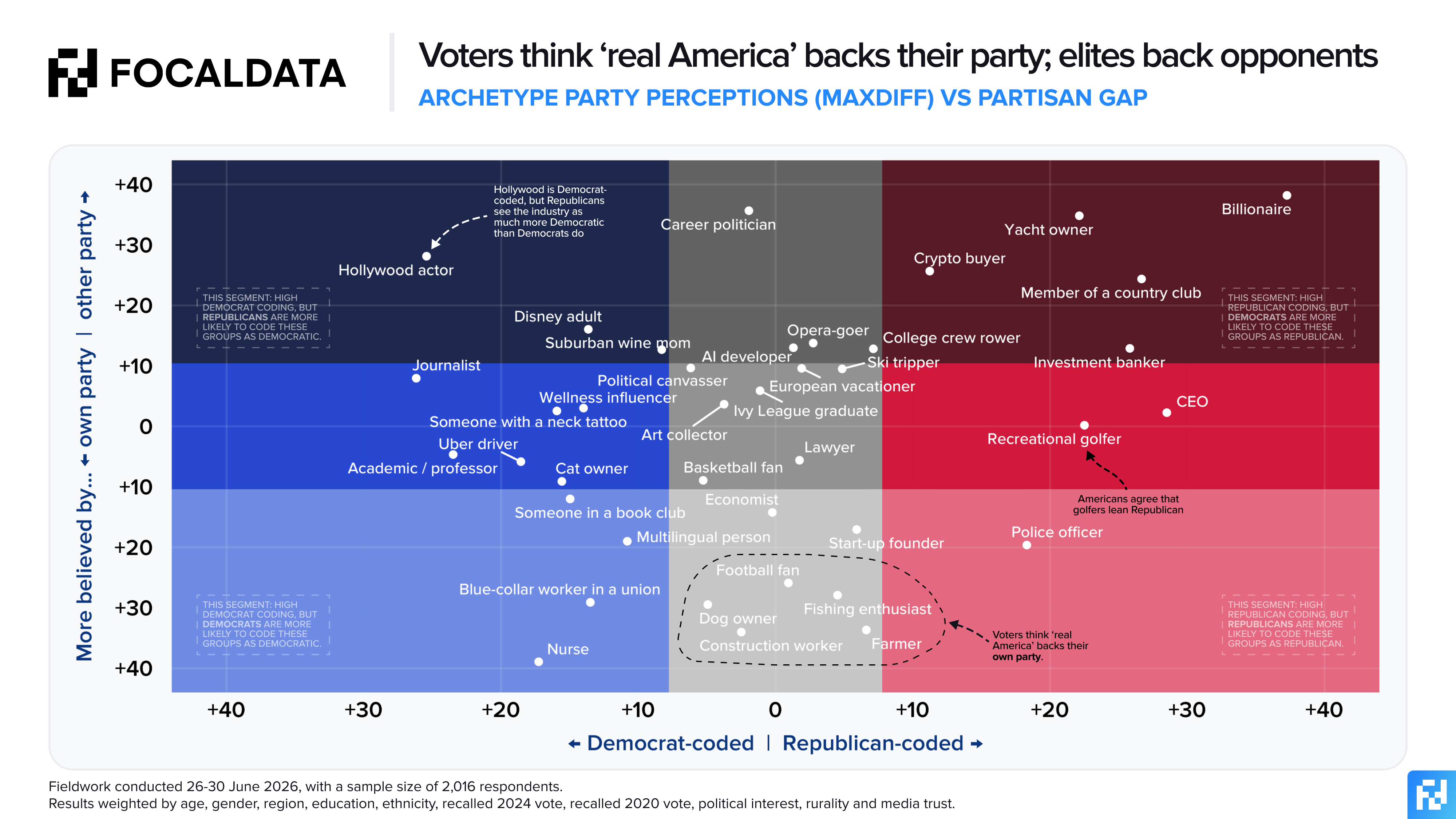
What we see here is that the most 'in-demand' groups (those which parties most want to be associated with) are everyday, somewhat timeless American archetypes: manual workers (nurses, farmers, construction workers) who own dogs, go fishing in their spare time and watch football (that's American football for UK readers, rather than soccer).
In contrast, voters explicitly do not want to be associated with economic, cultural, and political elites. Billionaires, yacht owners, Hollywood actors and opera-goers all landed in the 10 archetypes with the highest out-group scores. Perhaps Timothée Chalamet's infamous statement back in March touched upon a national mood.
These results augur well for the future of anti-elite sentiment in US politics. Both major parties have negative net favourability scores (-4 for the Democrats, -16 for Republicans), meaning negative partisanship is continuing to motivate voters, and they are clear about what they think their opponents stand for: elites they want little personal association with.
A major issue for Republicans in particular is that their party brand has become very closely aligned with these same unpopular elites. The data show a near linear relationship between how elite-coded an archetype is, and how Republican-coded it is. CEOs and billionaires show the two highest Republican leads, alongside the highest share of respondents seeing them as part of the elite.
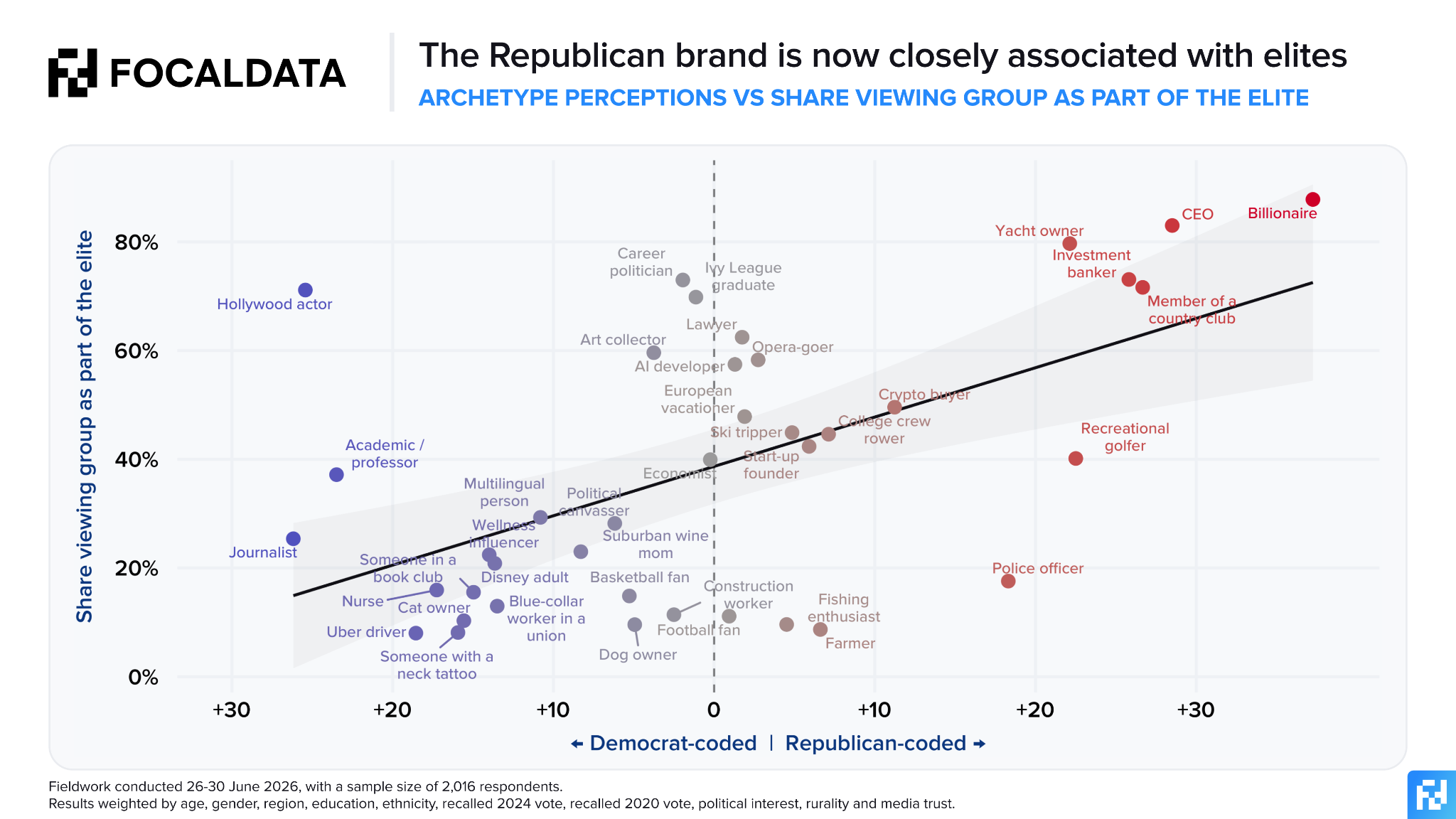
Though the Democrats are significantly less popular than they were 20 years ago, the brands of both parties look rather similar to those of 2006. It remains an open question whether today's brand perceptions create another opening for a charismatic young senator to exploit in a successful run for the presidency. Polling at just 2% in our Democratic presidential lineup, Jon Ossoff has a long way to go yet, but the potential is certainly there.
Data tables for this survey can be downloaded here.